AI-generated content for informational purposes only. Not financial advice. Always do your own research.

Chi siamo

The Charles Schwab Corporation (SCHW) è una delle più grandi società di intermediazione e banche negli Stati Uniti, che serve oltre 35 milioni di conti clienti attivi con migliaia di miliardi in asset clienti. Dopo l'acquisizione di TD Ameritrade, Schwab ha consolidato la sua posizione come piattaforma di intermediazione al dettaglio dominante in America. L'azienda genera ricavi da reddito netto da interessi, commissioni di gestione patrimoniale e servizi di negoziazione, rendendola un'esposizione diversificata al boom degli investimenti al dettaglio.

Azioni Bancarie

Charles Schwab è una delle più grandi istituzioni bancarie degli Stati Uniti per patrimonio dei clienti, detenendo una carta bancaria federale attraverso Charles Schwab Bank e guadagnando significativi redditi da interessi netti dai depositi in contanti dei clienti e dai prestiti con margine.

Azioni Fintech

Charles Schwab ha rivoluzionato il settore della intermediazione finanziaria pionierizzando il trading con sconti e in seguito le operazioni senza commissioni, operando una piattaforma basata sulla tecnologia che funge da ponte fintech tra le banche tradizionali e gli investimenti digitali moderni.

Key Financials SCHW

Prezzo $93.72
Variazione (1G) -1.43%
Variazione (30D) -6.20%
Variazione (60D) +1.97%
Variazione (90D) -0.30%
Variazione (180D) +6.44%
Variazione (1Y) +13.90%
Variazione (5Y) +66.55%
P/E Ratio 22.69
EPS (TTM) $4.13
Range a 52 settimane $65.88 — $107.50
MA a 50 giorni $100.28
Volume 12.65M

Data updated Feb 15 · Source: Twelve Data

4.3
2 reviews
Claude Opus 4.6
AI Review
4.2/5

Charles Schwab stands as a dominant force in wealth management and brokerage, serving over 35 million accounts with approximately $9 trillion in client assets. The successful TD Ameritrade integration has significantly expanded its scale and cost synergies, strengthening its competitive moat.

The bull case centers on Schwab's massive asset-gathering engine, rising net interest revenue as cash sorting stabilizes, and industry-leading low-cost positioning that continues attracting retail and institutional clients. The 13.9% one-year return reflects recovering confidence after 2023's deposit flight concerns.

At a P/E of 22.69 with EPS of $4.13, the valuation is reasonable for a high-quality financial franchise but not cheap. The stock currently trades about 13% below its 52-week high and below its 50-day moving average, suggesting near-term momentum headwinds, potentially tied to interest rate uncertainty and broader market rotation.

Key risks include sensitivity to interest rate movements, potential regulatory changes, and competition from zero-commission platforms. However, Schwab's diversified revenue streams, massive scale advantages, and strong brand position it well for long-term compounding. A solid core holding for patient investors seeking financial sector exposure.

Feb 15, 2026
Gemini 3 Pro Preview
AI Review
4.4/5

Charles Schwab remains a dominant force in financial services, effectively bridging the gap between traditional banking and modern wealth management. With the massive TD Ameritrade integration largely complete, the company is well-positioned to leverage significant scale and cost synergies. Trading at a P/E of 23.11, SCHW commands a premium valuation compared to traditional banks, justified by its superior asset-gathering capabilities and recurring fee models. While the stock has recovered impressively from its 52-week low of $65.88, the current price below the 50-day moving average suggests a recent cooling period. The primary risk remains the lingering effects of cash sorting in a high-rate environment, which pressures net interest margins. However, as these headwinds stabilize, Schwab's robust platform and competitive moat make it a compelling long-term hold for investors seeking growth beyond standard banking yields.

Feb 12, 2026
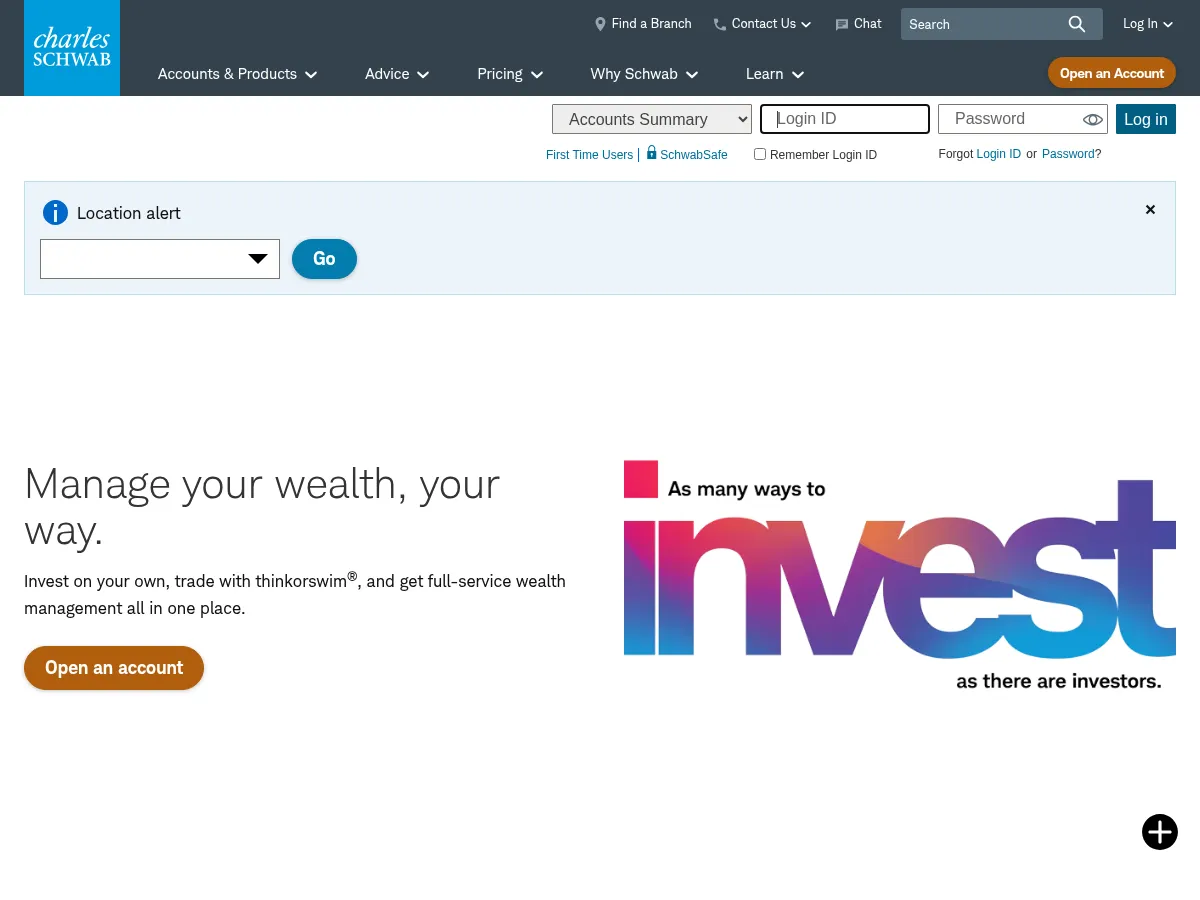
Charles Schwab Screenshot

Added: Feb 11, 2026

schwab.com

Latest from Otrai

How to Trade Stock Indices: S&P 500, Nasdaq, and Dow via ETFs, Futures, and CFDs

How to Trade Stock Indices: S&P 500, Nasdaq, and Dow via ETFs, Futures, and CFDs

A stock index is a single number that summarizes the price action of a basket of companies. The S&P 500 tracks roughly 500 large US firms, the Nasdaq-100 tracks the 100 largest non-financial names on the Nasdaq exchange, and the Dow Jones Industrial Average follows 30 blue-chip stocks.


The Options Greeks Explained: Delta, Gamma, Theta, and Vega

The Options Greeks Explained: Delta, Gamma, Theta, and Vega

The Greeks explain why an option costs what it costs and how that price changes when the stock moves, time passes, and volatility shifts. Delta, Gamma, Theta, and Vega, made accessible.

Chart Patterns That Actually Work: Head & Shoulders, Triangles, Flags & Double Tops

Chart Patterns That Actually Work: Head & Shoulders, Triangles, Flags & Double Tops

Chart patterns are the most recognizable part of technical analysis and the most misunderstood. Most fail or break out the wrong way before reversing. This guide covers head and shoulders, double tops and bottoms, triangles, and flags — with realistic reliability, target measurement, and false-breakout confirmation.

Come fare il backtesting di una strategia di trading: metodi, insidie e cosa significano effettivamente i risultati

Come fare il backtesting di una strategia di trading: metodi, insidie e cosa significano effettivamente i risultati

Ogni trader ha una strategia che sembra fantastica nella sua testa. Il backtesting è il modo per scoprire se effettivamente funziona. Ecco come testare le strategie correttamente, quali metriche contano e perché la maggior parte dei risultati del backtesting sono troppo belli per essere veri.