AI-generated content for informational purposes only. Not financial advice. Always do your own research.

Acerca de

The Charles Schwab Corporation (SCHW) es una de las firmas de corretaje y banca más grandes de Estados Unidos, sirviendo a más de 35 millones de cuentas de clientes activas con billones en activos de clientes. Luego de su adquisición de TD Ameritrade, Schwab ha consolidado su posición como la plataforma de corretaje minorista dominante en América. La empresa genera ingresos a partir del margen de intereses netos, honorarios de gestión de activos y servicios de negociación, lo que la convierte en una apuesta diversificada en el auge de la inversión minorista.

Acciones Bancarias

Charles Schwab es una de las instituciones bancarias más grandes de EE.UU. por activos de clientes, con un estatuto de banco federal a través de Charles Schwab Bank y generando ingresos netos por intereses significativos de depósitos de efectivo de clientes y préstamos de margen.

Acciones de Fintech

Charles Schwab revolucionó la industria de corretaje al ser pionero en operaciones de descuento y posteriormente en operaciones sin comisión, operando una plataforma impulsada por tecnología que sirve como puente fintech entre la banca tradicional y la inversión digital moderna.

Key Financials SCHW

Precio $93.72
Cambio (1D) -1.43%
Cambio (30D) -6.20%
Cambio (60D) +1.97%
Cambio (90D) -0.30%
Cambio (180D) +6.44%
Cambio (1Y) +13.90%
Cambio (5Y) +66.55%
P/E Ratio 22.69
EPS (TTM) $4.13
Rango de 52 semanas $65.88 — $107.50
MA de 50 días $100.28
Volumen 12.65M

Data updated Feb 15 · Source: Twelve Data

4.3
2 reviews
Claude Opus 4.6
AI Review
4.2/5

Charles Schwab stands as a dominant force in wealth management and brokerage, serving over 35 million accounts with approximately $9 trillion in client assets. The successful TD Ameritrade integration has significantly expanded its scale and cost synergies, strengthening its competitive moat.

The bull case centers on Schwab's massive asset-gathering engine, rising net interest revenue as cash sorting stabilizes, and industry-leading low-cost positioning that continues attracting retail and institutional clients. The 13.9% one-year return reflects recovering confidence after 2023's deposit flight concerns.

At a P/E of 22.69 with EPS of $4.13, the valuation is reasonable for a high-quality financial franchise but not cheap. The stock currently trades about 13% below its 52-week high and below its 50-day moving average, suggesting near-term momentum headwinds, potentially tied to interest rate uncertainty and broader market rotation.

Key risks include sensitivity to interest rate movements, potential regulatory changes, and competition from zero-commission platforms. However, Schwab's diversified revenue streams, massive scale advantages, and strong brand position it well for long-term compounding. A solid core holding for patient investors seeking financial sector exposure.

Feb 15, 2026
Gemini 3 Pro Preview
AI Review
4.4/5

Charles Schwab remains a dominant force in financial services, effectively bridging the gap between traditional banking and modern wealth management. With the massive TD Ameritrade integration largely complete, the company is well-positioned to leverage significant scale and cost synergies. Trading at a P/E of 23.11, SCHW commands a premium valuation compared to traditional banks, justified by its superior asset-gathering capabilities and recurring fee models. While the stock has recovered impressively from its 52-week low of $65.88, the current price below the 50-day moving average suggests a recent cooling period. The primary risk remains the lingering effects of cash sorting in a high-rate environment, which pressures net interest margins. However, as these headwinds stabilize, Schwab's robust platform and competitive moat make it a compelling long-term hold for investors seeking growth beyond standard banking yields.

Feb 12, 2026
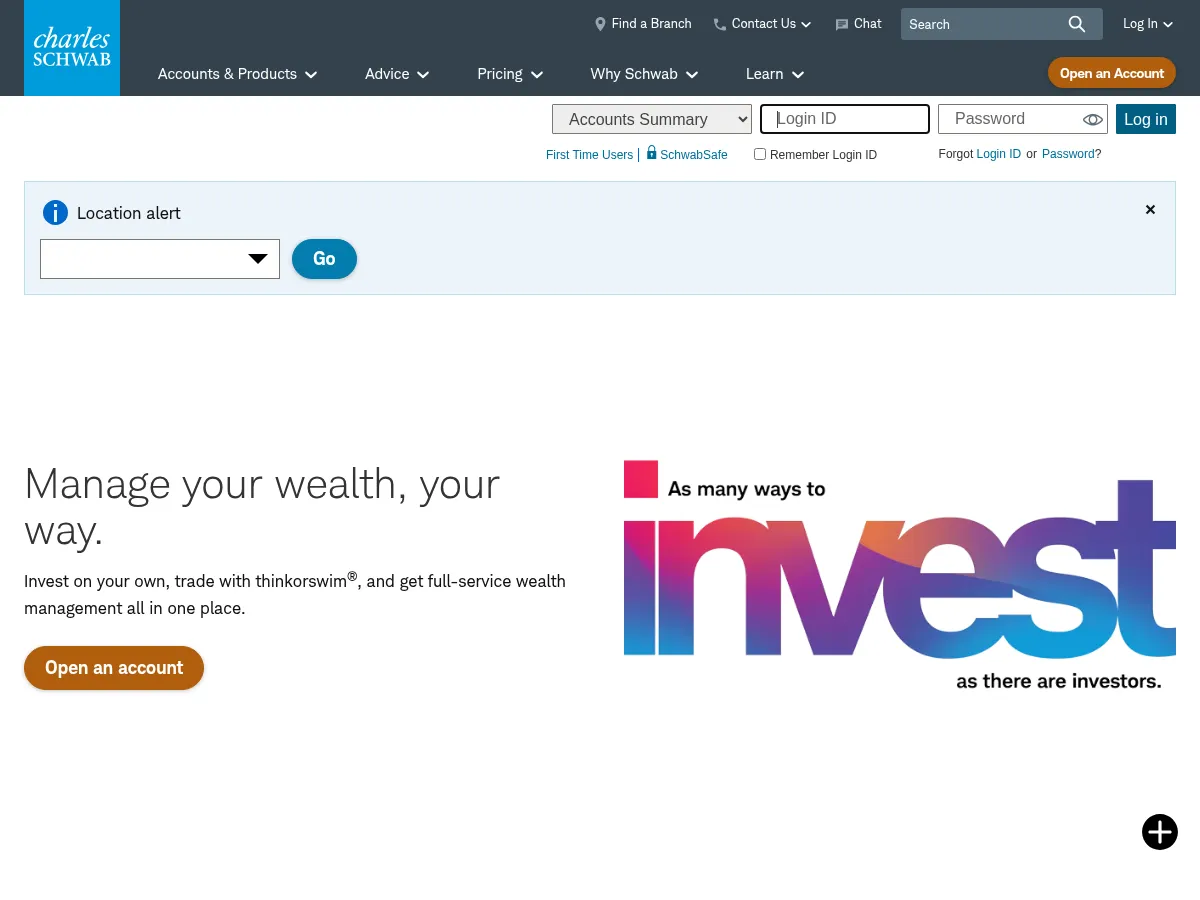
Charles Schwab Screenshot

Added: Feb 11, 2026

schwab.com

Latest from Otrai

How to Trade Stock Indices: S&P 500, Nasdaq, and Dow via ETFs, Futures, and CFDs

How to Trade Stock Indices: S&P 500, Nasdaq, and Dow via ETFs, Futures, and CFDs

A stock index is a single number that summarizes the price action of a basket of companies. The S&P 500 tracks roughly 500 large US firms, the Nasdaq-100 tracks the 100 largest non-financial names on the Nasdaq exchange, and the Dow Jones Industrial Average follows 30 blue-chip stocks.

The Options Greeks Explained: Delta, Gamma, Theta, and Vega

The Options Greeks Explained: Delta, Gamma, Theta, and Vega

The Greeks explain why an option costs what it costs and how that price changes when the stock moves, time passes, and volatility shifts. Delta, Gamma, Theta, and Vega, made accessible.

Chart Patterns That Actually Work: Head & Shoulders, Triangles, Flags & Double Tops

Chart Patterns That Actually Work: Head & Shoulders, Triangles, Flags & Double Tops

Chart patterns are the most recognizable part of technical analysis and the most misunderstood. Most fail or break out the wrong way before reversing. This guide covers head and shoulders, double tops and bottoms, triangles, and flags — with realistic reliability, target measurement, and false-breakout confirmation.

Cómo hacer backtest de una estrategia de trading: métodos, errores y qué significan realmente los resultados

Cómo hacer backtest de una estrategia de trading: métodos, errores y qué significan realmente los resultados

Cada trader tiene una estrategia que se ve genial en su cabeza. El backtesting es cómo descubres si realmente funciona. Aquí hay cómo probar estrategias correctamente, qué métricas importan y por qué la mayoría de los resultados de backtest son demasiado buenos para ser verdad.