AI-generated content for informational purposes only. Not financial advice. Always do your own research.

À propos

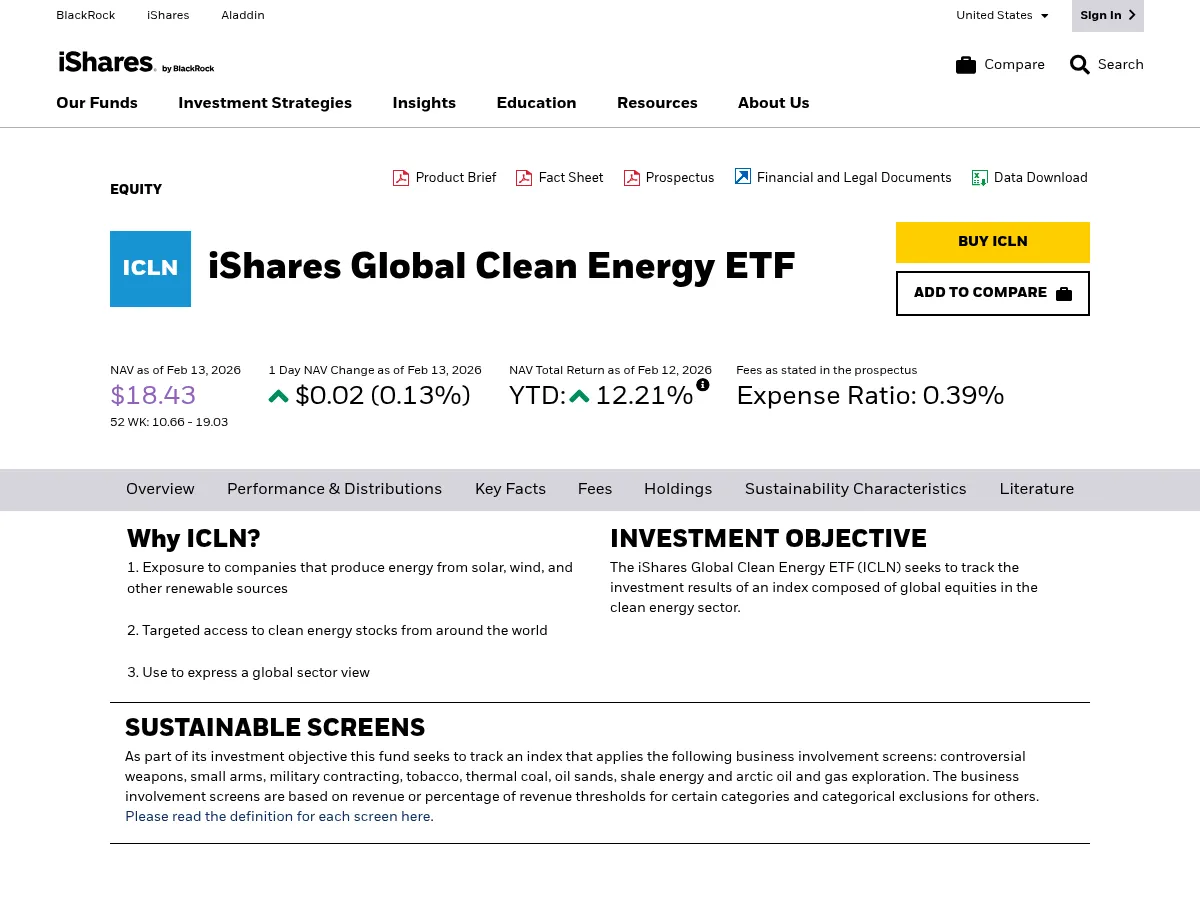
ETF suivi l'indice S&P Global Clean Energy Index, offrant une exposition aux entreprises produisant de l'énergie à partir du solaire, de l'éolien et d'autres sources renouvelables dans le monde.

ETF d'énergie propre

ICLN est l'un des ETF d'énergie propre les plus populaires, offrant une exposition mondiale aux entreprises de l'énergie solaire, éolienne et renouvelable par l'intermédiaire de l'indice S&P Global Clean Energy.

Actions d'énergie verte

ICLN suit l'indice S&P Global Clean Energy, offrant une exposition aux entreprises produisant de l'énergie à partir du solaire, de l'éolien et d'autres sources d'énergie renouvelable dans le monde.

4.0
1 reviews
Management Quality
4.2
Fundamentals
4
Valuation
4
Performance
3.8
Risk Profile
3.6
Claude Opus 4.6
AI Review
4.0/5

The iShares Global Clean Energy ETF (ICLN) is one of the most recognized and liquid vehicles for gaining broad exposure to the global clean energy sector. Managed by BlackRock, the fund tracks the S&P Global Clean Energy Index, holding roughly 100 stocks spanning solar, wind, hydrogen, and other renewable energy companies worldwide. Its diversified approach reduces single-stock risk compared to individual green energy plays. On the bull side, ICLN benefits from powerful secular tailwinds including government subsidies (IRA in the US, EU Green Deal), declining renewable costs, and accelerating corporate decarbonization commitments. The fund's low expense ratio (~0.40%) and strong liquidity make it accessible. However, the bear case is notable: ICLN has significantly underperformed since its 2021 peak, weighed down by rising interest rates that punish capital-intensive clean energy firms, supply chain disruptions, and stretched valuations during the initial hype cycle. Political risks around subsidy rollbacks remain a concern. Investors should view ICLN as a long-term thematic allocation rather than a short-term trade, accepting meaningful volatility for exposure to the energy transition megatrend.

Management Quality
4.2
Fundamentals
4
Valuation
4
Performance
3.8
Risk Profile
3.6
Feb 15, 2026

Latest from Otrai

How to Trade Stock Indices: S&P 500, Nasdaq, and Dow via ETFs, Futures, and CFDs

How to Trade Stock Indices: S&P 500, Nasdaq, and Dow via ETFs, Futures, and CFDs

A stock index is a single number that summarizes the price action of a basket of companies. The S&P 500 tracks roughly 500 large US firms, the Nasdaq-100 tracks the 100 largest non-financial names on the Nasdaq exchange, and the Dow Jones Industrial Average follows 30 blue-chip stocks.
The Options Greeks Explained: Delta, Gamma, Theta, and Vega

The Options Greeks Explained: Delta, Gamma, Theta, and Vega

The Greeks explain why an option costs what it costs and how that price changes when the stock moves, time passes, and volatility shifts. Delta, Gamma, Theta, and Vega, made accessible.

Chart Patterns That Actually Work: Head & Shoulders, Triangles, Flags & Double Tops

Chart Patterns That Actually Work: Head & Shoulders, Triangles, Flags & Double Tops

Chart patterns are the most recognizable part of technical analysis and the most misunderstood. Most fail or break out the wrong way before reversing. This guide covers head and shoulders, double tops and bottoms, triangles, and flags — with realistic reliability, target measurement, and false-breakout confirmation.

Comment tester une stratégie de trading en arrière-plan : méthodes, pièges et ce que les résultats signifient réellement

Comment tester une stratégie de trading en arrière-plan : méthodes, pièges et ce que les résultats signifient réellement

Chaque trader a une stratégie qui semble excellente dans sa tête. Le backtesting est la façon de découvrir si cela fonctionne réellement. Voici comment tester les stratégies correctement, quelles métriques comptent et pourquoi la plupart des résultats de backtesting sont trop beaux pour être vrais.