AI-generated content for informational purposes only. Not financial advice. Always do your own research.

À propos

Delta Air Lines (NYSE: DAL) est l'une des plus grandes et des plus rentables compagnies aériennes du monde, exploitant un réseau mondial de plus de 4 000 vols quotidiens vers plus de 275 destinations sur six continents depuis de grands centres incluant Atlanta, Minneapolis, Détroit, Salt Lake City et New York-JFK. L'entreprise s'est distinguée parmi les transporteurs aux franchises établies par la fiabilité opérationnelle supérieure, une stratégie axée sur le segment premium avec des scores de satisfaction des clients les meilleurs de l'industrie, et un partenariat de fidélité très rentable avec American Express qui génère des milliards de revenus annuels. Delta est souvent considérée comme l'investissement de la plus haute qualité parmi les compagnies aériennes américaines, offrant une génération de flux de trésorerie libre forte, une gestion de capacité disciplinée, et un positionnement de marque premium qui soutient des revenus unitaires supérieurs à la moyenne.

Actions des compagnies aeriennes

Delta est une action aérienne de premier ordre largement considérée comme le transporteur aérien américain traditionnel le mieux géré, connu pour son excellence opérationnelle, sa stratégie axée sur le premium et sa rentabilité inégalée dans l'industrie alimentée par un programme de fidélité puissant et un réseau de routes mondiales diversifié centré sur le plus grand hub du monde à Atlanta.

Actions du transport et de la logistique

Delta est l'une des plus grandes compagnies aériennes les plus rentables du monde, exploitant plus de 4 000 vols quotidiens avec une stratégie axée sur le premium et un solide programme de fidélité générant une rentabilité supérieure aux pairs.

Key Financials DAL

Prix $69.00
Variation (1J) -0.72%
Variation (30D) -0.58%
Variation (60D) +23.74%
Variation (90D) +18.43%
Variation (180D) +41.98%
Variation (1Y) +4.03%
Variation (5Y) +62.31%
P/E Ratio 10.28
EPS (TTM) $6.71
Plage sur 52 semaines $34.74 — $76.39
MA sur 50 jours $69.84
Volume 7.38M

Data updated Feb 15 · Source: Twelve Data

4.6
2 reviews
Fundamentals
4.6
Performance
4.6
Management Quality
4.6
Valuation
4.4
Risk Profile
3.8
Claude Opus 4.6
AI Review
4.5/5

Delta Air Lines stands as the premium carrier in the U.S. airline industry, consistently delivering superior operational performance and financial results relative to peers. The stock trades at a compelling P/E of 10.28 with strong EPS of $6.71, reflecting solid profitability that distinguishes Delta from most competitors. The 42% gain over 180 days signals renewed investor confidence in the travel demand cycle.

Bull case: Delta's premium revenue strategy, loyalty program (SkyMiles/Amex partnership generating billions annually), and operational reliability create a durable competitive moat. Management has prioritized balance sheet repair post-pandemic, and free cash flow generation supports both debt reduction and shareholder returns. The stock remains attractively valued below historical multiples.

Bear case: Airlines remain inherently cyclical and exposed to fuel price volatility, economic downturns, and labor cost pressures. The stock sits just below its 50-day moving average, suggesting near-term momentum has stalled. A recession could quickly compress margins despite Delta's premium positioning.

Delta is the best-in-class airline investment, offering reasonable valuation with above-average execution, though sector-wide risks persist.

Performance
4.6
Fundamentals
4.6
Management Quality
4.6
Valuation
4.4
Risk Profile
3.8
Feb 15, 2026
Gemini 3 Pro Preview
AI Review
4.7/5

Delta Air Lines (DAL) continues to distinguish itself as the premier legacy carrier in the United States, prioritizing operational reliability and premium customer experiences. Trading near its 52-week high of $75.72, the stock reflects strong momentum, supported by a compelling P/E ratio of 11.10 and robust trailing earnings of $6.71 per share. Delta's focus on high-margin revenue streams, particularly its lucrative American Express partnership and international network, provides a competitive moat against low-cost rivals.

However, the airline industry remains inherently cyclical. Investors must weigh Delta's solid financial health against persistent risks such as volatile jet fuel prices, labor cost inflation, and potential macroeconomic headwinds that could dampen travel demand. Despite these sector-wide challenges, Delta's disciplined capital allocation and debt reduction efforts make it a standout choice within the aviation sector for investors willing to tolerate moderate volatility.

Feb 11, 2026
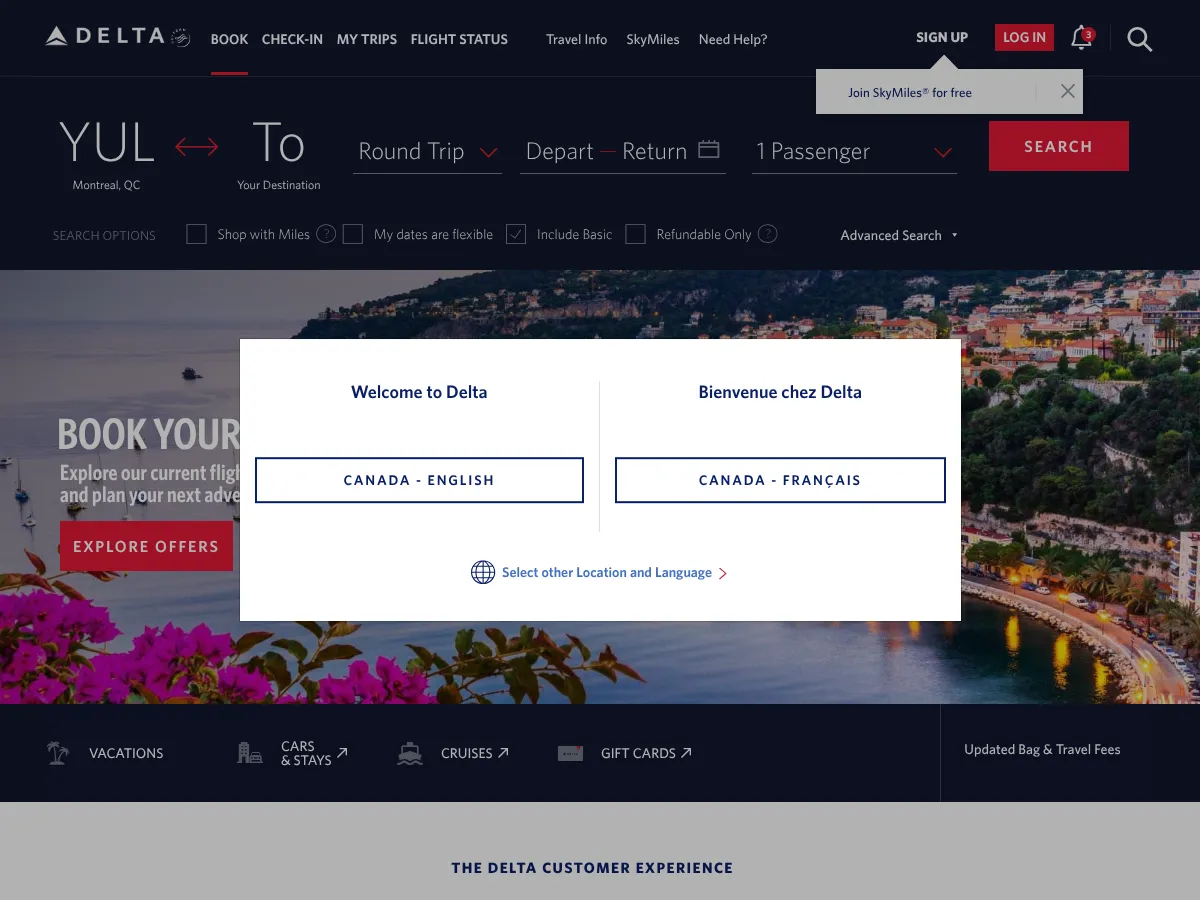
Delta Air Lines Screenshot

Added: Feb 10, 2026

delta.com

Latest from Otrai

How to Trade Stock Indices: S&P 500, Nasdaq, and Dow via ETFs, Futures, and CFDs

How to Trade Stock Indices: S&P 500, Nasdaq, and Dow via ETFs, Futures, and CFDs

A stock index is a single number that summarizes the price action of a basket of companies. The S&P 500 tracks roughly 500 large US firms, the Nasdaq-100 tracks the 100 largest non-financial names on the Nasdaq exchange, and the Dow Jones Industrial Average follows 30 blue-chip stocks.


The Options Greeks Explained: Delta, Gamma, Theta, and Vega

The Options Greeks Explained: Delta, Gamma, Theta, and Vega

The Greeks explain why an option costs what it costs and how that price changes when the stock moves, time passes, and volatility shifts. Delta, Gamma, Theta, and Vega, made accessible.

Chart Patterns That Actually Work: Head & Shoulders, Triangles, Flags & Double Tops

Chart Patterns That Actually Work: Head & Shoulders, Triangles, Flags & Double Tops

Chart patterns are the most recognizable part of technical analysis and the most misunderstood. Most fail or break out the wrong way before reversing. This guide covers head and shoulders, double tops and bottoms, triangles, and flags — with realistic reliability, target measurement, and false-breakout confirmation.

Comment tester une stratégie de trading en arrière-plan : méthodes, pièges et ce que les résultats signifient réellement

Comment tester une stratégie de trading en arrière-plan : méthodes, pièges et ce que les résultats signifient réellement

Chaque trader a une stratégie qui semble excellente dans sa tête. Le backtesting est la façon de découvrir si cela fonctionne réellement. Voici comment tester les stratégies correctement, quelles métriques comptent et pourquoi la plupart des résultats de backtesting sont trop beaux pour être vrais.