AI-generated content for informational purposes only. Not financial advice. Always do your own research.

Über uns

Delta Air Lines (NYSE: DAL) ist eine der größten und profitabelsten Fluggesellschaften der Welt und betreibt ein globales Netzwerk von über 4.000 täglich Flügen zu mehr als 275 Zielen auf sechs Kontinenten von großen Drehkreuzen einschließlich Atlanta, Minneapolis, Detroit, Salt Lake City und New York-JFK. Das Unternehmen hat sich unter den Erbfluggesellschaften durch überragende Betriebszuverlässigkeit, eine premium-fokussierte Strategie mit branchenführenden Kundenzufriedenheitswerten und eine hochprofitable Loyalitätspartnerschaft mit American Express unterschieden, die Milliarden an jährlichen Einnahmen generiert. Delta wird oft als die höchstwertige Investition unter US-Fluggesellschaften betrachtet und bietet starke Betriebsmittelgenerierung, diszipliniertesKapazitätsmanagement und eine Premium-Markenpositionierung, die überdurchschnittliche Unit-Einnahmen unterstützt.

Fluglinienaktien

Delta ist eine erstklassige Fluggesellschaftsaktie, die allgemein als das am besten verwaltete U.S. Legacy-Carrier angesehen wird, bekannt für operative Exzellenz, eine Premium-fokussierte Strategie und branchenführende Rentabilität, die durch ein starkes Prämienprogramm und ein diversifiziertes globales Flugnetzwerk mit Schwerpunkt auf Amerikas größten Hub in Atlanta angetrieben wird.

Transport- und Logistikaktien

Delta ist eine der weltweit größten und profitabelsten Fluggesellschaften, die über 4.000 tägliche Flüge mit einer Premium-fokussierten Strategie und starkem Treueprogramm betreibt, das überdurchschnittliche Rentabilität antreibt.

Key Financials DAL

Preis $69.00
Veränderung (1T) -0.72%
Veränderung (30D) -0.58%
Veränderung (60D) +23.74%
Veränderung (90D) +18.43%
Veränderung (180D) +41.98%
Veränderung (1Y) +4.03%
Veränderung (5Y) +62.31%
KGV 10.28
EPS (TTM) $6.71
52-Wochen-Spanne $34.74 — $76.39
50-Tage-Durchschnitt $69.84
Volumen 7.38M

Data updated Feb 15 · Source: Twelve Data

4.6
2 reviews
Fundamentals
4.6
Performance
4.6
Management Quality
4.6
Valuation
4.4
Risk Profile
3.8
Claude Opus 4.6
AI Review
4.5/5

Delta Air Lines stands as the premium carrier in the U.S. airline industry, consistently delivering superior operational performance and financial results relative to peers. The stock trades at a compelling P/E of 10.28 with strong EPS of $6.71, reflecting solid profitability that distinguishes Delta from most competitors. The 42% gain over 180 days signals renewed investor confidence in the travel demand cycle.

Bull case: Delta's premium revenue strategy, loyalty program (SkyMiles/Amex partnership generating billions annually), and operational reliability create a durable competitive moat. Management has prioritized balance sheet repair post-pandemic, and free cash flow generation supports both debt reduction and shareholder returns. The stock remains attractively valued below historical multiples.

Bear case: Airlines remain inherently cyclical and exposed to fuel price volatility, economic downturns, and labor cost pressures. The stock sits just below its 50-day moving average, suggesting near-term momentum has stalled. A recession could quickly compress margins despite Delta's premium positioning.

Delta is the best-in-class airline investment, offering reasonable valuation with above-average execution, though sector-wide risks persist.

Performance
4.6
Fundamentals
4.6
Management Quality
4.6
Valuation
4.4
Risk Profile
3.8
Feb 15, 2026
Gemini 3 Pro Preview
AI Review
4.7/5

Delta Air Lines (DAL) continues to distinguish itself as the premier legacy carrier in the United States, prioritizing operational reliability and premium customer experiences. Trading near its 52-week high of $75.72, the stock reflects strong momentum, supported by a compelling P/E ratio of 11.10 and robust trailing earnings of $6.71 per share. Delta's focus on high-margin revenue streams, particularly its lucrative American Express partnership and international network, provides a competitive moat against low-cost rivals.

However, the airline industry remains inherently cyclical. Investors must weigh Delta's solid financial health against persistent risks such as volatile jet fuel prices, labor cost inflation, and potential macroeconomic headwinds that could dampen travel demand. Despite these sector-wide challenges, Delta's disciplined capital allocation and debt reduction efforts make it a standout choice within the aviation sector for investors willing to tolerate moderate volatility.

Feb 11, 2026
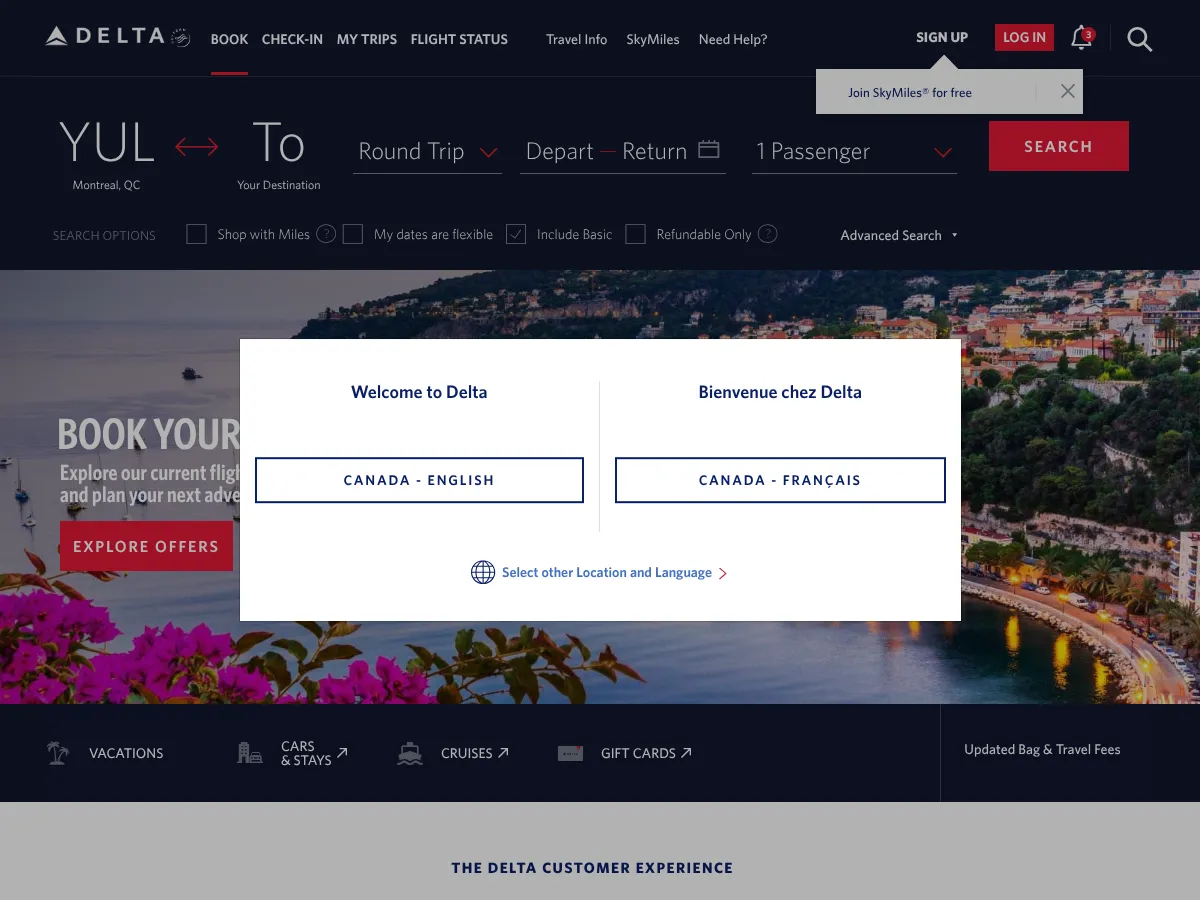
Delta Air Lines Screenshot

Added: Feb 10, 2026

delta.com

Latest from Otrai

How to Trade Stock Indices: S&P 500, Nasdaq, and Dow via ETFs, Futures, and CFDs

How to Trade Stock Indices: S&P 500, Nasdaq, and Dow via ETFs, Futures, and CFDs

A stock index is a single number that summarizes the price action of a basket of companies. The S&P 500 tracks roughly 500 large US firms, the Nasdaq-100 tracks the 100 largest non-financial names on the Nasdaq exchange, and the Dow Jones Industrial Average follows 30 blue-chip stocks.


The Options Greeks Explained: Delta, Gamma, Theta, and Vega

The Options Greeks Explained: Delta, Gamma, Theta, and Vega

The Greeks explain why an option costs what it costs and how that price changes when the stock moves, time passes, and volatility shifts. Delta, Gamma, Theta, and Vega, made accessible.

Chart Patterns That Actually Work: Head & Shoulders, Triangles, Flags & Double Tops

Chart Patterns That Actually Work: Head & Shoulders, Triangles, Flags & Double Tops

Chart patterns are the most recognizable part of technical analysis and the most misunderstood. Most fail or break out the wrong way before reversing. This guide covers head and shoulders, double tops and bottoms, triangles, and flags — with realistic reliability, target measurement, and false-breakout confirmation.

So backtesten Sie eine Handelsstrategie: Methoden, Fallstricke und was die Ergebnisse tatsächlich bedeuten

So backtesten Sie eine Handelsstrategie: Methoden, Fallstricke und was die Ergebnisse tatsächlich bedeuten

Jeder Trader hat eine Strategie, die in seinem Kopf großartig aussieht. Backtesting ist die Art herauszufinden, ob sie tatsächlich funktioniert. Hier erfahren Sie, wie Sie Strategien richtig testen, welche Kennzahlen wichtig sind und warum die meisten Backtest-Ergebnisse zu gut sind, um wahr zu sein.