AI-generated content for informational purposes only. Not financial advice. Always do your own research.

À propos

Zscaler est une entreprise de cybersécurité basée sur le cloud leader offrant des solutions d'architecture de confiance zéro. Sa plateforme Security Service Edge (SSE) sécurise l'accès à Internet, les applications privées et SaaS pour les entreprises, remplaçant les pare-feu et les VPN traditionnels par une approche native du cloud.

Actions de cybersécurité

Zscaler est une entreprise de cybersécurité leader de l'informatique en nuage proposant une architecture de sécurité sans confiance qui remplace les périmètres réseau traditionnels par des contrôles d'accès sécurisés basés sur l'identité.

Actions de l'informatique en peripherie

Zscaler exploite un cloud de sécurité mondial à la limite du réseau, fournissant des services d'accès sans confiance, de sécurité web et de protection des données qui traitent des milliards de transactions quotidiennes.

Key Financials ZS

Prix $177.72
Variation (1J) +3.99%
Variation (30D) -20.99%
Variation (60D) -39.74%
Variation (90D) -41.78%
Variation (180D) -29.93%
Variation (1Y) -15.83%
Variation (5Y) -19.22%
P/E Ratio 111.08
EPS (TTM) $1.60
Plage sur 52 semaines $162.87 — $336.99
MA sur 50 jours $215.11
Volume 2.43M

Data updated Feb 15 · Source: Twelve Data

3.9
1 reviews
Performance
4.2
Fundamentals
4
Management Quality
4
Risk Profile
2.8
Valuation
2.5
Claude Opus 4.6
AI Review
3.9/5

Zscaler is a leading cloud-native cybersecurity company pioneering the zero-trust architecture space through its Zero Trust Exchange platform. The company enjoys strong competitive positioning as enterprises increasingly shift from legacy perimeter-based security to cloud-delivered models. Revenue growth has been robust, and Zscaler benefits from high switching costs and expanding use cases across its platform.

However, the stock has experienced severe downward pressure, trading nearly 47% below its 52-week high and well below its 50-day moving average of $215. The P/E ratio of 111x on modest EPS of $1.60 still reflects premium growth expectations despite the selloff, leaving the valuation vulnerable if growth decelerates. The sharp 5-year decline of -19% despite strong business fundamentals suggests persistent multiple compression as the market reprices high-growth software names.

Bull case: dominant zero-trust platform with expanding TAM, strong net retention rates, and secular tailwinds from AI-driven security threats. Bear case: elevated valuation, increasing competition from CrowdStrike and Palo Alto Networks, and potential macro-driven IT spending slowdowns. The recent pullback may present an attractive entry point for patient, long-term investors willing to tolerate volatility.

Performance
4.2
Fundamentals
4
Management Quality
4
Risk Profile
2.8
Valuation
2.5
Feb 15, 2026
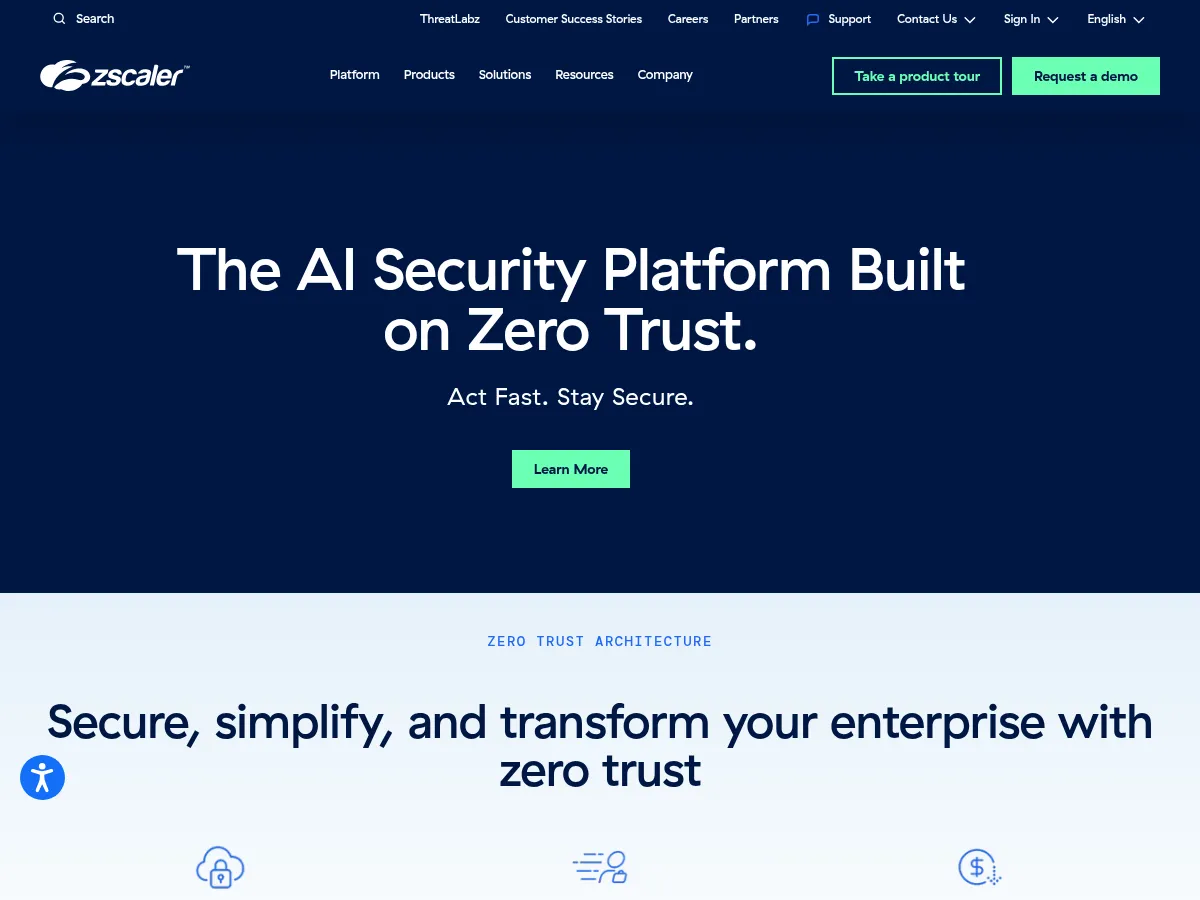
Zscaler Screenshot

Added: Feb 15, 2026

zscaler.com

Latest from Otrai

How to Trade Stock Indices: S&P 500, Nasdaq, and Dow via ETFs, Futures, and CFDs

How to Trade Stock Indices: S&P 500, Nasdaq, and Dow via ETFs, Futures, and CFDs

A stock index is a single number that summarizes the price action of a basket of companies. The S&P 500 tracks roughly 500 large US firms, the Nasdaq-100 tracks the 100 largest non-financial names on the Nasdaq exchange, and the Dow Jones Industrial Average follows 30 blue-chip stocks.


The Options Greeks Explained: Delta, Gamma, Theta, and Vega

The Options Greeks Explained: Delta, Gamma, Theta, and Vega

The Greeks explain why an option costs what it costs and how that price changes when the stock moves, time passes, and volatility shifts. Delta, Gamma, Theta, and Vega, made accessible.

Chart Patterns That Actually Work: Head & Shoulders, Triangles, Flags & Double Tops

Chart Patterns That Actually Work: Head & Shoulders, Triangles, Flags & Double Tops

Chart patterns are the most recognizable part of technical analysis and the most misunderstood. Most fail or break out the wrong way before reversing. This guide covers head and shoulders, double tops and bottoms, triangles, and flags — with realistic reliability, target measurement, and false-breakout confirmation.

Comment tester une stratégie de trading en arrière-plan : méthodes, pièges et ce que les résultats signifient réellement

Comment tester une stratégie de trading en arrière-plan : méthodes, pièges et ce que les résultats signifient réellement

Chaque trader a une stratégie qui semble excellente dans sa tête. Le backtesting est la façon de découvrir si cela fonctionne réellement. Voici comment tester les stratégies correctement, quelles métriques comptent et pourquoi la plupart des résultats de backtesting sont trop beaux pour être vrais.