AI-generated content for informational purposes only. Not financial advice. Always do your own research.

Sobre

Teucrium Corn Fund rastreando futuros de milho de Chicago. O grão mais produzido nos EUA, com demanda de alimentos, ração e produção de etanol.

Commodities - Agrícolas

CORN rastreia futuros de milho de Chicago, proporcionando exposição ao grão mais produzido nos EUA com demanda impulsionada por ciclos de alimentos, ração animal e produção de etanol.

Market Data CORN

Preço $17.65
Variação (1D) +0.17%
Variação (30D) -0.45%
Variação (60D) -2.05%
Variação (90D) +0.28%
Variação (180D) -3.23%
Variação (1Y) -12.62%
Variação (5Y) +3.22%
Faixa de 52 Semanas $16.61 — $20.69
MA de 50 Dias $17.60
Volume 39.0K

Data updated Feb 15 · Source: Twelve Data

3.1
1 reviews
Accessibility
3.4
Liquidity
3.2
Volatility
3
Market Fundamentals
3
Historical Performance
2.6
Claude Opus 4.6
AI Review
3.1/5

Corn has been under sustained pressure over the past year, declining roughly 12.6% and trading well below its 52-week high of $20.69. Ample global supply remains the dominant bearish factor, with strong U.S. production and competitive exports from Brazil keeping inventories elevated. The current price of $17.65 sits near its 50-day moving average, suggesting a period of consolidation rather than directional conviction. On the bearish side, a relatively strong U.S. dollar continues to weigh on export competitiveness, while slowing Chinese import demand has removed a key demand pillar. However, several bullish factors merit attention: ethanol mandates provide a structural demand floor, weather volatility during the upcoming growing season could tighten supply expectations, and any geopolitical disruption to Black Sea grain flows would be supportive. Seasonal patterns typically favor corn prices into spring planting uncertainty. The modest 5-year return of 3.22% highlights corn's limited appeal as a long-term hold, functioning better as a tactical trade around supply shocks. Current conditions suggest a neutral-to-cautious stance until clearer demand catalysts emerge.

Accessibility
3.4
Liquidity
3.2
Volatility
3
Market Fundamentals
3
Historical Performance
2.6
Feb 15, 2026
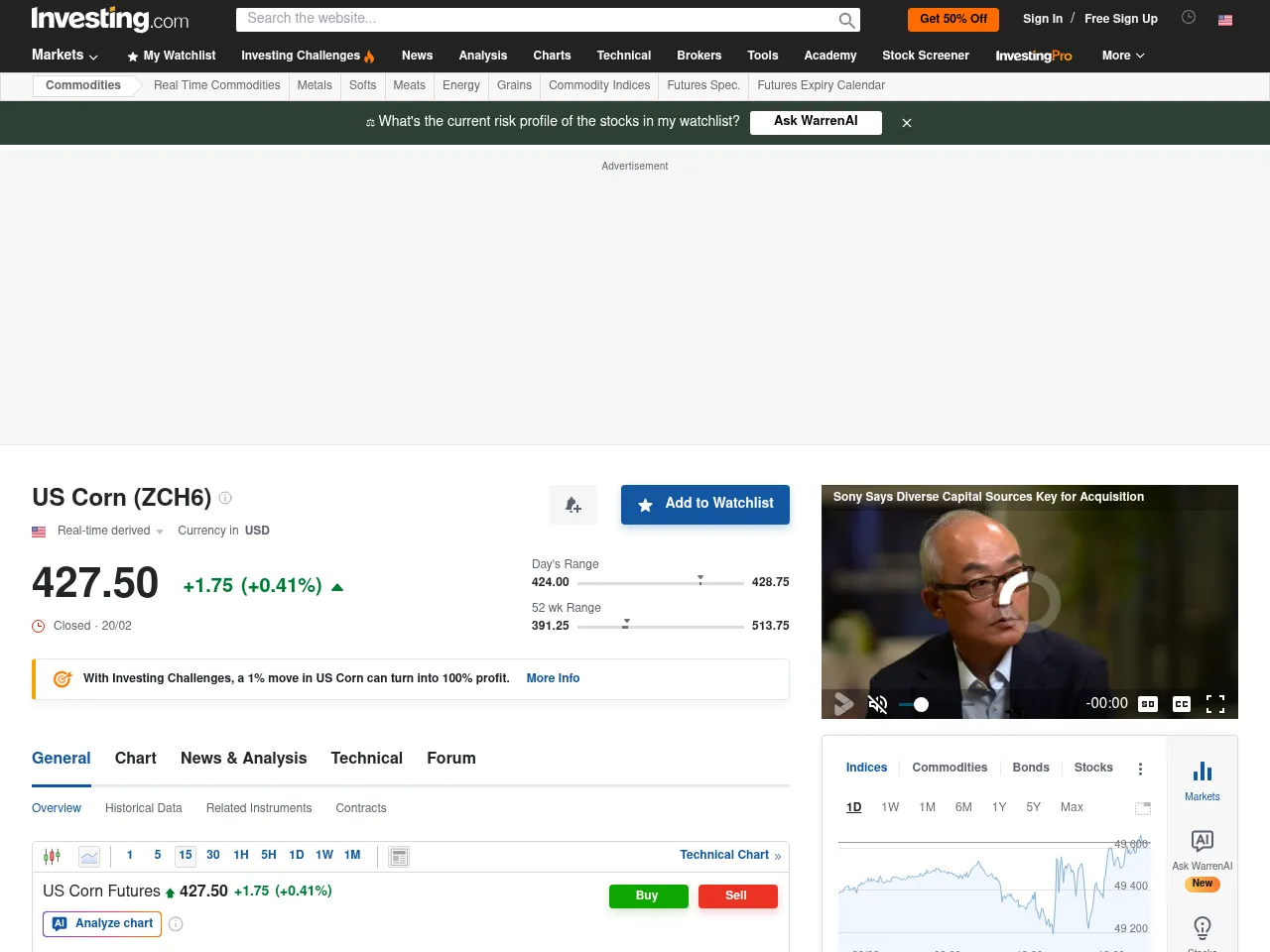
Corn (CORN) Screenshot

Added: Feb 15, 2026

investing.com/commodities/us-corn

Latest from Otrai

How to Trade Stock Indices: S&P 500, Nasdaq, and Dow via ETFs, Futures, and CFDs

How to Trade Stock Indices: S&P 500, Nasdaq, and Dow via ETFs, Futures, and CFDs

A stock index is a single number that summarizes the price action of a basket of companies. The S&P 500 tracks roughly 500 large US firms, the Nasdaq-100 tracks the 100 largest non-financial names on the Nasdaq exchange, and the Dow Jones Industrial Average follows 30 blue-chip stocks.
The Options Greeks Explained: Delta, Gamma, Theta, and Vega

The Options Greeks Explained: Delta, Gamma, Theta, and Vega

The Greeks explain why an option costs what it costs and how that price changes when the stock moves, time passes, and volatility shifts. Delta, Gamma, Theta, and Vega, made accessible.

Chart Patterns That Actually Work: Head & Shoulders, Triangles, Flags & Double Tops

Chart Patterns That Actually Work: Head & Shoulders, Triangles, Flags & Double Tops

Chart patterns are the most recognizable part of technical analysis and the most misunderstood. Most fail or break out the wrong way before reversing. This guide covers head and shoulders, double tops and bottoms, triangles, and flags — with realistic reliability, target measurement, and false-breakout confirmation.

Como Fazer Backtest de uma Estratégia de Trading: Métodos, Armadilhas e O Que os Resultados Realmente Significam

Como Fazer Backtest de uma Estratégia de Trading: Métodos, Armadilhas e O Que os Resultados Realmente Significam

Todo trader tem uma estratégia que parece ótima em sua cabeça. Backtesting é como você descobre se ela realmente funciona. Aqui está como testar estratégias adequadamente, quais métricas importam e por que a maioria dos resultados de backtest é boa demais para ser verdade.