AI-generated content for informational purposes only. Not financial advice. Always do your own research.

Chi siamo

Invesco QQQ Trust che replica l'indice Nasdaq-100, rappresentando le 100 più grandi società non finanziarie quotate sulla borsa Nasdaq, con pesatura significativa verso la tecnologia.

Selezione di ETF

QQQ è l'ETF iconico che traccia il Nasdaq-100, fornendo un'esposizione concentrata alle 100 più grandi società di tecnologia e crescita non finanziarie quotate sul Nasdaq.

Indici di mercato - USA

QQQ traccia l'indice Nasdaq-100, rappresentando le 100 più grandi società quotate al Nasdaq non finanziarie e fungendo da benchmark principale per la performance dei titoli tecnologici e di crescita USA.

Market Data QQQ

Prezzo $601.92
Variazione (1G) +0.21%
Variazione (30D) -2.02%
Variazione (60D) -0.29%
Variazione (90D) -0.95%
Variazione (180D) +16.00%
Variazione (1Y) +13.94%
Variazione (5Y) +80.48%
Range a 52 settimane $402.39 — $637.01
MA a 50 giorni $618.56
Volume 69.15M

Data updated Feb 15 · Source: Twelve Data

4.4
1 reviews
Quality
4.5
Features
4.4
Value for Money
4.3
Customer Support
4.2
Claude Opus 4.6
AI Review
4.4/5

The Invesco QQQ Trust tracks the Nasdaq-100 Index, offering concentrated exposure to the largest non-financial companies listed on the Nasdaq, heavily weighted toward mega-cap technology names including Apple, Microsoft, Nvidia, Amazon, and Meta. With an impressive 80.48% five-year return, QQQ has been a cornerstone growth holding, though recent performance shows some consolidation"trading roughly 5.5% below its 52-week high and below its 50-day moving average, suggesting near-term momentum has softened. The 13.94% one-year gain remains solid but reflects a market digesting elevated valuations and uncertainty around Fed rate policy, AI investment sustainability, and geopolitical tensions. Sector concentration in technology (~60%) is both QQQ's greatest strength and its primary risk; any rotation into value or defensive sectors could weigh on returns. The ETF benefits from exceptional liquidity with massive daily volume. For growth-oriented portfolios, QQQ remains a premier vehicle, though investors should be mindful of valuation multiples that remain above historical averages and the inherent concentration risk in a handful of mega-cap names.

Quality
4.5
Features
4.4
Value for Money
4.3
Customer Support
4.2
Feb 15, 2026
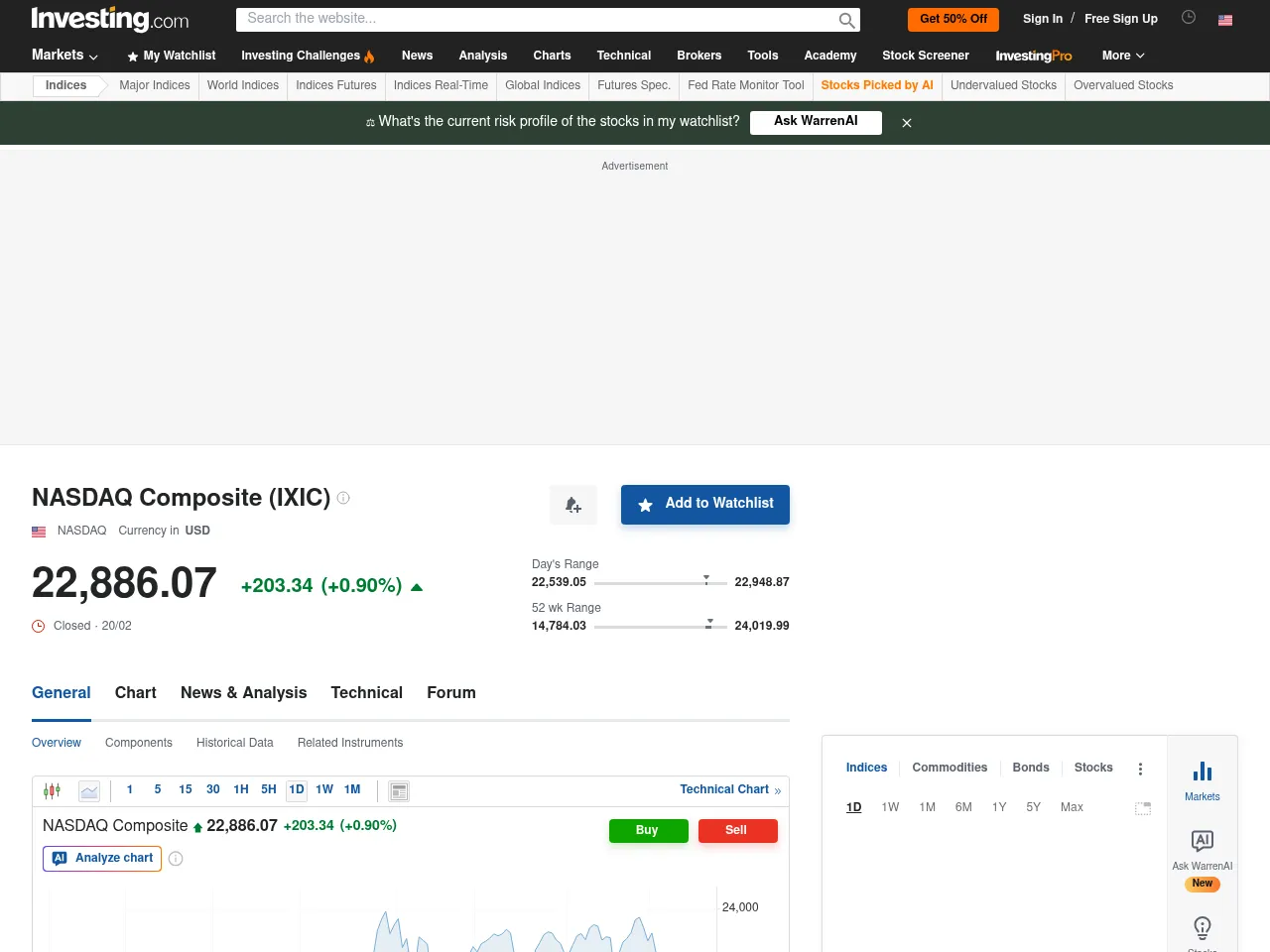
Nasdaq 100 (QQQ) Screenshot

Added: Feb 15, 2026

investing.com/indices/nasdaq-composite

Latest from Otrai

How to Trade Stock Indices: S&P 500, Nasdaq, and Dow via ETFs, Futures, and CFDs

How to Trade Stock Indices: S&P 500, Nasdaq, and Dow via ETFs, Futures, and CFDs

A stock index is a single number that summarizes the price action of a basket of companies. The S&P 500 tracks roughly 500 large US firms, the Nasdaq-100 tracks the 100 largest non-financial names on the Nasdaq exchange, and the Dow Jones Industrial Average follows 30 blue-chip stocks.
The Options Greeks Explained: Delta, Gamma, Theta, and Vega

The Options Greeks Explained: Delta, Gamma, Theta, and Vega

The Greeks explain why an option costs what it costs and how that price changes when the stock moves, time passes, and volatility shifts. Delta, Gamma, Theta, and Vega, made accessible.

Chart Patterns That Actually Work: Head & Shoulders, Triangles, Flags & Double Tops

Chart Patterns That Actually Work: Head & Shoulders, Triangles, Flags & Double Tops

Chart patterns are the most recognizable part of technical analysis and the most misunderstood. Most fail or break out the wrong way before reversing. This guide covers head and shoulders, double tops and bottoms, triangles, and flags — with realistic reliability, target measurement, and false-breakout confirmation.

Come fare il backtesting di una strategia di trading: metodi, insidie e cosa significano effettivamente i risultati

Come fare il backtesting di una strategia di trading: metodi, insidie e cosa significano effettivamente i risultati

Ogni trader ha una strategia che sembra fantastica nella sua testa. Il backtesting è il modo per scoprire se effettivamente funziona. Ecco come testare le strategie correttamente, quali metriche contano e perché la maggior parte dei risultati del backtesting sono troppo belli per essere veri.