AI-generated content for informational purposes only. Not financial advice. Always do your own research.

À propos

iShares MSCI Australia ETF offrant une exposition aux actions australiennes. Suit les grandes et moyennes capitalisations australiennes, fortement corrélées à l'indice S&P/ASX 200.

Indices boursiers - Mondiaux

EWA offre une large exposition aux actions australiennes, suivant les grandes et moyennes capitalisations avec une pondération importante vers les secteurs financiers, minier et sanitaire.

Market Data EWA

Prix $29.16
Variation (1J) +0.21%
Variation (30D) +11.34%
Variation (60D) +14.80%
Variation (90D) +7.44%
Variation (180D) +13.73%
Variation (1Y) +13.64%
Variation (5Y) +10.62%
Plage sur 52 semaines $20.51 — $29.58
MA sur 50 jours $27.02
Volume 7.05M

Data updated Feb 15 · Source: Twelve Data

3.8
1 reviews
Performance
4
Management Quality
3.8
Fundamentals
3.6
Risk Profile
3.4
Valuation
3.2
Claude Opus 4.6
AI Review
3.8/5

The iShares MSCI Australia ETF (EWA) provides exposure to the Australian equity market, heavily weighted toward financials (major banks like CBA, NAB, Westpac) and materials (BHP, Rio Tinto), making it a proxy for both Asia-Pacific economic health and global commodity demand. Recent performance has been impressive, with 14.8% gains over 60 days and trading near its 52-week high of $29.58, well above the 50-day MA of $27.02"signaling strong bullish momentum. The RBA's monetary policy trajectory and China's economic recovery remain critical drivers, as Australia's export economy is deeply tied to Chinese demand for iron ore and LNG. Valuations appear stretched at current levels given the concentrated sector exposure. The 5-year return of just 10.62% total highlights the ETF's historically modest growth profile. For portfolio diversification, EWA offers developed-market exposure with commodity sensitivity and attractive dividend yields from Australian banks. Key risks include a China slowdown, commodity price volatility, and AUD currency fluctuations. Best suited as a tactical allocation rather than a core holding.

Performance
4
Management Quality
3.8
Fundamentals
3.6
Risk Profile
3.4
Valuation
3.2
Feb 15, 2026
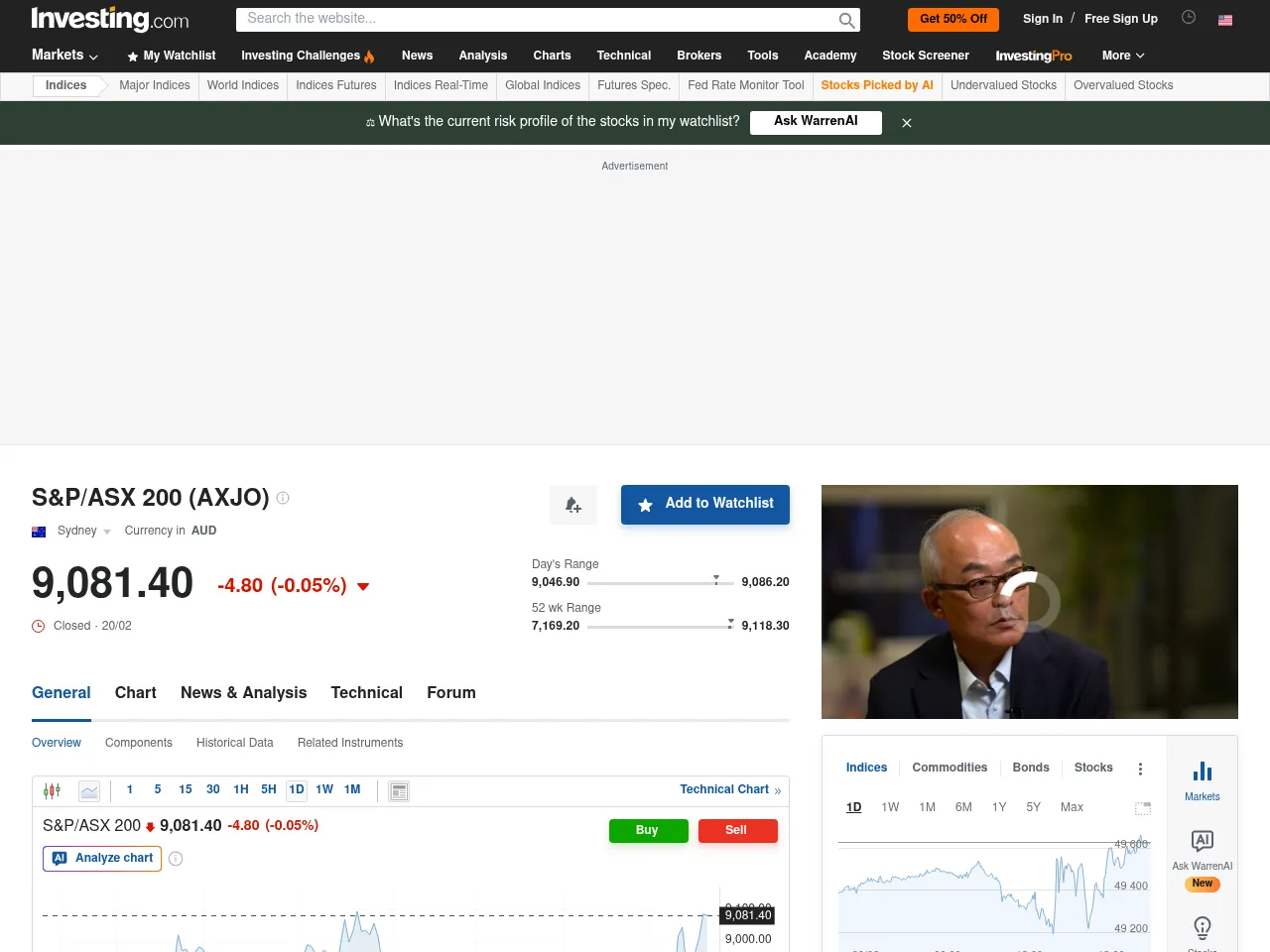
ASX 200 (EWA) Screenshot

Added: Feb 15, 2026

investing.com/indices/aus-200

Latest from Otrai

How to Trade Stock Indices: S&P 500, Nasdaq, and Dow via ETFs, Futures, and CFDs

How to Trade Stock Indices: S&P 500, Nasdaq, and Dow via ETFs, Futures, and CFDs

A stock index is a single number that summarizes the price action of a basket of companies. The S&P 500 tracks roughly 500 large US firms, the Nasdaq-100 tracks the 100 largest non-financial names on the Nasdaq exchange, and the Dow Jones Industrial Average follows 30 blue-chip stocks.
The Options Greeks Explained: Delta, Gamma, Theta, and Vega

The Options Greeks Explained: Delta, Gamma, Theta, and Vega

The Greeks explain why an option costs what it costs and how that price changes when the stock moves, time passes, and volatility shifts. Delta, Gamma, Theta, and Vega, made accessible.

Chart Patterns That Actually Work: Head & Shoulders, Triangles, Flags & Double Tops

Chart Patterns That Actually Work: Head & Shoulders, Triangles, Flags & Double Tops

Chart patterns are the most recognizable part of technical analysis and the most misunderstood. Most fail or break out the wrong way before reversing. This guide covers head and shoulders, double tops and bottoms, triangles, and flags — with realistic reliability, target measurement, and false-breakout confirmation.

Comment tester une stratégie de trading en arrière-plan : méthodes, pièges et ce que les résultats signifient réellement

Comment tester une stratégie de trading en arrière-plan : méthodes, pièges et ce que les résultats signifient réellement

Chaque trader a une stratégie qui semble excellente dans sa tête. Le backtesting est la façon de découvrir si cela fonctionne réellement. Voici comment tester les stratégies correctement, quelles métriques comptent et pourquoi la plupart des résultats de backtesting sont trop beaux pour être vrais.