AI-generated content for informational purposes only. Not financial advice. Always do your own research.

À propos

Teucrium Sugar Fund suivi des contrats à terme sur le sucre ICE. Les prix sont déterminés par la production brésilienne, les exportations indiennes et les mandats de mélange d'éthanol.

Matières premières - Agricoles

CANE suit les contrats à terme sur le sucre ICE, avec des prix déterminés par les volumes de production brésiliens, les politiques d'exportation indiennes et les mandats de mélange d'éthanol qui réorientent l'approvisionnement en sucre vers la production de biocarburants.

Market Data CANE

Prix $9.03
Variation (1J) -0.11%
Variation (30D) -7.48%
Variation (60D) -5.05%
Variation (90D) -15.61%
Variation (180D) -19.95%
Variation (1Y) -23.15%
Variation (5Y) +25.94%
Plage sur 52 semaines $8.97 — $12.83
MA sur 50 jours $9.54
Volume 62.4K

Data updated Feb 15 · Source: Twelve Data

2.8
1 reviews
Market Fundamentals
3.2
Liquidity
3
Accessibility
2.8
Historical Performance
2.6
Volatility
2.5
Claude Opus 4.6
AI Review
2.8/5

Sugar (CANE ETF) tracks the Teucrium Sugar Fund, providing exposure to sugar futures without direct futures trading. The commodity has been in a pronounced downtrend, falling 23.15% over the past year and currently trading near its 52-week low of $8.97, well below its 50-day moving average of $9.54"a bearish technical signal. On the supply side, strong production from Brazil, the world's largest exporter, has pressured prices, with favorable weather supporting robust harvests. India's improved output and Thailand's recovery have further eased supply concerns. Bearish factors include a stronger U.S. dollar weighing on dollar-denominated commodities and subdued global demand growth. However, potential bullish catalysts exist: El Nino-related weather disruptions could threaten Asian production, and rising ethanol diversion in Brazil may tighten exportable supply. Additionally, long-term inflationary pressures and rising production costs provide a floor. The 5-year gain of 25.94% shows sugar's cyclical potential, but near-term momentum remains decidedly negative. Investors should await signs of supply tightening or technical stabilization before establishing positions.

Market Fundamentals
3.2
Liquidity
3
Accessibility
2.8
Historical Performance
2.6
Volatility
2.5
Feb 15, 2026
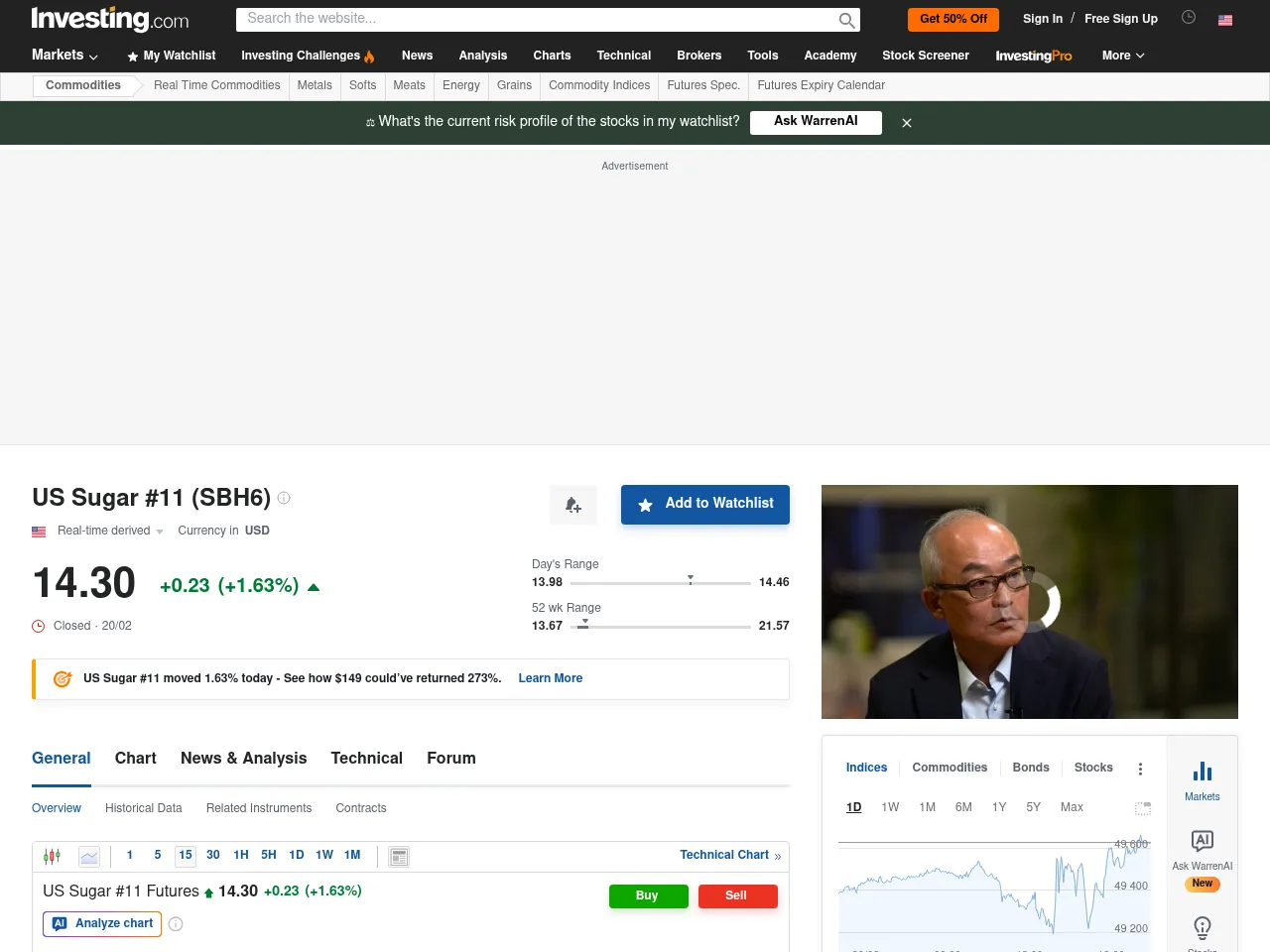
Sugar (CANE) Screenshot

Added: Feb 15, 2026

investing.com/commodities/us-sugar-no11

Latest from Otrai

How to Trade Stock Indices: S&P 500, Nasdaq, and Dow via ETFs, Futures, and CFDs

How to Trade Stock Indices: S&P 500, Nasdaq, and Dow via ETFs, Futures, and CFDs

A stock index is a single number that summarizes the price action of a basket of companies. The S&P 500 tracks roughly 500 large US firms, the Nasdaq-100 tracks the 100 largest non-financial names on the Nasdaq exchange, and the Dow Jones Industrial Average follows 30 blue-chip stocks.
The Options Greeks Explained: Delta, Gamma, Theta, and Vega

The Options Greeks Explained: Delta, Gamma, Theta, and Vega

The Greeks explain why an option costs what it costs and how that price changes when the stock moves, time passes, and volatility shifts. Delta, Gamma, Theta, and Vega, made accessible.

Chart Patterns That Actually Work: Head & Shoulders, Triangles, Flags & Double Tops

Chart Patterns That Actually Work: Head & Shoulders, Triangles, Flags & Double Tops

Chart patterns are the most recognizable part of technical analysis and the most misunderstood. Most fail or break out the wrong way before reversing. This guide covers head and shoulders, double tops and bottoms, triangles, and flags — with realistic reliability, target measurement, and false-breakout confirmation.

Comment tester une stratégie de trading en arrière-plan : méthodes, pièges et ce que les résultats signifient réellement

Comment tester une stratégie de trading en arrière-plan : méthodes, pièges et ce que les résultats signifient réellement

Chaque trader a une stratégie qui semble excellente dans sa tête. Le backtesting est la façon de découvrir si cela fonctionne réellement. Voici comment tester les stratégies correctement, quelles métriques comptent et pourquoi la plupart des résultats de backtesting sont trop beaux pour être vrais.