AI-generated content for informational purposes only. Not financial advice. Always do your own research.

À propos

Dollar américain vs dollar de Singapour. Géré par l'Autorité monétaire de Singapour par un système de bandes plutôt que par les taux d'intérêt.

Forex - Paires exotiques

USD/SGD est géré par un système de bandes unique de l'Autorité monétaire de Singapour, reflétant l'économie stable et dépendante du commerce du centre financier asiatique.

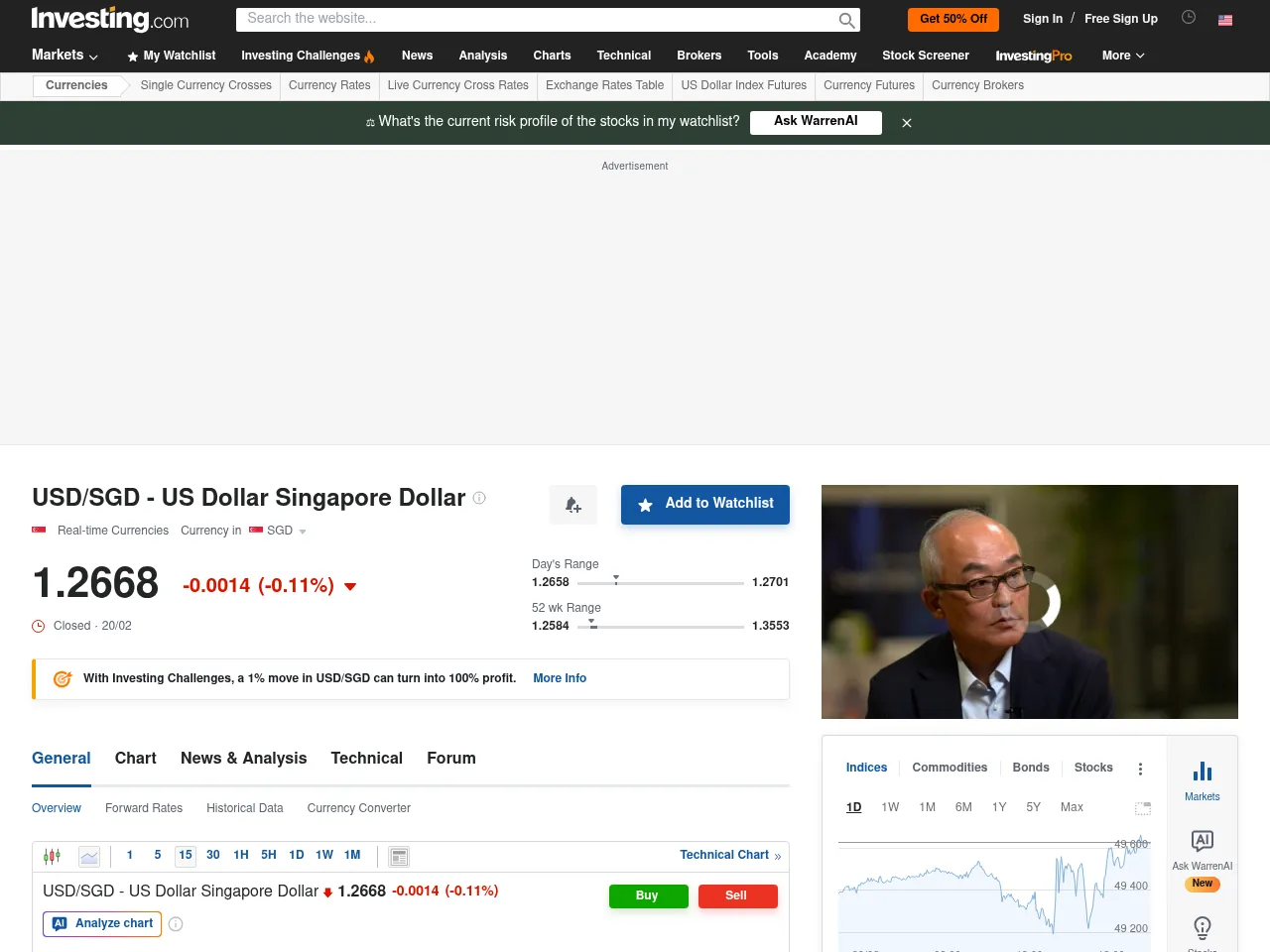
Market Data USD/SGD

Prix 1.2600
Variation (1J) +0.03%
Variation (30D) -2.03%
Variation (60D) -2.23%
Variation (90D) -2.87%
Variation (180D) -1.41%
Variation (1Y) -2.62%
Variation (5Y) -6.84%
Plage sur 52 semaines 1.2600 — 1.3600
MA sur 50 jours 1.2800

Data updated Feb 15 · Source: Twelve Data

4.2
1 reviews
Historical Performance
4.4
Liquidity
4.3
Market Fundamentals
4.2
Accessibility
4.1
Volatility
4
Claude Opus 4.6
AI Review
4.2/5

USD/SGD is trading at 1.2600, sitting precisely at its 52-week low, reflecting sustained US dollar weakness against the Singapore dollar. The pair has declined steadily across all timeframes, with a 2.87% drop over 90 days and 6.84% over five years, underscoring the SGD's structural appreciation trend. The Monetary Authority of Singapore (MAS) maintains its exchange rate-centered policy framework, and its relatively hawkish stance on the SGD NEER band has supported the currency. Singapore's robust trade surplus, sound fiscal position, and role as a regional financial hub provide fundamental backing. Trading below the 50-day MA of 1.2800 confirms bearish momentum. However, at the 52-week low, the pair may find technical support, and any hawkish Fed pivot or risk-off sentiment could trigger a corrective bounce. Bearish scenario: continued SGD strength if MAS maintains tightening bias and Asian growth stabilizes. Bullish scenario: US dollar recovery on stronger economic data or geopolitical safe-haven flows. Liquidity is excellent for an exotic pair, making it attractive for carry and directional strategies.

Historical Performance
4.4
Liquidity
4.3
Market Fundamentals
4.2
Accessibility
4.1
Volatility
4
Feb 15, 2026
USD/SGD Screenshot

Added: Feb 15, 2026

investing.com/currencies/usd-sgd

Latest from Otrai

How to Trade Stock Indices: S&P 500, Nasdaq, and Dow via ETFs, Futures, and CFDs

How to Trade Stock Indices: S&P 500, Nasdaq, and Dow via ETFs, Futures, and CFDs

A stock index is a single number that summarizes the price action of a basket of companies. The S&P 500 tracks roughly 500 large US firms, the Nasdaq-100 tracks the 100 largest non-financial names on the Nasdaq exchange, and the Dow Jones Industrial Average follows 30 blue-chip stocks.
The Options Greeks Explained: Delta, Gamma, Theta, and Vega

The Options Greeks Explained: Delta, Gamma, Theta, and Vega

The Greeks explain why an option costs what it costs and how that price changes when the stock moves, time passes, and volatility shifts. Delta, Gamma, Theta, and Vega, made accessible.

Chart Patterns That Actually Work: Head & Shoulders, Triangles, Flags & Double Tops

Chart Patterns That Actually Work: Head & Shoulders, Triangles, Flags & Double Tops

Chart patterns are the most recognizable part of technical analysis and the most misunderstood. Most fail or break out the wrong way before reversing. This guide covers head and shoulders, double tops and bottoms, triangles, and flags — with realistic reliability, target measurement, and false-breakout confirmation.

Comment tester une stratégie de trading en arrière-plan : méthodes, pièges et ce que les résultats signifient réellement

Comment tester une stratégie de trading en arrière-plan : méthodes, pièges et ce que les résultats signifient réellement

Chaque trader a une stratégie qui semble excellente dans sa tête. Le backtesting est la façon de découvrir si cela fonctionne réellement. Voici comment tester les stratégies correctement, quelles métriques comptent et pourquoi la plupart des résultats de backtesting sont trop beaux pour être vrais.