AI-generated content for informational purposes only. Not financial advice. Always do your own research.

À propos

Plus grande banque du Japon et l'une des plus grandes institutions financières du monde avec plus de 3 000 milliards de dollars d'actifs. Fournit des services bancaires, de fiducie et de valeurs mobilières à l'échelle mondiale.

Actions bancaires

Mitsubishi UFJ Financial Group est la plus grande banque du Japon avec plus de 3 milliards de dollars d'actifs, fournissant des services bancaires diversifiés, de fiducie et de valeurs mobilières sur les marchés mondiaux.

Actions japonaises

Keyence est l'entreprise technologique la plus précieuse du Japon, fabricant des capteurs d'automatisation avancés, des systèmes de vision par machine et des instruments de mesure avec des marges bénéficiaires leader du secteur.

Key Financials MUFG

Prix $19.73
Variation (1J) +0.66%
Variation (30D) +24.40%
Variation (60D) +27.95%
Variation (90D) +26.96%
Variation (180D) +44.01%
Variation (1Y) +59.76%
Variation (5Y) +295.39%
P/E Ratio 6.24
EPS (TTM) $3.16
Plage sur 52 semaines $10.46 — $20.15
MA sur 50 jours $17.21
Volume 3.84M

Data updated Feb 15 · Source: Twelve Data

4.6
1 reviews
Claude Opus 4.6
AI Review
4.6/5

Mitsubishi UFJ Financial Group, Japan's largest bank and one of the world's premier financial institutions, has delivered exceptional performance with a nearly 60% gain over the past year and a remarkable 295% return over five years. Trading near its 52-week high at $19.73, MUFG sports an attractively low P/E ratio of 6.24, suggesting the stock remains undervalued despite its strong run. The $3.16 EPS reflects robust earnings power driven by rising Japanese interest rates, which are finally boosting net interest margins after decades of near-zero policy. MUFG's diversified global operations, including its significant stake in Morgan Stanley, provide geographic and revenue diversification rare among Japanese banks. The bull case centers on the Bank of Japan's monetary policy normalization, continued shareholder-friendly capital returns, and strong corporate lending demand. Bear case risks include potential global economic slowdown impacting credit quality, yen volatility affecting USD-denominated returns for foreign investors, and the stock's rapid appreciation potentially limiting near-term upside. The strong momentum above the 50-day moving average ($17.21) confirms bullish sentiment, though some consolidation near these levels would be healthy.

Feb 15, 2026
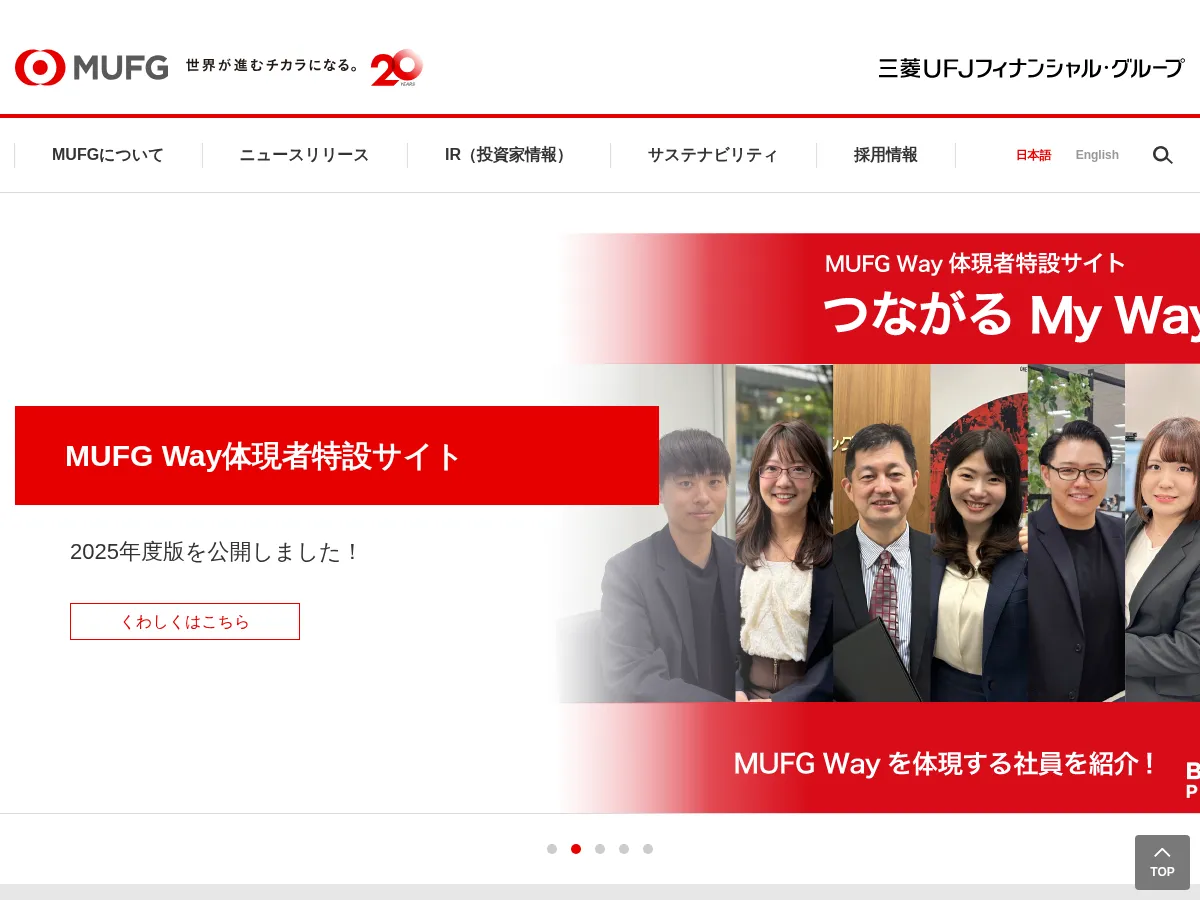
Mitsubishi UFJ Financial Screenshot

Added: Feb 15, 2026

mufg.jp

Latest from Otrai

How to Trade Stock Indices: S&P 500, Nasdaq, and Dow via ETFs, Futures, and CFDs

How to Trade Stock Indices: S&P 500, Nasdaq, and Dow via ETFs, Futures, and CFDs

A stock index is a single number that summarizes the price action of a basket of companies. The S&P 500 tracks roughly 500 large US firms, the Nasdaq-100 tracks the 100 largest non-financial names on the Nasdaq exchange, and the Dow Jones Industrial Average follows 30 blue-chip stocks.
The Options Greeks Explained: Delta, Gamma, Theta, and Vega

The Options Greeks Explained: Delta, Gamma, Theta, and Vega

The Greeks explain why an option costs what it costs and how that price changes when the stock moves, time passes, and volatility shifts. Delta, Gamma, Theta, and Vega, made accessible.

Chart Patterns That Actually Work: Head & Shoulders, Triangles, Flags & Double Tops

Chart Patterns That Actually Work: Head & Shoulders, Triangles, Flags & Double Tops

Chart patterns are the most recognizable part of technical analysis and the most misunderstood. Most fail or break out the wrong way before reversing. This guide covers head and shoulders, double tops and bottoms, triangles, and flags — with realistic reliability, target measurement, and false-breakout confirmation.

Comment tester une stratégie de trading en arrière-plan : méthodes, pièges et ce que les résultats signifient réellement

Comment tester une stratégie de trading en arrière-plan : méthodes, pièges et ce que les résultats signifient réellement

Chaque trader a une stratégie qui semble excellente dans sa tête. Le backtesting est la façon de découvrir si cela fonctionne réellement. Voici comment tester les stratégies correctement, quelles métriques comptent et pourquoi la plupart des résultats de backtesting sont trop beaux pour être vrais.