AI-generated content for informational purposes only. Not financial advice. Always do your own research.

À propos

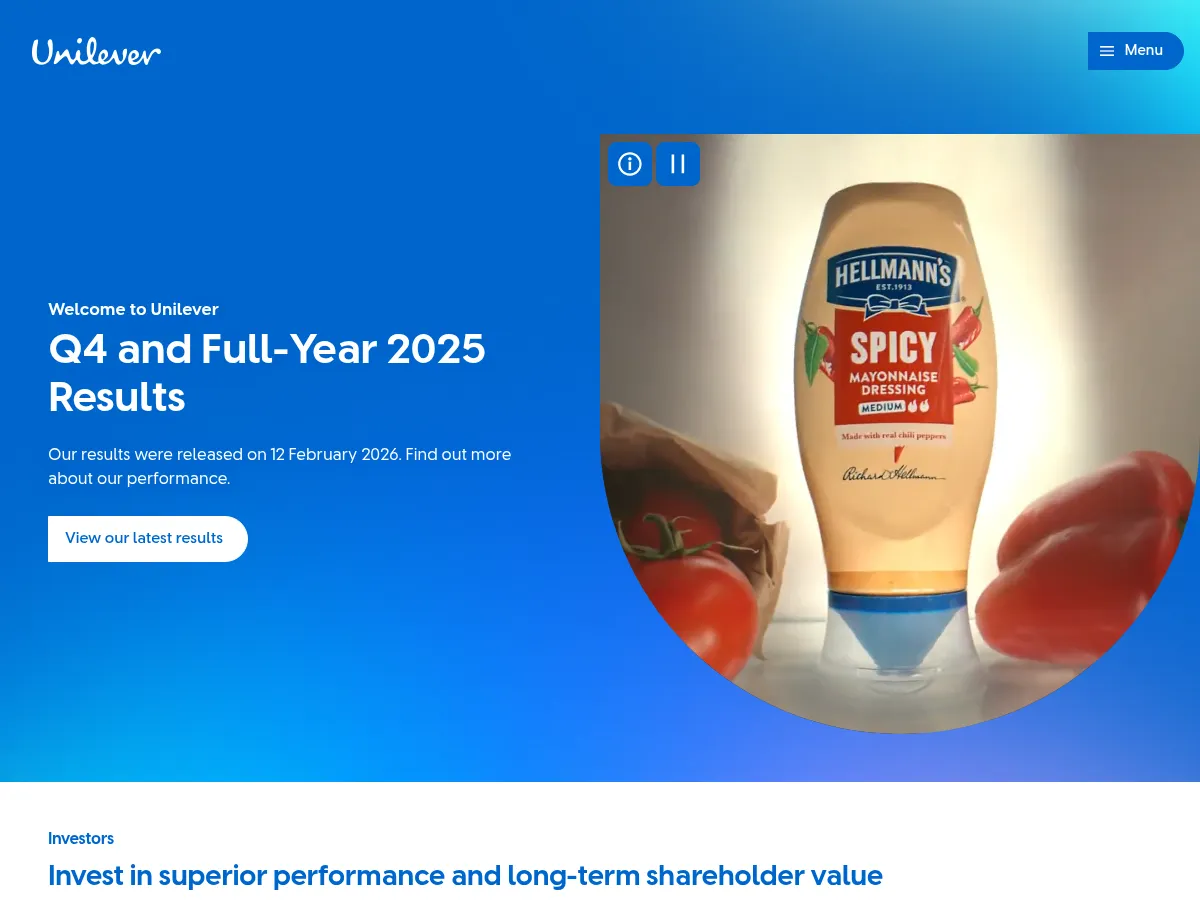
Multinationale britannico-néerlandaise propriétaire de plus de 400 marques incluant Dove, Ben & Jerry's, Hellmann's et Vaseline. L'une des plus grandes sociétés de biens de consommation au monde.

Valeurs vedettes européennes

Unilever est un blue chip européen des biens de consommation avec plus de 400 marques couvrant l'alimentation, les soins personnels et les produits ménagers, offrant une exposition défensive aux modes de consommation mondiale.

Actions agroalimentaires

Unilever est un géant britannique-néerlandais des biens de consommation possédant plus de 400 marques, dont Dove, Ben & Jerry's, Hellmann's et Vaseline, offrant une exposition large aux marchés mondiaux de l'alimentation et des soins personnels.

Key Financials UL

Prix $74.59
Variation (1J) +1.54%
Variation (30D) +14.05%
Variation (60D) +11.87%
Variation (90D) +13.07%
Variation (180D) +4.64%
Variation (1Y) +12.00%
Variation (5Y) +21.58%
P/E Ratio 32.01
EPS (TTM) $2.33
Plage sur 52 semaines $61.17 — $74.98
MA sur 50 jours $66.57
Volume 7.03M

Data updated Feb 15 · Source: Twelve Data

4.1
1 reviews
Brand Reputation
4.3
Market Leadership
4
Governance & Ethics
3.9
Financial Stability
3.8
Innovation Capability
3.5
Claude Opus 4.6
AI Review
4.1/5

Unilever is a global consumer goods giant with a portfolio spanning food, beauty, home care, and personal care brands including Dove, Hellmann's, and Ben & Jerry's. The stock is trading near its 52-week high at $74.59, reflecting strong recent momentum with a 14% gain over 30 days, suggesting renewed investor confidence following its strategic restructuring into focused business units.

The P/E ratio of 32.01 is elevated for a mature consumer staples company, implying the market is pricing in margin expansion from CEO Hein Schumacher's productivity-focused turnaround plan. EPS of $2.33 is modest, and bulls will point to significant room for operational improvement and potential brand divestitures to unlock value. The dividend yield remains attractive for income investors.

Bear case concerns include premium valuation relative to peers, exposure to emerging market currency volatility, and competitive pressures in key categories. The 5-year return of just 21.58% underscores a prolonged period of underperformance versus broader indices. However, the strategic refocus and improving execution make Unilever a solid defensive holding with turnaround upside.

Brand Reputation
4.3
Market Leadership
4
Governance & Ethics
3.9
Financial Stability
3.8
Innovation Capability
3.5
Feb 15, 2026
Unilever Screenshot

Added: Feb 15, 2026

unilever.com

Latest from Otrai

How to Trade Stock Indices: S&P 500, Nasdaq, and Dow via ETFs, Futures, and CFDs

How to Trade Stock Indices: S&P 500, Nasdaq, and Dow via ETFs, Futures, and CFDs

A stock index is a single number that summarizes the price action of a basket of companies. The S&P 500 tracks roughly 500 large US firms, the Nasdaq-100 tracks the 100 largest non-financial names on the Nasdaq exchange, and the Dow Jones Industrial Average follows 30 blue-chip stocks.
The Options Greeks Explained: Delta, Gamma, Theta, and Vega

The Options Greeks Explained: Delta, Gamma, Theta, and Vega

The Greeks explain why an option costs what it costs and how that price changes when the stock moves, time passes, and volatility shifts. Delta, Gamma, Theta, and Vega, made accessible.

Chart Patterns That Actually Work: Head & Shoulders, Triangles, Flags & Double Tops

Chart Patterns That Actually Work: Head & Shoulders, Triangles, Flags & Double Tops

Chart patterns are the most recognizable part of technical analysis and the most misunderstood. Most fail or break out the wrong way before reversing. This guide covers head and shoulders, double tops and bottoms, triangles, and flags — with realistic reliability, target measurement, and false-breakout confirmation.

Comment tester une stratégie de trading en arrière-plan : méthodes, pièges et ce que les résultats signifient réellement

Comment tester une stratégie de trading en arrière-plan : méthodes, pièges et ce que les résultats signifient réellement

Chaque trader a une stratégie qui semble excellente dans sa tête. Le backtesting est la façon de découvrir si cela fonctionne réellement. Voici comment tester les stratégies correctement, quelles métriques comptent et pourquoi la plupart des résultats de backtesting sont trop beaux pour être vrais.