AI-generated content for informational purposes only. Not financial advice. Always do your own research.

À propos

Plus grand producteur d'agrégats de construction aux États-Unis, fournissant de la pierre concassée, du sable et du gravier pour les infrastructures, la construction résidentielle et commerciale.

Actions de la construction et des materiaux

Vulcan Materials est le plus grand producteur américain d'agrégats de construction, fournissant la pierre concassée, le sable et le gravier essentiels aux projets de construction de routes, d'autoroutes et de bâtiments.

Actions des infrastructures

Vulcan Materials est le principal producteur d'agrégats aux États-Unis, bénéficiant d'actifs irremplaçables de carrières locales et de dépenses d'infrastructure soutenues sur les routes, autoroutes et constructions.

Key Financials VMC

Prix $327.65
Variation (1J) +1.78%
Variation (30D) +14.88%
Variation (60D) +16.98%
Variation (90D) +7.54%
Variation (180D) +24.80%
Variation (1Y) +24.20%
Variation (5Y) +110.50%
P/E Ratio 39.24
EPS (TTM) $8.35
Plage sur 52 semaines $215.08 — $331.09
MA sur 50 jours $301.18
Volume 1.39M

Data updated Feb 15 · Source: Twelve Data

4.5
1 reviews
Performance
4.8
Management Quality
4.7
Fundamentals
4.5
Risk Profile
4
Valuation
3.8
Claude Opus 4.6
AI Review
4.5/5

Vulcan Materials is the largest U.S. producer of construction aggregates (crushed stone, sand, gravel), holding a dominant competitive position with strategically located quarries that are nearly impossible to replicate due to permitting barriers. This creates a wide economic moat and significant pricing power.

The stock has performed exceptionally well, up 24.8% over six months and trading near its 52-week high of $331.09. The 50-day moving average of $301.18 confirms strong upward momentum. The five-year return of 110.5% demonstrates consistent long-term wealth creation.

The bull case centers on the Infrastructure Investment and Jobs Act driving sustained demand for aggregates, Vulcan's pricing discipline, and high barriers to entry. The company benefits from population growth in its key Sun Belt markets.

The bear case involves the elevated P/E ratio of 39.24, which prices in substantial growth expectations. EPS of $8.35 is modest relative to the share price, and any slowdown in construction spending or housing could pressure results. Interest rate sensitivity in construction activity remains a risk.

Vulcan is a premium franchise commanding a premium valuation " appropriate for long-term infrastructure-focused portfolios, though new buyers should be mindful of the stretched multiple.

Performance
4.8
Management Quality
4.7
Fundamentals
4.5
Risk Profile
4
Valuation
3.8
Feb 15, 2026
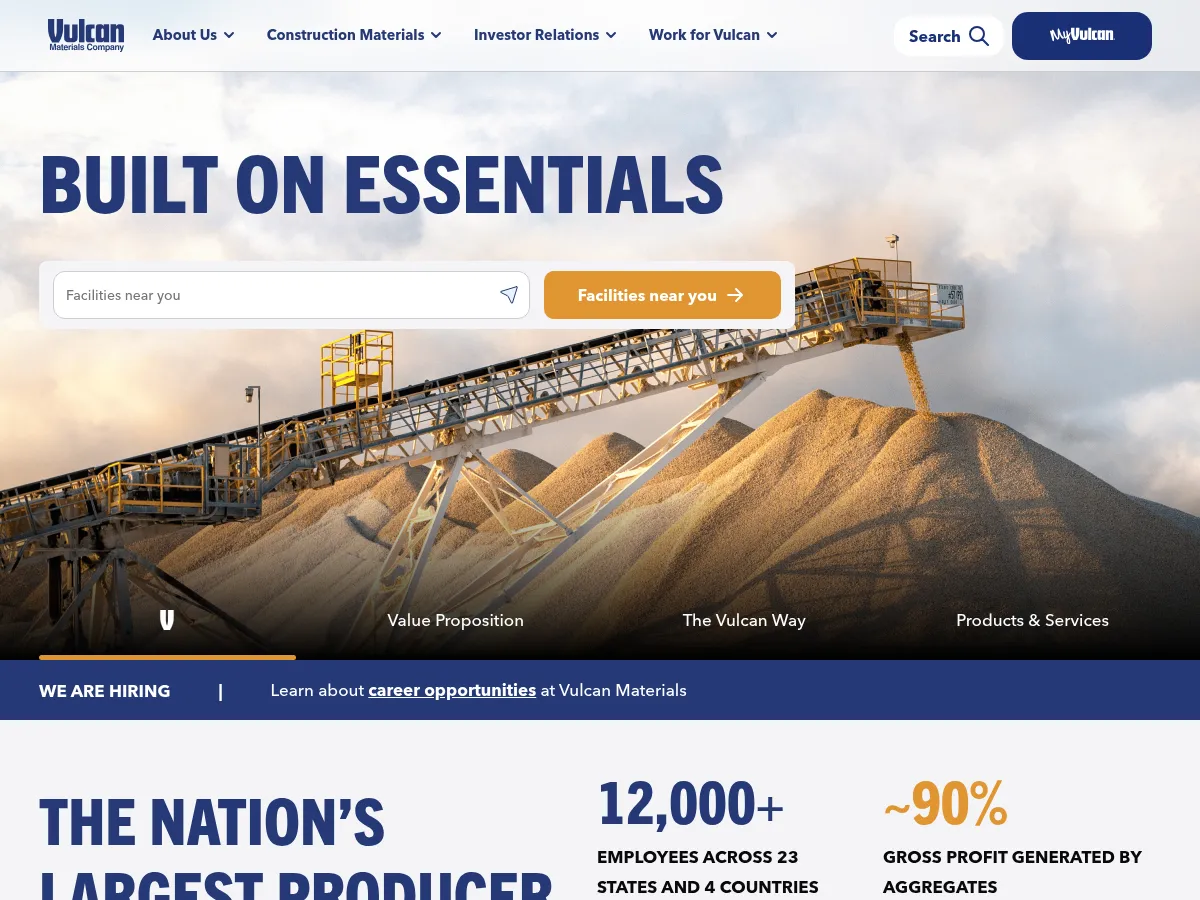
Vulcan Materials Screenshot

Added: Feb 15, 2026

vulcanmaterials.com

Latest from Otrai

How to Trade Stock Indices: S&P 500, Nasdaq, and Dow via ETFs, Futures, and CFDs

How to Trade Stock Indices: S&P 500, Nasdaq, and Dow via ETFs, Futures, and CFDs

A stock index is a single number that summarizes the price action of a basket of companies. The S&P 500 tracks roughly 500 large US firms, the Nasdaq-100 tracks the 100 largest non-financial names on the Nasdaq exchange, and the Dow Jones Industrial Average follows 30 blue-chip stocks.
The Options Greeks Explained: Delta, Gamma, Theta, and Vega

The Options Greeks Explained: Delta, Gamma, Theta, and Vega

The Greeks explain why an option costs what it costs and how that price changes when the stock moves, time passes, and volatility shifts. Delta, Gamma, Theta, and Vega, made accessible.

Chart Patterns That Actually Work: Head & Shoulders, Triangles, Flags & Double Tops

Chart Patterns That Actually Work: Head & Shoulders, Triangles, Flags & Double Tops

Chart patterns are the most recognizable part of technical analysis and the most misunderstood. Most fail or break out the wrong way before reversing. This guide covers head and shoulders, double tops and bottoms, triangles, and flags — with realistic reliability, target measurement, and false-breakout confirmation.

Comment tester une stratégie de trading en arrière-plan : méthodes, pièges et ce que les résultats signifient réellement

Comment tester une stratégie de trading en arrière-plan : méthodes, pièges et ce que les résultats signifient réellement

Chaque trader a une stratégie qui semble excellente dans sa tête. Le backtesting est la façon de découvrir si cela fonctionne réellement. Voici comment tester les stratégies correctement, quelles métriques comptent et pourquoi la plupart des résultats de backtesting sont trop beaux pour être vrais.