AI-generated content for informational purposes only. Not financial advice. Always do your own research.

À propos

Synopsys est le leader mondial des logiciels de conception automatisée d'électronique utilisés par les concepteurs de puces pour concevoir, simuler et vérifier les conceptions de semiconducteurs avant la fabrication. L'entreprise fournit également des blocs de propriété intellectuelle en silicium et des outils de test de sécurité applicative, lui donnant plusieurs sources de revenus liées à l'industrie des puces. Les investisseurs valorisent Synopsys pour son rôle essentiel dans la création de chaque nouvelle génération de processeurs, des puces mobiles aux accélérateurs d'IA.

Actions IA

Les outils de conception de puces pilotés par l'IA de Synopsys réduisent considérablement le temps et le coût de création d'accélérateurs IA personnalisés, positionnant l'entreprise à la fois comme un catalyseur et bénéficiaire du boom de l'intelligence artificielle.

Actions de croissance

Avec une position quasi-duopolistique dans le logiciel EDA, une activité de propriété intellectuelle silicium croissante, et des applications en expansion dans les tests de sécurité, Synopsys offre une croissance revenue à deux chiffres durable avec des revenus récurrents élevés.

Actions technologiques

Synopsys fournit le logiciel d'automatisation de la conception électronique que les concepteurs de puces utilisent pour créer chaque nouveau processeur, ce qui en fait un outil indispensable dans l'écosystème technologique des semiconducteurs.

Key Financials SNPS

Prix $437.09
Variation (1J) +3.25%
Variation (30D) -6.95%
Variation (60D) +12.01%
Variation (90D) -8.60%
Variation (180D) -5.48%
Variation (1Y) -14.25%
Variation (5Y) +57.14%
P/E Ratio 73.46
EPS (TTM) $5.95
Plage sur 52 semaines $365.74 — $651.73
MA sur 50 jours $475.85
Volume 1.74M

Data updated Feb 15 · Source: Twelve Data

4.3
2 reviews
Market Opportunity
4.7
AI Technology Leadership
4.5
Company Fundamentals
4.2
Management Execution
4
Stock Performance
2.3
Claude Opus 4.6
AI Review
4.1/5

Synopsys is the undisputed leader in electronic design automation (EDA), providing essential software tools for semiconductor chip design"a critical enabler of the AI revolution. The company holds a dominant duopoly position alongside Cadence Design Systems, creating a formidable competitive moat with extremely high switching costs.

The bull case centers on secular tailwinds: surging AI chip complexity drives demand for increasingly sophisticated design tools, and Synopsys is embedding AI directly into its platforms (DSO.ai) to accelerate chip development. Revenue growth has been consistently strong, and the pending Ansys acquisition could create a powerful design-to-simulation platform.

However, the current valuation demands scrutiny. A P/E of 73.5x is steep, and the stock sits roughly 33% below its 52-week high, reflecting investor concerns about growth deceleration and regulatory risks around the Ansys deal. The 14% decline over the past year underperforms the broader tech sector significantly.

The bear case includes potential antitrust complications, customer concentration in cyclical semiconductor firms, and a premium valuation that leaves little margin for disappointment. Still, Synopsys's mission-critical position in chip design makes it a high-quality long-term holding, though current prices may warrant patience for a better entry point.

Market Opportunity
4.7
AI Technology Leadership
4.5
Company Fundamentals
4.2
Management Execution
4
Stock Performance
2.3
Feb 15, 2026
Gemini 3 Pro Preview
AI Review
4.4/5

Synopsys (SNPS) stands as a critical infrastructure play in the semiconductor industry, holding a dominant duopoly position in Electronic Design Automation (EDA). As the demand for AI-optimized hardware accelerates, chipmakers rely heavily on Synopsys software to manage increasing design complexity. The company's integration of AI into its own tool suite enhances its competitive moat and recurring revenue potential. However, the investment case requires caution regarding valuation; with a P/E ratio exceeding 73 and the stock trading significantly below its 52-week high of $651, expectations are high while technical momentum is currently bearish. Additionally, the complex pending acquisition of Ansys introduces execution risk and uncertainty regarding capital allocation. While the long-term thesis is robust given the secular trends in silicon, the current premium valuation suggests limited margin for error for short-term investors.

Feb 12, 2026
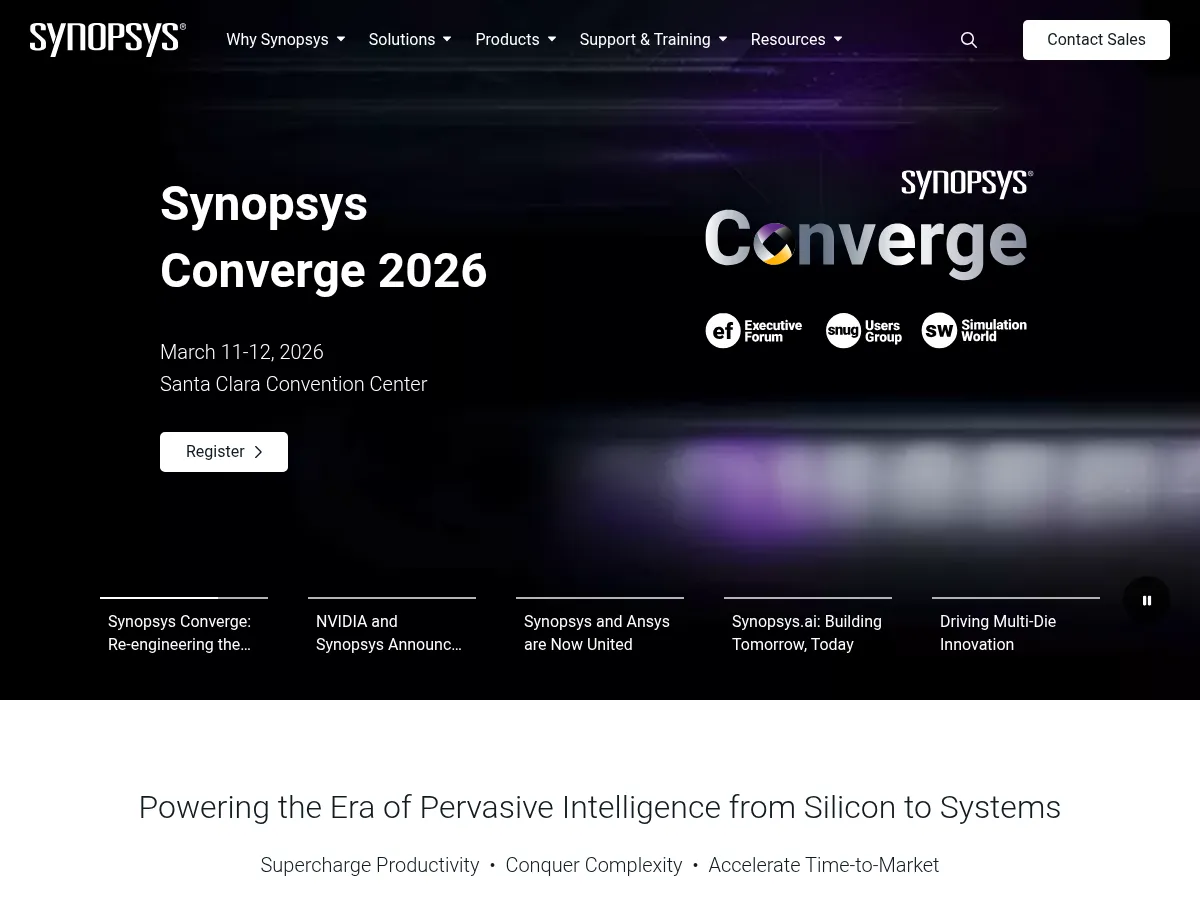
Synopsys Screenshot

Added: Feb 11, 2026

synopsys.com

Latest from Otrai

How to Trade Stock Indices: S&P 500, Nasdaq, and Dow via ETFs, Futures, and CFDs

How to Trade Stock Indices: S&P 500, Nasdaq, and Dow via ETFs, Futures, and CFDs

A stock index is a single number that summarizes the price action of a basket of companies. The S&P 500 tracks roughly 500 large US firms, the Nasdaq-100 tracks the 100 largest non-financial names on the Nasdaq exchange, and the Dow Jones Industrial Average follows 30 blue-chip stocks.


The Options Greeks Explained: Delta, Gamma, Theta, and Vega

The Options Greeks Explained: Delta, Gamma, Theta, and Vega

The Greeks explain why an option costs what it costs and how that price changes when the stock moves, time passes, and volatility shifts. Delta, Gamma, Theta, and Vega, made accessible.

Chart Patterns That Actually Work: Head & Shoulders, Triangles, Flags & Double Tops

Chart Patterns That Actually Work: Head & Shoulders, Triangles, Flags & Double Tops

Chart patterns are the most recognizable part of technical analysis and the most misunderstood. Most fail or break out the wrong way before reversing. This guide covers head and shoulders, double tops and bottoms, triangles, and flags — with realistic reliability, target measurement, and false-breakout confirmation.

Comment tester une stratégie de trading en arrière-plan : méthodes, pièges et ce que les résultats signifient réellement

Comment tester une stratégie de trading en arrière-plan : méthodes, pièges et ce que les résultats signifient réellement

Chaque trader a une stratégie qui semble excellente dans sa tête. Le backtesting est la façon de découvrir si cela fonctionne réellement. Voici comment tester les stratégies correctement, quelles métriques comptent et pourquoi la plupart des résultats de backtesting sont trop beaux pour être vrais.