AI-generated content for informational purposes only. Not financial advice. Always do your own research.

À propos

Royal Caribbean Group (NYSE: RCL) est la deuxième plus grande compagnie de croisière au monde et est largement considérée comme le leader de l'innovation dans l'industrie, exploitant Royal Caribbean International, Celebrity Cruises et Silversea Cruises avec une flotte de plus de 60 navires incluant les plus grands navires de croisière du monde dans les classes Icon et Oasis. L'entreprise s'est différenciée par la conception révolutionnaire des navires comportant des attractions comme des simulateurs de surf, des expériences de parachutisme et des barmen robotiques, tandis que sa destination d'île privée Perfect Day at CocoCay est devenue l'un des ports d'escale les plus populaires des Caraïbes. Royal Caribbean offre aux investisseurs une exposition à un opérateur de croisière positionné haut de gamme qui a livré une performance financière post-pandémie leader du secteur, une forte croissance des revenus et un chemin clair vers des améliorations de rentabilité durables.

Actions des compagnies de croisiere

Royal Caribbean Group est une action de ligne de croisière de premier plan connue pour l'innovation de navires définissant l'industrie et les plus grands navires de croisière du monde, exploitant trois marques du contemporain au ultra-luxe qui ont réalisé une meilleure reprise des revenus après la pandémie et une croissance d'rendement forte grâce aux expériences et destinations haut de gamme à bord.

Key Financials RCL

Prix $319.61
Variation (1J) -3.96%
Variation (30D) +14.59%
Variation (60D) +29.55%
Variation (90D) +0.73%
Variation (180D) +27.44%
Variation (1Y) +24.70%
Variation (5Y) +363.94%
P/E Ratio 22.12
EPS (TTM) $14.45
Plage sur 52 semaines $164.01 — $366.50
MA sur 50 jours $295.36
Volume 2.39M

Data updated Feb 15 · Source: Twelve Data

4.7
2 reviews
Performance
4.8
Management Quality
4.7
Fundamentals
4.6
Valuation
4.2
Risk Profile
4
Claude Opus 4.6
AI Review
4.6/5

Royal Caribbean Group stands as the premier pure-play cruise operator, commanding a dominant market position with its Royal Caribbean International, Celebrity Cruises, and Silversea brands spanning mass-market to ultra-luxury segments. The stock's remarkable 364% five-year return reflects a stunning post-pandemic recovery and then some, driven by record booking volumes, strong pricing power, and disciplined yield management.

Financially, RCL is firing on all cylinders with TTM EPS of $14.45 and a P/E of 22.12"reasonable for a company demonstrating sustained earnings growth. The company has made meaningful progress deleveraging its pandemic-era balance sheet while investing in new ship deliveries that drive capacity growth.

Bull case: Consumer demand for experiential travel remains robust, forward bookings are at record levels, and management continues to expand margins through operational efficiency and premium pricing. Bear case: The stock trades near its 52-week high ($366.50), significant debt remains on the balance sheet, and the business is inherently cyclical"vulnerable to economic downturns, fuel cost spikes, and geopolitical disruptions. Rising capacity industry-wide could eventually pressure yields. Overall, RCL is the best-in-class cruise operator, though current valuation demands continued execution.

Performance
4.8
Management Quality
4.7
Fundamentals
4.6
Valuation
4.2
Risk Profile
4
Feb 15, 2026
Gemini 3 Pro Preview
AI Review
4.8/5

Royal Caribbean Group (RCL) has firmly established itself as the operational leader in the cruise industry, demonstrating a remarkable recovery with superior margins compared to its peers. The stock has demonstrated incredible momentum, currently trading near its 52-week high of $366.50 and well above its 50-day moving average, reflecting high investor confidence driven by record bookings and strong pricing power from new vessels like the *Icon of the Seas*.

With a P/E ratio of 24.03 and impressive earnings of $14.45 per share, the valuation is premium but supported by best-in-class execution and effective debt management. While the bull case is supported by the ongoing shift in consumer spending toward experiences, investors should remain cautious of potential pullbacks given the stock's rapid ascent from a low of $164. Macroeconomic headwinds or fuel price volatility could impact future discretionary spending, yet RCL remains the highest-quality pick within the sector for long-term growth.

Feb 11, 2026
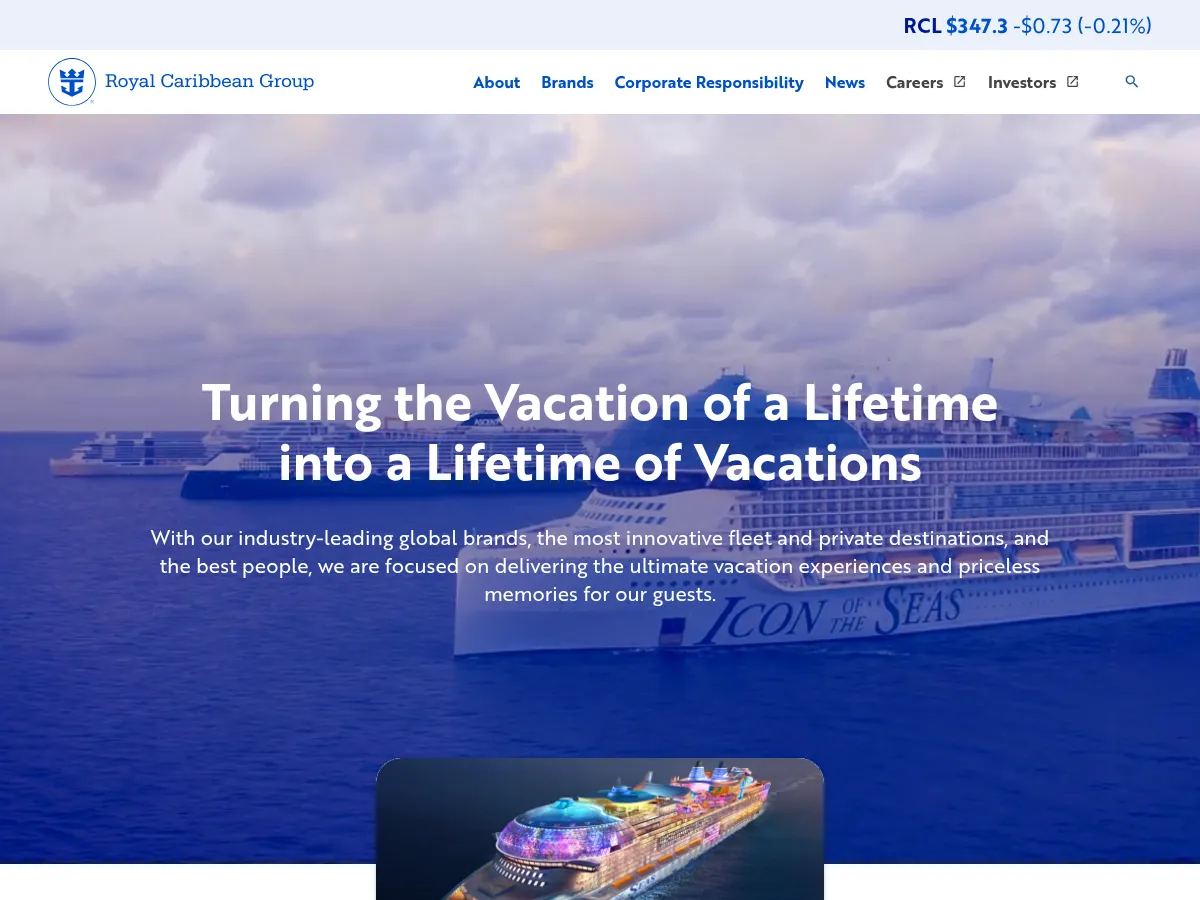
Royal Caribbean Group Screenshot

Added: Feb 10, 2026

royalcaribbeangroup.com

Latest from Otrai

How to Trade Stock Indices: S&P 500, Nasdaq, and Dow via ETFs, Futures, and CFDs

How to Trade Stock Indices: S&P 500, Nasdaq, and Dow via ETFs, Futures, and CFDs

A stock index is a single number that summarizes the price action of a basket of companies. The S&P 500 tracks roughly 500 large US firms, the Nasdaq-100 tracks the 100 largest non-financial names on the Nasdaq exchange, and the Dow Jones Industrial Average follows 30 blue-chip stocks.


The Options Greeks Explained: Delta, Gamma, Theta, and Vega

The Options Greeks Explained: Delta, Gamma, Theta, and Vega

The Greeks explain why an option costs what it costs and how that price changes when the stock moves, time passes, and volatility shifts. Delta, Gamma, Theta, and Vega, made accessible.

Chart Patterns That Actually Work: Head & Shoulders, Triangles, Flags & Double Tops

Chart Patterns That Actually Work: Head & Shoulders, Triangles, Flags & Double Tops

Chart patterns are the most recognizable part of technical analysis and the most misunderstood. Most fail or break out the wrong way before reversing. This guide covers head and shoulders, double tops and bottoms, triangles, and flags — with realistic reliability, target measurement, and false-breakout confirmation.

Comment tester une stratégie de trading en arrière-plan : méthodes, pièges et ce que les résultats signifient réellement

Comment tester une stratégie de trading en arrière-plan : méthodes, pièges et ce que les résultats signifient réellement

Chaque trader a une stratégie qui semble excellente dans sa tête. Le backtesting est la façon de découvrir si cela fonctionne réellement. Voici comment tester les stratégies correctement, quelles métriques comptent et pourquoi la plupart des résultats de backtesting sont trop beaux pour être vrais.