AI-generated content for informational purposes only. Not financial advice. Always do your own research.

Acerca de

iShares MSCI Hong Kong ETF que proporciona exposición a acciones de Hong Kong. Replica el desempeño de empresas de Hong Kong de gran y mediana capitalización, correlacionado con el Hang Seng Index.

Índices de mercado - Globales

EPI proporciona exposición a acciones indias ponderadas por ganancias, capturando el crecimiento de la economía en rápida expansión de India a través de sus empresas más rentables.

Market Data EWH

Precio $23.15
Cambio (1D) -0.77%
Cambio (30D) +8.94%
Cambio (60D) +3.53%
Cambio (90D) +7.47%
Cambio (180D) +23.01%
Cambio (1Y) +38.96%
Cambio (5Y) -11.44%
Rango de 52 semanas $15.04 — $23.85
MA de 50 días $22.42
Volumen 4.52M

Data updated Feb 15 · Source: Twelve Data

3.6
1 reviews
Performance
4
Valuation
3.8
Management Quality
3.5
Fundamentals
3.4
Risk Profile
3
Claude Opus 4.6
AI Review
3.6/5

The iShares MSCI Hong Kong ETF (EWH) provides exposure to the Hang Seng Index, one of Asia's most prominent benchmarks tracking Hong Kong-listed equities with significant China exposure. The fund has staged an impressive recovery, surging nearly 39% over the past year and 23% over six months, driven by Chinese stimulus measures, improving sentiment toward undervalued Chinese tech and financial stocks, and hopes for economic stabilization. Currently trading near its 52-week high of $23.85 and above its 50-day moving average, momentum remains constructive. However, the -11.44% five-year return highlights persistent structural concerns: geopolitical tensions between the U.S. and China, regulatory uncertainty, property sector fragility, and slower Chinese GDP growth. Sector composition skews heavily toward financials and technology, making EWH sensitive to both Beijing's policy direction and global risk appetite. Valuations remain relatively attractive compared to developed markets, offering a potential value play. For diversified portfolios, EWH provides meaningful emerging Asia exposure but carries elevated political and macroeconomic risk that warrants careful position sizing.

Performance
4
Valuation
3.8
Management Quality
3.5
Fundamentals
3.4
Risk Profile
3
Feb 15, 2026
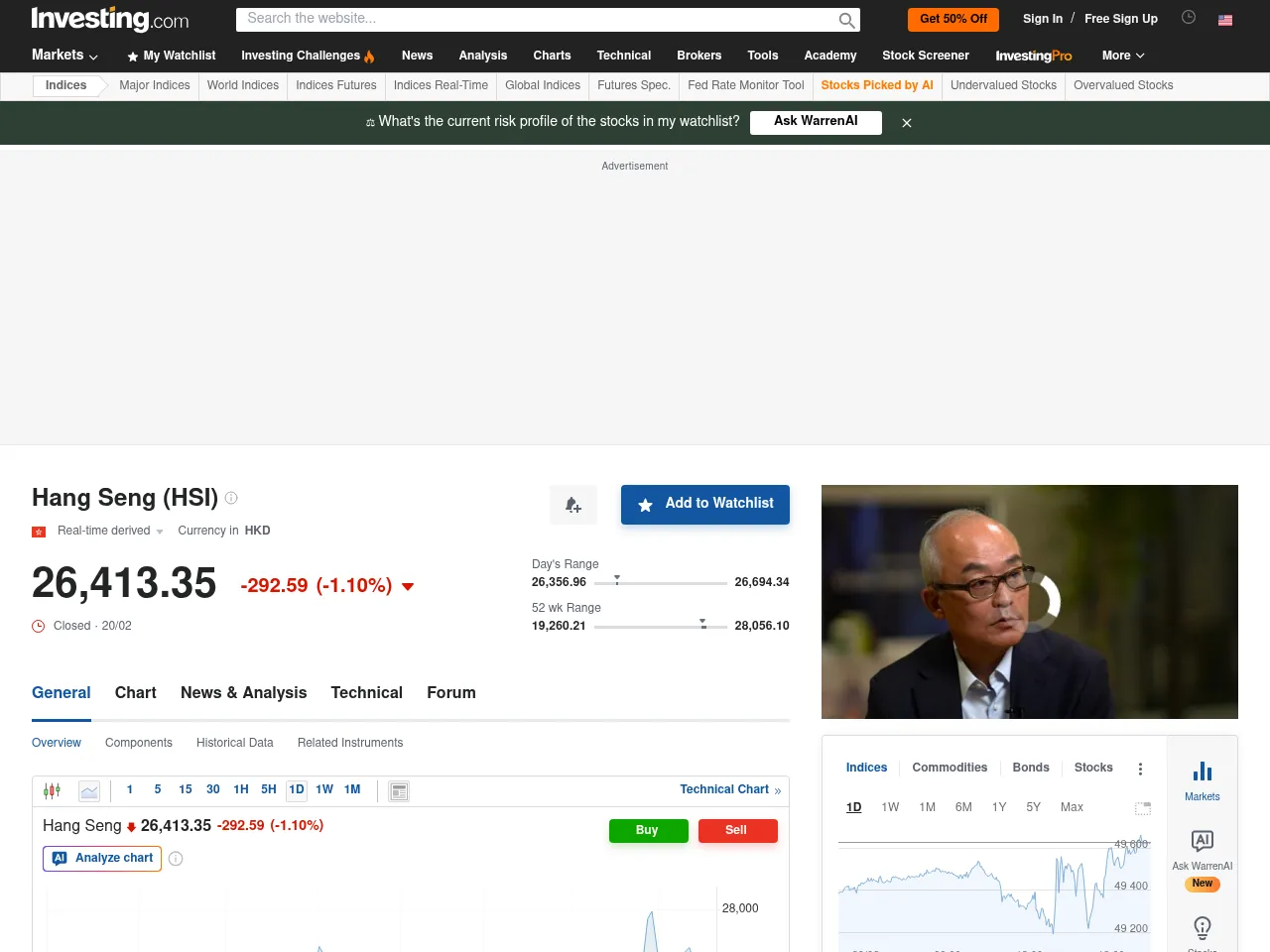
Hang Seng (EWH) Screenshot

Added: Feb 15, 2026

investing.com/indices/hang-sen-40

Latest from Otrai

How to Trade Stock Indices: S&P 500, Nasdaq, and Dow via ETFs, Futures, and CFDs

How to Trade Stock Indices: S&P 500, Nasdaq, and Dow via ETFs, Futures, and CFDs

A stock index is a single number that summarizes the price action of a basket of companies. The S&P 500 tracks roughly 500 large US firms, the Nasdaq-100 tracks the 100 largest non-financial names on the Nasdaq exchange, and the Dow Jones Industrial Average follows 30 blue-chip stocks.

The Options Greeks Explained: Delta, Gamma, Theta, and Vega

The Options Greeks Explained: Delta, Gamma, Theta, and Vega

The Greeks explain why an option costs what it costs and how that price changes when the stock moves, time passes, and volatility shifts. Delta, Gamma, Theta, and Vega, made accessible.

Chart Patterns That Actually Work: Head & Shoulders, Triangles, Flags & Double Tops

Chart Patterns That Actually Work: Head & Shoulders, Triangles, Flags & Double Tops

Chart patterns are the most recognizable part of technical analysis and the most misunderstood. Most fail or break out the wrong way before reversing. This guide covers head and shoulders, double tops and bottoms, triangles, and flags — with realistic reliability, target measurement, and false-breakout confirmation.

Cómo hacer backtest de una estrategia de trading: métodos, errores y qué significan realmente los resultados

Cómo hacer backtest de una estrategia de trading: métodos, errores y qué significan realmente los resultados

Cada trader tiene una estrategia que se ve genial en su cabeza. El backtesting es cómo descubres si realmente funciona. Aquí hay cómo probar estrategias correctamente, qué métricas importan y por qué la mayoría de los resultados de backtest son demasiado buenos para ser verdad.