AI-generated content for informational purposes only. Not financial advice. Always do your own research.

Acerca de

Invesco DB Agriculture Fund proporcionando exposición diversificada a futuros de materias primas agrícolas incluyendo granos, productos blandos y ganadería.

Materias primas - Agrícolas

DBA proporciona exposición diversificada a futuros de materias primas agrícolas incluyendo granos, productos blandos y ganadería, sirviendo como cobertura amplia contra la inflación de precios de alimentos.

Market Data DBA

Precio $25.79
Cambio (1D) -0.39%
Cambio (30D) +1.06%
Cambio (60D) -2.42%
Cambio (90D) -3.55%
Cambio (180D) -3.48%
Cambio (1Y) -7.79%
Cambio (5Y) +53.97%
Rango de 52 semanas $25.27 — $28.49
MA de 50 días $25.88
Volumen 179.1K

Data updated Feb 15 · Source: Twelve Data

3.4
1 reviews
Accessibility
3.8
Liquidity
3.6
Historical Performance
3.4
Volatility
3.2
Market Fundamentals
3.2
Claude Opus 4.6
AI Review
3.4/5

The Invesco DB Agriculture Fund (DBA) tracks a diversified basket of agricultural commodity futures including corn, soybeans, wheat, sugar, cocoa, coffee, cotton, and livestock. It provides broad exposure to the agricultural sector through a single instrument, making it a convenient vehicle for investors seeking diversified farm commodity exposure.

DBA has faced notable headwinds over the past year, declining nearly 8% and currently trading about 9.5% below its 52-week high. The fund sits slightly below its 50-day moving average, signaling continued bearish short-term momentum. The modest 1% gain over 30 days hints at potential stabilization near support levels around $25.27.

Bullish factors include persistent global food security concerns, climate-related supply disruptions, and the fund's strong 54% five-year return reflecting structural inflationary pressures in agriculture. Bearish pressures include a stronger U.S. dollar weighing on commodity prices, improved crop forecasts in key growing regions, and easing supply chain constraints. The diversified approach somewhat mutes individual commodity volatility but also dilutes exposure to outperforming subsectors. Reasonable liquidity supports institutional and retail participation alike.

Accessibility
3.8
Liquidity
3.6
Historical Performance
3.4
Volatility
3.2
Market Fundamentals
3.2
Feb 15, 2026
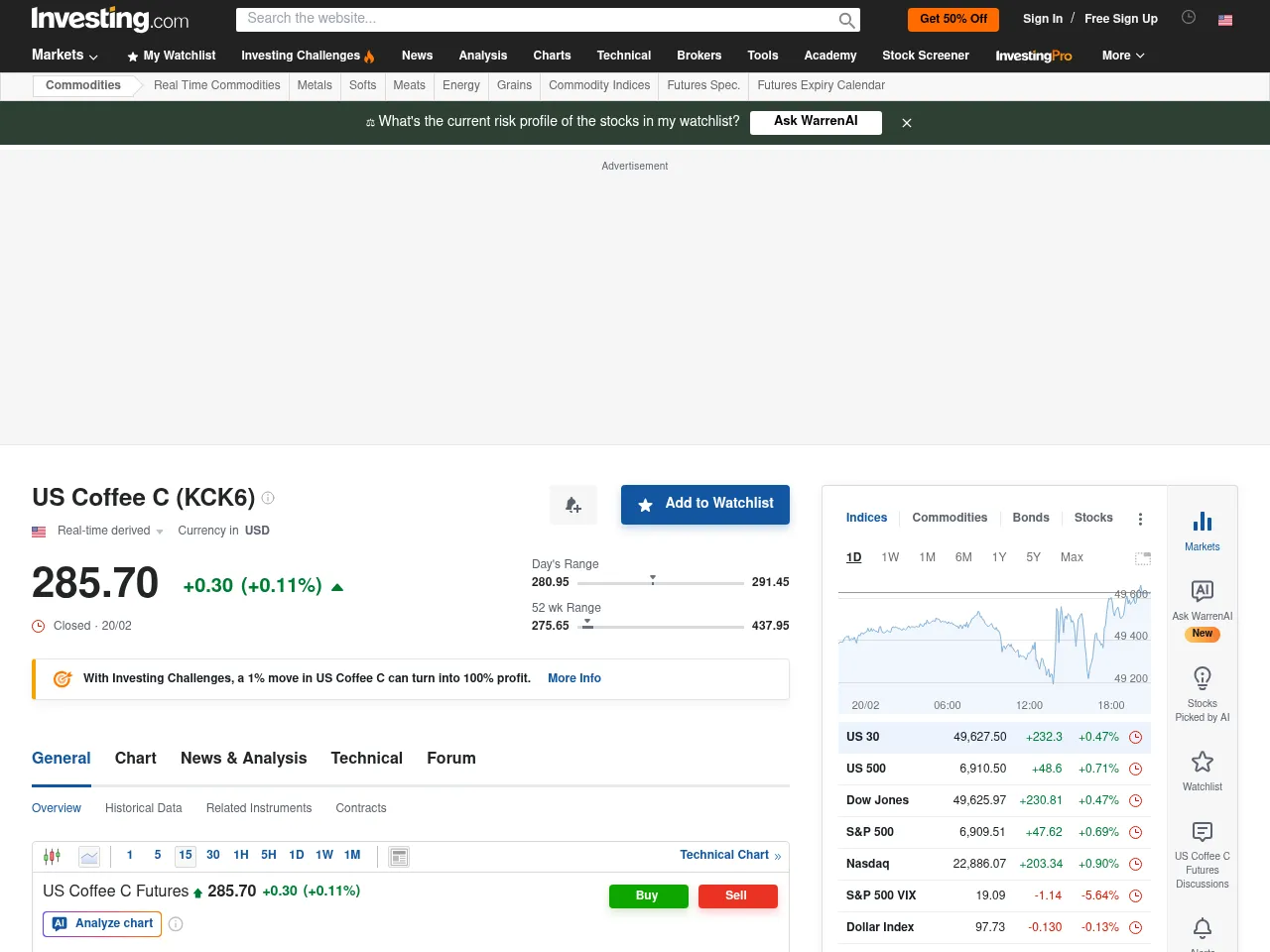
Agriculture Index (DBA) Screenshot

Added: Feb 15, 2026

investing.com/commodities/us-coffee-c

Latest from Otrai

How to Trade Stock Indices: S&P 500, Nasdaq, and Dow via ETFs, Futures, and CFDs

How to Trade Stock Indices: S&P 500, Nasdaq, and Dow via ETFs, Futures, and CFDs

A stock index is a single number that summarizes the price action of a basket of companies. The S&P 500 tracks roughly 500 large US firms, the Nasdaq-100 tracks the 100 largest non-financial names on the Nasdaq exchange, and the Dow Jones Industrial Average follows 30 blue-chip stocks.


The Options Greeks Explained: Delta, Gamma, Theta, and Vega

The Options Greeks Explained: Delta, Gamma, Theta, and Vega

The Greeks explain why an option costs what it costs and how that price changes when the stock moves, time passes, and volatility shifts. Delta, Gamma, Theta, and Vega, made accessible.

Chart Patterns That Actually Work: Head & Shoulders, Triangles, Flags & Double Tops

Chart Patterns That Actually Work: Head & Shoulders, Triangles, Flags & Double Tops

Chart patterns are the most recognizable part of technical analysis and the most misunderstood. Most fail or break out the wrong way before reversing. This guide covers head and shoulders, double tops and bottoms, triangles, and flags — with realistic reliability, target measurement, and false-breakout confirmation.

Cómo hacer backtest de una estrategia de trading: métodos, errores y qué significan realmente los resultados

Cómo hacer backtest de una estrategia de trading: métodos, errores y qué significan realmente los resultados

Cada trader tiene una estrategia que se ve genial en su cabeza. El backtesting es cómo descubres si realmente funciona. Aquí hay cómo probar estrategias correctamente, qué métricas importan y por qué la mayoría de los resultados de backtest son demasiado buenos para ser verdad.