AI-generated content for informational purposes only. Not financial advice. Always do your own research.

Über uns

Australischer Dollar vs US-Dollar, bekannt als "Aussie". Stark korreliert mit Rohstoffpreisen, besonders Eisenerz und Gold.

Forex - Hauptwährungspaare

AUD/USD, bekannt als der 'Aussie', ist stark mit Rohstoffpreisen korreliert, besonders mit Eisenerz und Gold, was es zu einem Schlüsselpaar für den Handel mit globalen Rohstoffnachfragzyklen macht.

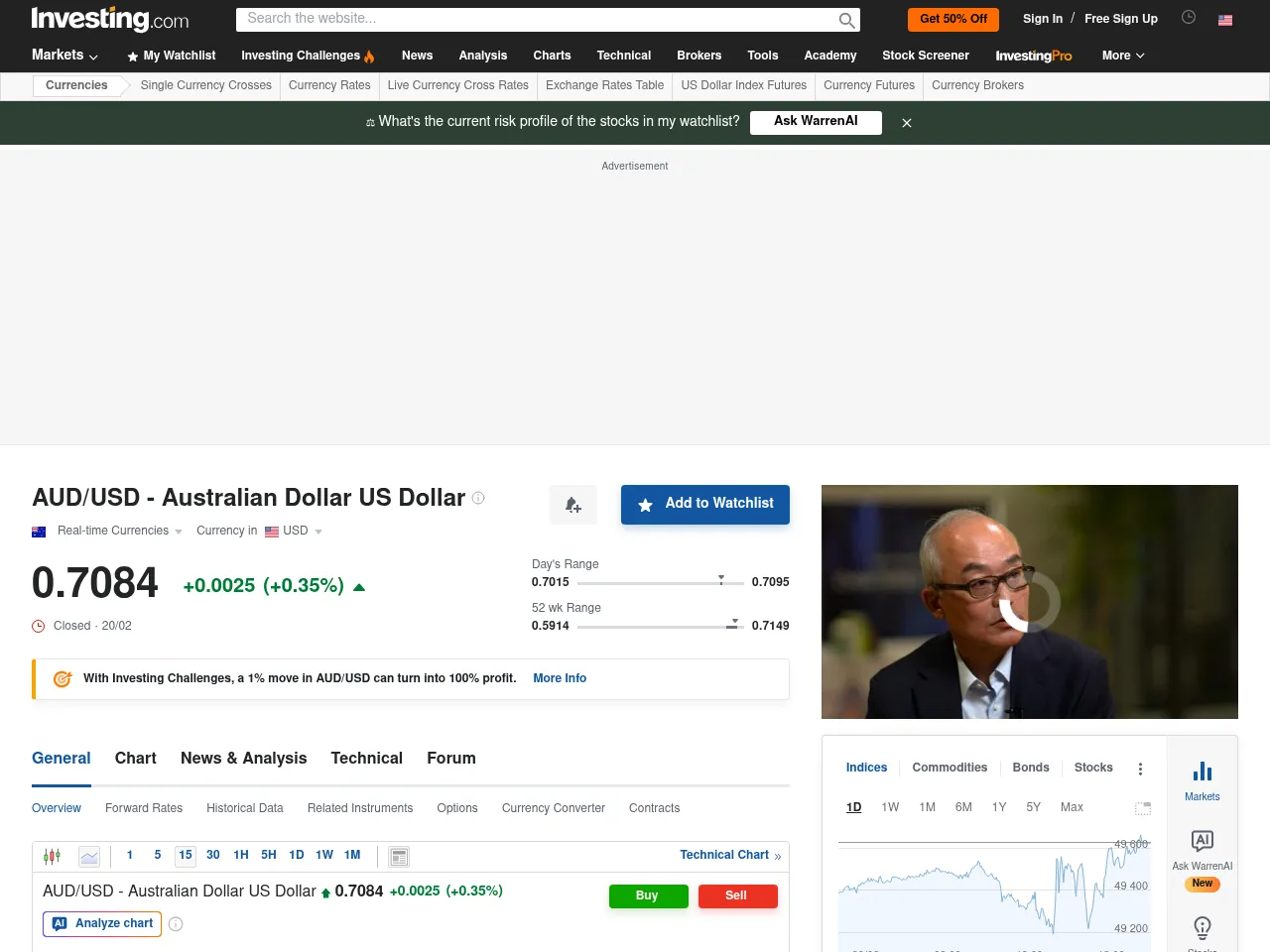
Market Data AUD/USD

Preis 0.7100
Veränderung (1T) +0.01%
Veränderung (30D) +5.83%
Veränderung (60D) +6.32%
Veränderung (90D) +8.87%
Veränderung (180D) +7.69%
Veränderung (1Y) +9.55%
Veränderung (5Y) -2.42%
52-Wochen-Spanne 0.5900 — 0.7100
50-Tage-Durchschnitt 0.6800

Data updated Feb 15 · Source: Twelve Data

4.2
1 reviews
Liquidity
4.8
Accessibility
4.5
Market Fundamentals
4.2
Volatility
3.8
Historical Performance
3.6
Claude Opus 4.6
AI Review
4.2/5

AUD/USD has staged an impressive rally, gaining nearly 9% over the past 90 days and currently trading at its 52-week high of 0.7100, well above the 50-day moving average of 0.6800. This momentum reflects improving risk sentiment, resilient Australian commodity exports, and expectations that the RBA may maintain a relatively hawkish stance compared to a potentially dovish pivot from the Federal Reserve. The interest rate differential narrative remains central, with markets pricing in Fed rate cuts that could narrow the yield gap in Australia's favor. Strong Chinese stimulus measures have also buoyed the Aussie given Australia's trade dependence on China. However, caution is warranted at current levels"trading at the 52-week high suggests potential resistance, and the 5-year return of -2.42% reminds traders of longer-term structural headwinds. A global risk-off event or disappointing Chinese economic data could trigger a pullback. Key support lies near the 50-day MA at 0.6800, while a sustained break above 0.7100 could target 0.7250. This pair offers strong liquidity and clear macro-driven trading opportunities.

Liquidity
4.8
Accessibility
4.5
Market Fundamentals
4.2
Volatility
3.8
Historical Performance
3.6
Feb 15, 2026
AUD/USD Screenshot

Added: Feb 15, 2026

investing.com/currencies/aud-usd

Latest from Otrai

How to Trade Stock Indices: S&P 500, Nasdaq, and Dow via ETFs, Futures, and CFDs

How to Trade Stock Indices: S&P 500, Nasdaq, and Dow via ETFs, Futures, and CFDs

A stock index is a single number that summarizes the price action of a basket of companies. The S&P 500 tracks roughly 500 large US firms, the Nasdaq-100 tracks the 100 largest non-financial names on the Nasdaq exchange, and the Dow Jones Industrial Average follows 30 blue-chip stocks.
The Options Greeks Explained: Delta, Gamma, Theta, and Vega

The Options Greeks Explained: Delta, Gamma, Theta, and Vega

The Greeks explain why an option costs what it costs and how that price changes when the stock moves, time passes, and volatility shifts. Delta, Gamma, Theta, and Vega, made accessible.

Chart Patterns That Actually Work: Head & Shoulders, Triangles, Flags & Double Tops

Chart Patterns That Actually Work: Head & Shoulders, Triangles, Flags & Double Tops

Chart patterns are the most recognizable part of technical analysis and the most misunderstood. Most fail or break out the wrong way before reversing. This guide covers head and shoulders, double tops and bottoms, triangles, and flags — with realistic reliability, target measurement, and false-breakout confirmation.

So backtesten Sie eine Handelsstrategie: Methoden, Fallstricke und was die Ergebnisse tatsächlich bedeuten

So backtesten Sie eine Handelsstrategie: Methoden, Fallstricke und was die Ergebnisse tatsächlich bedeuten

Jeder Trader hat eine Strategie, die in seinem Kopf großartig aussieht. Backtesting ist die Art herauszufinden, ob sie tatsächlich funktioniert. Hier erfahren Sie, wie Sie Strategien richtig testen, welche Kennzahlen wichtig sind und warum die meisten Backtest-Ergebnisse zu gut sind, um wahr zu sein.