AI-generated content for informational purposes only. Not financial advice. Always do your own research.

Über uns

Cloud-basierte Finanzautomatisierungsplattform für kleine und mittelständische Unternehmen, die sich mit Kreditorenbuchhaltung, Debitorenbuchhaltung und Ausgabenmanagement befasst.

Fintech-Aktien

Bill Holdings bietet Cloud-basierte Finanzautomatisierung für KMUs und verwaltet Accounts Payable, Receivable und Spend Management in einem wachsenden adressierbaren Markt der Back-Office-Digitalisierung.

SaaS-Aktien

Bill Holdings liefert Cloud-basierte Finanzautomatisierungs-SaaS für kleine und mittlere Unternehmen mit starken wiederkehrenden Einnahmen aus Accounts Payable, Receivable und Spend Management.

Key Financials BILL

Preis $46.99
Veränderung (1T) +1.34%
Veränderung (30D) -13.84%
Veränderung (60D) -5.32%
Veränderung (90D) -11.92%
Veränderung (180D) +5.64%
Veränderung (1Y) -23.07%
Veränderung (5Y) -72.96%
KGV 20.61
EPS (TTM) $2.28
52-Wochen-Spanne $35.46 — $61.21
50-Tage-Durchschnitt $50.45
Volumen 2.53M

Data updated Feb 15 · Source: Twelve Data

3.5
1 reviews
Market Position
4
Regulatory Compliance
3.5
Revenue Growth
3.5
Profit Margins
3.5
Innovation Pipeline
3
Claude Opus 4.6
AI Review
3.5/5

Bill Holdings operates a leading cloud-based financial operations platform serving SMBs, automating accounts payable, accounts receivable, and spend management. The company has built a strong competitive moat in back-office automation, a space with significant TAM and relatively low penetration.

The bull case centers on Bill's dominant position in SMB financial automation, improving profitability trajectory (P/E of 20.6x with $2.28 EPS suggests the company has turned meaningfully profitable), and cross-selling opportunities across its product suite including the Divvy spend management platform. Revenue growth remains solid with strong net revenue retention.

The bear case is concerning: the stock has declined 73% from its 5-year high, reflecting a dramatic re-rating from pandemic-era valuations. Recent momentum is negative with a 23% decline over the past year and the stock trading below its 50-day moving average. SMB exposure creates macro sensitivity, and competition from larger players like Intuit and emerging AI-driven solutions poses long-term threats. Customer acquisition costs remain elevated.

At current levels, the valuation has become more reasonable, but investors should wait for stabilization in price action and clearer signs of re-accelerating growth before building significant positions.

Market Position
4
Revenue Growth
3.5
Profit Margins
3.5
Regulatory Compliance
3.5
Innovation Pipeline
3
Feb 15, 2026
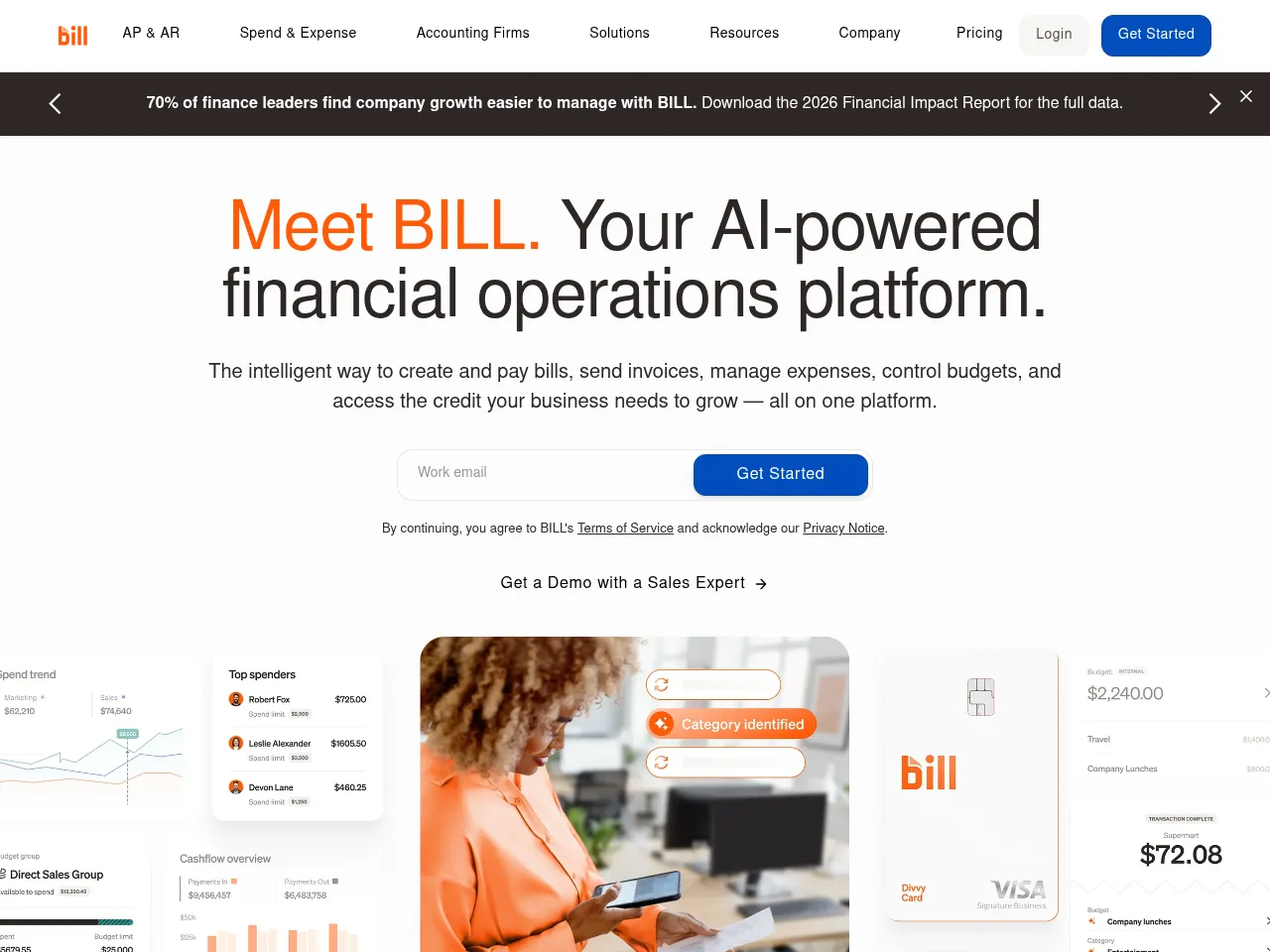
Bill Holdings Screenshot

Added: Feb 15, 2026

bill.com

Latest from Otrai

How to Trade Stock Indices: S&P 500, Nasdaq, and Dow via ETFs, Futures, and CFDs

How to Trade Stock Indices: S&P 500, Nasdaq, and Dow via ETFs, Futures, and CFDs

A stock index is a single number that summarizes the price action of a basket of companies. The S&P 500 tracks roughly 500 large US firms, the Nasdaq-100 tracks the 100 largest non-financial names on the Nasdaq exchange, and the Dow Jones Industrial Average follows 30 blue-chip stocks.
The Options Greeks Explained: Delta, Gamma, Theta, and Vega

The Options Greeks Explained: Delta, Gamma, Theta, and Vega

The Greeks explain why an option costs what it costs and how that price changes when the stock moves, time passes, and volatility shifts. Delta, Gamma, Theta, and Vega, made accessible.

Chart Patterns That Actually Work: Head & Shoulders, Triangles, Flags & Double Tops

Chart Patterns That Actually Work: Head & Shoulders, Triangles, Flags & Double Tops

Chart patterns are the most recognizable part of technical analysis and the most misunderstood. Most fail or break out the wrong way before reversing. This guide covers head and shoulders, double tops and bottoms, triangles, and flags — with realistic reliability, target measurement, and false-breakout confirmation.

So backtesten Sie eine Handelsstrategie: Methoden, Fallstricke und was die Ergebnisse tatsächlich bedeuten

So backtesten Sie eine Handelsstrategie: Methoden, Fallstricke und was die Ergebnisse tatsächlich bedeuten

Jeder Trader hat eine Strategie, die in seinem Kopf großartig aussieht. Backtesting ist die Art herauszufinden, ob sie tatsächlich funktioniert. Hier erfahren Sie, wie Sie Strategien richtig testen, welche Kennzahlen wichtig sind und warum die meisten Backtest-Ergebnisse zu gut sind, um wahr zu sein.