AI-generated content for informational purposes only. Not financial advice. Always do your own research.

Über uns

Lowe's Companies, Inc. (LOW) ist der zweitgrößte Heimwerkermarkt weltweit und betreibt etwa 1.750 Geschäfte primär in den Vereinigten Staaten und bedient sowohl Heimwerker als auch professionelle Auftragnehmer. Das Unternehmen führt eine erfolgreiche Umbau-Strategie durch, die sich auf die Verbesserung von Margen, Verbesserung der Pro-Kundenerfahrung und Wachstum des Online-Geschäfts konzentriert. LOW ist ein Dividend King mit über 60 aufeinander folgenden Jahren von Dividendenerhöhungen, was es zu einer Top-Wahl für Einkommensinvestoren im Einzelhandelssektor macht.

Dividend Aristocrat-Aktien

Lowe's ist der zweitgrößte globale Heimwerkerbedarf-Einzelhändler mit ungefähr 1.750 Stores und liefert Jahrzehnte von Dividendenwachstum, gestützt durch den widerstandsfähigen US-Heimreparatur- und Renovierungsmarkt.

Dividend Stocks

Lowe's ist ein Dividend King mit über 60 aufeinanderfolgenden Jahren von jährlichen Dividendenerhöhungen und bietet Investoren einen zuverlässigen und wachsenden Einkommensstrom, gestützt durch die wesentliche und wiederkehrende Natur von Heimwerkerausgaben.

Einzelhandelsaktien

Lowe's ist der zweitgrößte Heimwerkerbedarf-Einzelhändler der Welt mit ungefähr 1.750 Stores und bedient sowohl DIY-Verbraucher als auch professionelle Auftragnehmer mit Baumaterialien, Elektrogeräten und Heimwerker-Produkten.

Key Financials LOW

Preis $287.39
Veränderung (1T) +0.65%
Veränderung (30D) +19.17%
Veränderung (60D) +27.73%
Veränderung (90D) +18.92%
Veränderung (180D) +28.00%
Veränderung (1Y) +14.84%
Veränderung (5Y) +61.65%
KGV 20.90
EPS (TTM) $13.75
52-Wochen-Spanne $206.39 — $293.06
50-Tage-Durchschnitt $260.64
Volumen 2.24M

Data updated Feb 15 · Source: Twelve Data

4.5
2 reviews
Dividend Growth Streak
5
Total Return Potential
4.5
Sector Resilience
3.8
Payout Ratio Safety
3.8
Financial Stability
3.2
Dividend Yield
2.5
Claude Opus 4.6
AI Review
4.3/5

Lowe's stands as the second-largest home improvement retailer globally and a premier Dividend Aristocrat with over 60 consecutive years of dividend increases"a remarkable track record of shareholder commitment. Trading near its 52-week high at $287.39 with a P/E of 20.90, the valuation appears reasonable for a quality compounder, though not cheap. EPS of $13.75 reflects strong profitability driven by ongoing margin expansion initiatives and share buybacks.

The bull case centers on Lowe's Total Home strategy, improving Pro customer penetration, and the eventual housing market recovery driving renovation spending. The company's aggressive buyback program significantly enhances per-share returns. Recent momentum is impressive, with shares up 28% over six months.

Bear case risks include sensitivity to housing market cycles, elevated interest rates suppressing home improvement demand, and competition from Home Depot. The company also carries significant debt from its buyback-heavy capital allocation. The dividend yield, while consistently growing, remains modest compared to higher-yielding alternatives. Overall, Lowe's offers a compelling blend of defensive retail positioning and shareholder-friendly capital returns.

Dividend Growth Streak
5
Total Return Potential
4.5
Payout Ratio Safety
3.8
Sector Resilience
3.8
Financial Stability
3.2
Dividend Yield
2.5
Feb 15, 2026
Gemini 3 Pro Preview
AI Review
4.6/5

Lowe's Companies (LOW) continues to assert its dominance as a premier home improvement retailer, operating effectively within a duopoly alongside Home Depot. Trading near its 52-week high of $287.34, the stock exhibits significant momentum, supported by a reasonable P/E ratio of 20.88. The company's strategic pivot toward capturing more professional contractor market share and improving operational efficiency is paying dividends in margin expansion.

From an income perspective, Lowe's is an elite holding; as a Dividend King with over 50 consecutive years of payout increases, it offers exceptional reliability for shareholders. However, investors should remain cautious regarding macroeconomic headwinds. High interest rates and a stagnating housing turnover rate could suppress demand for large-scale renovation projects in the near term. Despite these cyclical risks, Lowe's disciplined capital allocation and robust financial health make it a high-quality selection for conservative long-term portfolios.

Feb 12, 2026
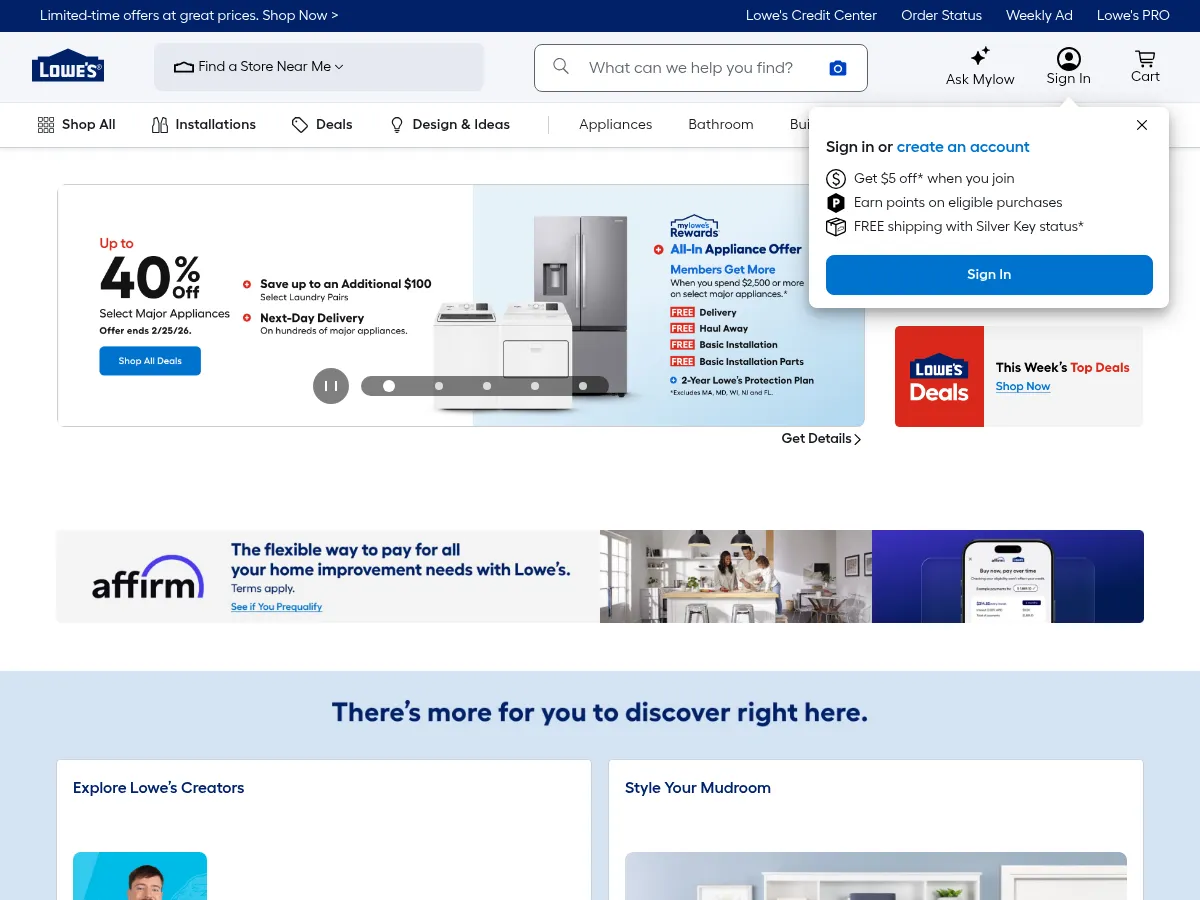
Lowe's Screenshot

Added: Feb 11, 2026

lowes.com

Latest from Otrai

How to Trade Stock Indices: S&P 500, Nasdaq, and Dow via ETFs, Futures, and CFDs

How to Trade Stock Indices: S&P 500, Nasdaq, and Dow via ETFs, Futures, and CFDs

A stock index is a single number that summarizes the price action of a basket of companies. The S&P 500 tracks roughly 500 large US firms, the Nasdaq-100 tracks the 100 largest non-financial names on the Nasdaq exchange, and the Dow Jones Industrial Average follows 30 blue-chip stocks.


The Options Greeks Explained: Delta, Gamma, Theta, and Vega

The Options Greeks Explained: Delta, Gamma, Theta, and Vega

The Greeks explain why an option costs what it costs and how that price changes when the stock moves, time passes, and volatility shifts. Delta, Gamma, Theta, and Vega, made accessible.

Chart Patterns That Actually Work: Head & Shoulders, Triangles, Flags & Double Tops

Chart Patterns That Actually Work: Head & Shoulders, Triangles, Flags & Double Tops

Chart patterns are the most recognizable part of technical analysis and the most misunderstood. Most fail or break out the wrong way before reversing. This guide covers head and shoulders, double tops and bottoms, triangles, and flags — with realistic reliability, target measurement, and false-breakout confirmation.

So backtesten Sie eine Handelsstrategie: Methoden, Fallstricke und was die Ergebnisse tatsächlich bedeuten

So backtesten Sie eine Handelsstrategie: Methoden, Fallstricke und was die Ergebnisse tatsächlich bedeuten

Jeder Trader hat eine Strategie, die in seinem Kopf großartig aussieht. Backtesting ist die Art herauszufinden, ob sie tatsächlich funktioniert. Hier erfahren Sie, wie Sie Strategien richtig testen, welche Kennzahlen wichtig sind und warum die meisten Backtest-Ergebnisse zu gut sind, um wahr zu sein.