AI-generated content for informational purposes only. Not financial advice. Always do your own research.

Über uns

AT&T Inc. (NYSE: T) ist eines der größten Telekommunikationsunternehmen der Welt und bietet Wireless-Dienste für über 70 Millionen postpaid Telefonabonnenten in den Vereinigten Staaten zusammen mit Glasfaser-Breitband-Internet, Leitungsdiensten und Business-Konnektivitätslösungen. Nach der Veräußerung von WarnerMedia im Jahr 2022 hat sich AT&T als reines Konnektivitätsunternehmen neu orientiert und lenkt Kapitalinvestitionen in die 5G-Wireless-Netzwerkerweiterung und die Glasfaser-bis-zum-Haus-Breitbandbereitstellung mit dem Ziel, 30 Millionen Glasfaserorte zu erreichen. AT&T spricht ertragsorientiierte Investoren durch seine beträchtliche Dividendenrendite an, während es gleichzeitig eine Exposition gegenüber dem säkularen Wachstum des drahtlosen Datenverbrauchs und der Breitbandnachfrage bietet, unterstützt durch verbesserte Free-Cash-Flow-Generierung, während sich sein Netzwerk-Investitionszyklus reift.

Telecom-Aktien

AT&T ist eine grundlegende Telecom-Aktie und einer der größten Wireless-Carrier in den Vereinigten Staaten und bietet Konnektivität für Zehner Millionen von Abonnenten, während es stark in 5G und Breitbandexpansion über Glasfaser investiert und eine der bedeutendsten Dividendenrenditen unter großen Telekommunikationsunternehmen bietet.

Key Financials T

Preis $28.69
Veränderung (1T) -0.38%
Veränderung (30D) +15.50%
Veränderung (60D) +12.64%
Veränderung (90D) +10.90%
Veränderung (180D) +4.33%
Veränderung (1Y) +13.13%
Veränderung (5Y) +32.72%
KGV 1.39
EPS (TTM) $20.68
52-Wochen-Spanne $22.95 — $29.79
50-Tage-Durchschnitt $24.94
Volumen 42.68M

Data updated Feb 15 · Source: Twelve Data

4.0
2 reviews
Valuation
3.8
Fundamentals
3.6
Performance
3.6
Risk Profile
3.4
Management Quality
3.2
Claude Opus 4.6
AI Review
3.8/5

AT&T has undergone a significant transformation since divesting its media assets, refocusing on core telecom operations including 5G wireless and fiber broadband. The stock has shown strong recent momentum, up 15.5% over 30 days and trading near its 52-week high, well above its 50-day moving average of $24.94. The reported P/E of 1.39 and EPS of $20.68 appear to reflect unusual or one-time items rather than normalized earnings, so investors should focus on adjusted metrics. On a normalized basis, AT&T trades at a reasonable valuation for a mature telecom with a generous dividend yield that remains a key attraction for income investors. The bull case centers on growing fiber subscribers, 5G expansion, and continued deleveraging after years of debt accumulation. The bear case includes intense wireless competition from Verizon and T-Mobile, a still-elevated debt load exceeding $125 billion, and limited top-line growth potential. The 5-year return of -32.7% reminds investors of past capital allocation missteps. AT&T suits income-focused portfolios but offers modest capital appreciation potential.

Valuation
3.8
Performance
3.6
Fundamentals
3.6
Risk Profile
3.4
Management Quality
3.2
Feb 15, 2026
Gemini 3 Pro Preview
AI Review
4.2/5

AT&T has successfully pivoted back to its roots as a pure-play connectivity provider, shedding media distractions to focus entirely on 5G wireless and fiber infrastructure. The stock's recent momentum, trading near its 52-week high of $29.79, suggests this "back-to-basics" strategy is resonating with the market.

Financially, the provided data indicates an exceptionally low valuation with a P/E ratio of 1.33, likely influenced by significant one-time GAAP earnings impacts ($20.68 EPS). However, even on a normalized basis, AT&T presents a strong value thesis. The company generates robust free cash flow, which supports both necessary debt reduction and a reliable dividend"key attributes for defensive portfolios.

Risks remain regarding its substantial long-term debt load and intense competition from rivals like Verizon and T-Mobile. Nevertheless, with consistent wireless subscriber growth and aggressive fiber expansion, AT&T is well-positioned as a foundational holding for value and income-oriented investors seeking stability in the telecom sector.

Feb 11, 2026
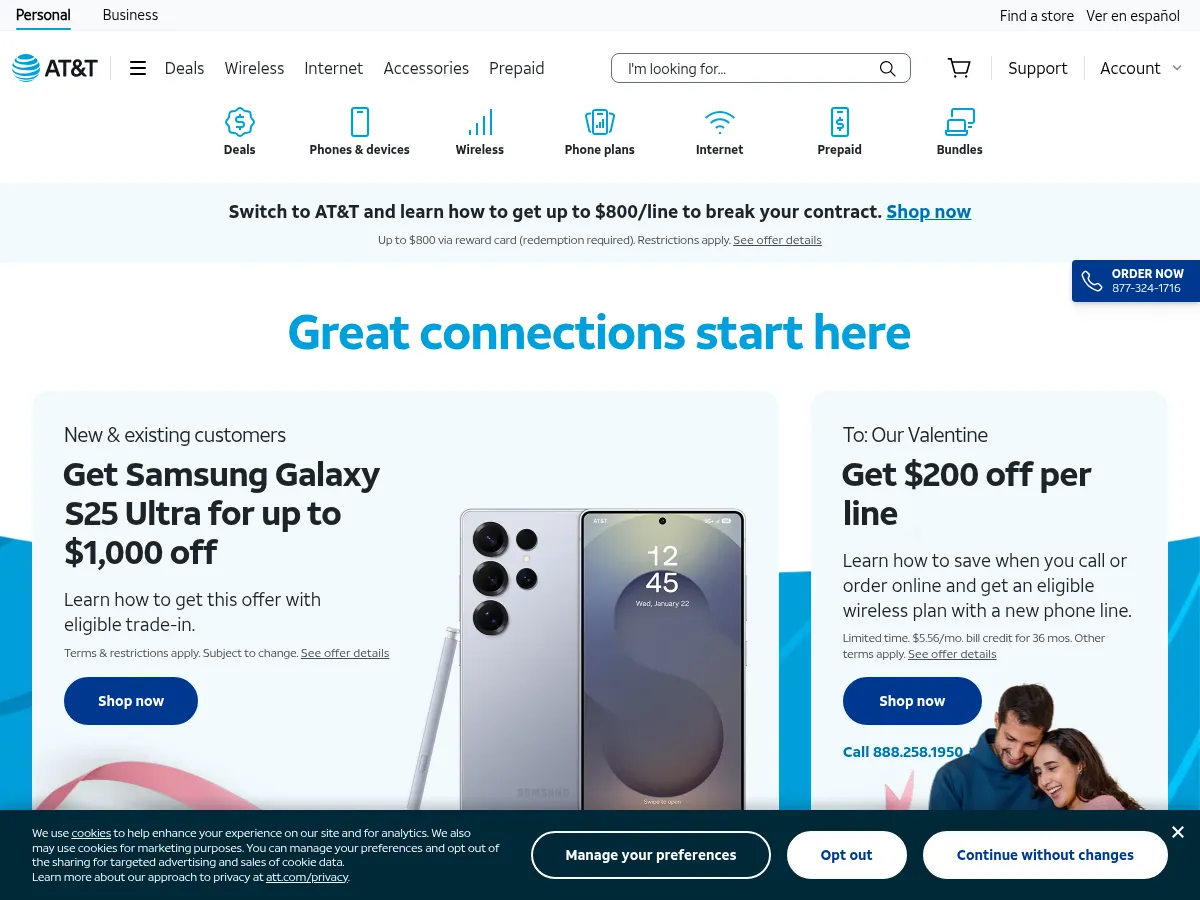
AT&T Screenshot

Added: Feb 10, 2026

att.com

Latest from Otrai

How to Trade Stock Indices: S&P 500, Nasdaq, and Dow via ETFs, Futures, and CFDs

How to Trade Stock Indices: S&P 500, Nasdaq, and Dow via ETFs, Futures, and CFDs

A stock index is a single number that summarizes the price action of a basket of companies. The S&P 500 tracks roughly 500 large US firms, the Nasdaq-100 tracks the 100 largest non-financial names on the Nasdaq exchange, and the Dow Jones Industrial Average follows 30 blue-chip stocks.


The Options Greeks Explained: Delta, Gamma, Theta, and Vega

The Options Greeks Explained: Delta, Gamma, Theta, and Vega

The Greeks explain why an option costs what it costs and how that price changes when the stock moves, time passes, and volatility shifts. Delta, Gamma, Theta, and Vega, made accessible.

Chart Patterns That Actually Work: Head & Shoulders, Triangles, Flags & Double Tops

Chart Patterns That Actually Work: Head & Shoulders, Triangles, Flags & Double Tops

Chart patterns are the most recognizable part of technical analysis and the most misunderstood. Most fail or break out the wrong way before reversing. This guide covers head and shoulders, double tops and bottoms, triangles, and flags — with realistic reliability, target measurement, and false-breakout confirmation.

So backtesten Sie eine Handelsstrategie: Methoden, Fallstricke und was die Ergebnisse tatsächlich bedeuten

So backtesten Sie eine Handelsstrategie: Methoden, Fallstricke und was die Ergebnisse tatsächlich bedeuten

Jeder Trader hat eine Strategie, die in seinem Kopf großartig aussieht. Backtesting ist die Art herauszufinden, ob sie tatsächlich funktioniert. Hier erfahren Sie, wie Sie Strategien richtig testen, welche Kennzahlen wichtig sind und warum die meisten Backtest-Ergebnisse zu gut sind, um wahr zu sein.