AI-generated content for informational purposes only. Not financial advice. Always do your own research.

Über uns

The Walt Disney Company (NYSE: DIS) ist ein diversifiziertes globales Unterhaltungskonglomerat, das Themenparks und Resorts, Film- und Fernsehstudios, lineare Fernsehnetze einschließlich ESPN und ABC sowie die Streaming-Plattformen Disney+, Hulu und ESPN+ betreibt. Das Streaming-Segment von Disney ist schnell gewachsen und ist zu einer großen Kraft im Direct-to-Consumer-Markt geworden, wobei das Unternehmen sein unvergleichliches Portfolio von Franchises einschließlich Marvel, Star Wars, Pixar und Disney Animation nutzt. Disney ist eine bedeutende Streaming-Aktie für Investoren, die auch von einer Exposition gegenüber den Themenparks, Studio-Unterhaltungs- und Sportmedien-Vermögenswerten des Unternehmens neben seiner Streaming-Wachstumsgeschichte profitieren.

Medien- und Unterhaltungsaktien

Walt Disney ist ein globales Unterhaltungskonglomerat, das Themenparks, Studios (Marvel, Pixar, Star Wars, Disney), ESPN und den Streaming-Dienst Disney+ in allen Unterhaltungskategorien betreibt.

Streaming-Aktien

Walt Disney Company ist ein großes Streaming-Unternehmen durch seine Plattformen Disney+, Hulu und ESPN+, die eine unvergleichliche Bibliothek ikonischer Franchises und Inhalte nutzen. Seine Kombination aus Streaming-Umfang, geliebten Immaterialgütern und Integration mit Themenparks und Studiobetrieben bietet eine differenzierte Streaming-Anlage mit mehreren Umsatztreibern.

Key Financials DIS

Preis $105.45
Veränderung (1T) +3.00%
Veränderung (30D) -7.31%
Veränderung (60D) -0.23%
Veränderung (90D) -6.47%
Veränderung (180D) -5.44%
Veränderung (1Y) -3.46%
Veränderung (5Y) -43.97%
KGV 24.58
EPS (TTM) $4.29
52-Wochen-Spanne $80.10 — $124.69
50-Tage-Durchschnitt $110.57
Volumen 12.84M

Data updated Feb 15 · Source: Twelve Data

4.0
2 reviews
Claude Opus 4.6
AI Review
3.7/5

Walt Disney Company remains one of the most iconic media conglomerates globally, with unmatched intellectual property across film, television, theme parks, and streaming. The stock trades at a P/E of 24.58 with EPS of $4.29, reflecting improved profitability after years of heavy streaming investment. Disney+ has reached profitability milestones, a critical inflection point for the bull case.

However, the stock's performance is concerning " down nearly 44% over five years and currently trading well below its 52-week high of $124.69. The 30-day decline of 7.3% suggests ongoing investor skepticism. Linear TV (ESPN, ABC) faces secular decline, and theme park growth may moderate amid consumer spending pressures.

The bull case centers on streaming profitability scaling, ESPN's direct-to-consumer transition, and parks' pricing power. The bear case highlights competition from Netflix and others, cord-cutting headwinds, and execution risk across multiple strategic pivots. At current levels, Disney offers reasonable value for patient investors, but near-term catalysts remain uncertain.

Feb 15, 2026
Gemini 3 Pro Preview
AI Review
4.2/5

The Walt Disney Company remains a diversified titan in the entertainment sector, currently balancing its lucrative Experiences division with a maturing Direct-to-Consumer (DTC) strategy. With the stock trading near $110 and a P/E ratio of 25.63, the valuation reflects a market cautiously optimistic about management's pivot from subscriber growth to streaming profitability. The diverse ecosystem of Disney+, Hulu, and ESPN+ provides a competitive moat that few rivals can match, supported by an unrivaled library of intellectual property.

However, significant headwinds remain. The decline of linear television continues to pressure revenue, and the capital-intensive transition of ESPN to a fully digital future poses execution risks. While the Parks division generates reliable cash flow to fund these transitions, consumer spending sensitivity could impact margins. For investors, Disney represents a blue-chip recovery play, offering a compelling mix of value and growth potential if it can successfully navigate the structural changes in media consumption.

Feb 11, 2026
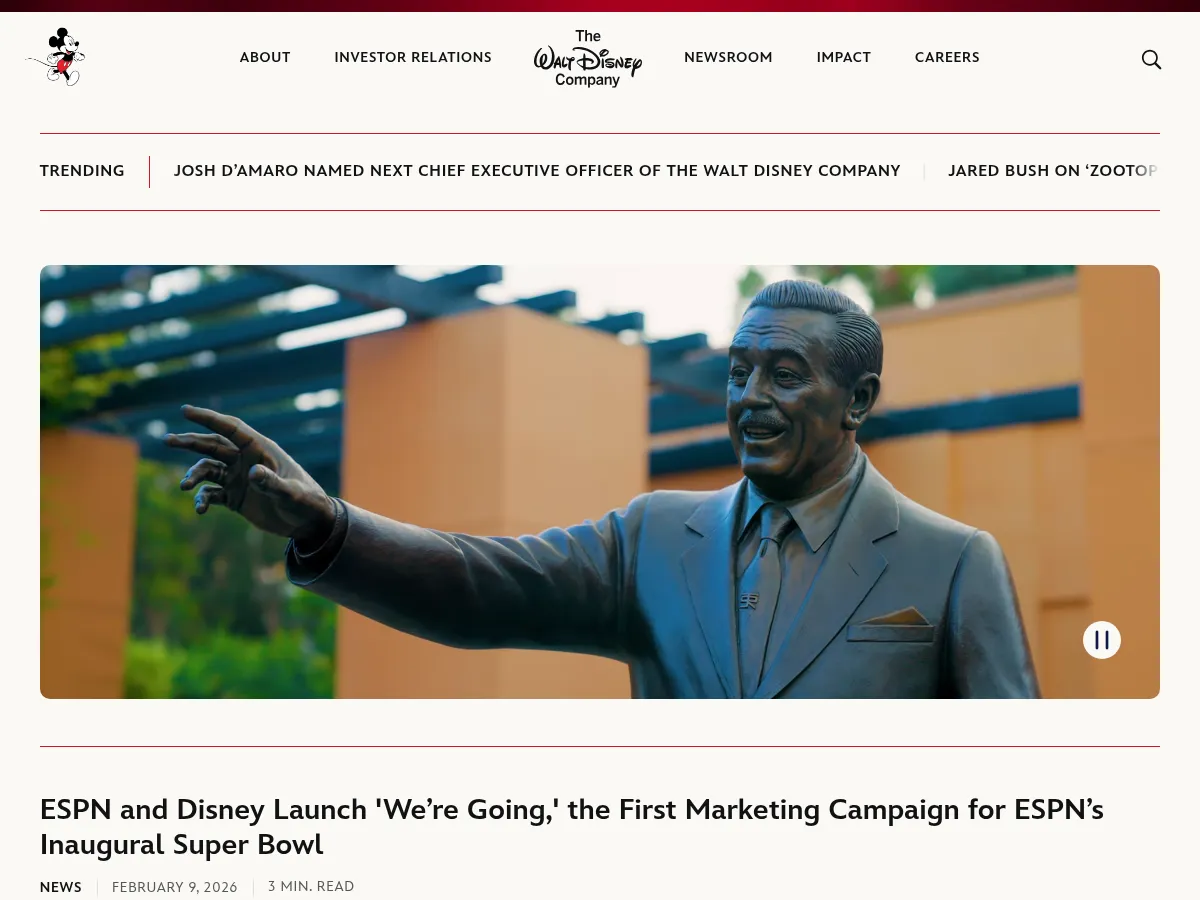
Walt Disney Company Screenshot

Added: Feb 10, 2026

thewaltdisneycompany.com

Latest from Otrai

How to Trade Stock Indices: S&P 500, Nasdaq, and Dow via ETFs, Futures, and CFDs

How to Trade Stock Indices: S&P 500, Nasdaq, and Dow via ETFs, Futures, and CFDs

A stock index is a single number that summarizes the price action of a basket of companies. The S&P 500 tracks roughly 500 large US firms, the Nasdaq-100 tracks the 100 largest non-financial names on the Nasdaq exchange, and the Dow Jones Industrial Average follows 30 blue-chip stocks.


The Options Greeks Explained: Delta, Gamma, Theta, and Vega

The Options Greeks Explained: Delta, Gamma, Theta, and Vega

The Greeks explain why an option costs what it costs and how that price changes when the stock moves, time passes, and volatility shifts. Delta, Gamma, Theta, and Vega, made accessible.

Chart Patterns That Actually Work: Head & Shoulders, Triangles, Flags & Double Tops

Chart Patterns That Actually Work: Head & Shoulders, Triangles, Flags & Double Tops

Chart patterns are the most recognizable part of technical analysis and the most misunderstood. Most fail or break out the wrong way before reversing. This guide covers head and shoulders, double tops and bottoms, triangles, and flags — with realistic reliability, target measurement, and false-breakout confirmation.

So backtesten Sie eine Handelsstrategie: Methoden, Fallstricke und was die Ergebnisse tatsächlich bedeuten

So backtesten Sie eine Handelsstrategie: Methoden, Fallstricke und was die Ergebnisse tatsächlich bedeuten

Jeder Trader hat eine Strategie, die in seinem Kopf großartig aussieht. Backtesting ist die Art herauszufinden, ob sie tatsächlich funktioniert. Hier erfahren Sie, wie Sie Strategien richtig testen, welche Kennzahlen wichtig sind und warum die meisten Backtest-Ergebnisse zu gut sind, um wahr zu sein.