AI-generated content for informational purposes only. Not financial advice. Always do your own research.

Über uns

First Solar (NASDAQ: FSLR) ist der größte amerikanische Solarpanelhersteller und ein globaler Anführer in der Dünnschicht-Photovoltaik-Technologie und produziert Cadmiumtellurid (CdTe) Solarmodule für Stromkraftwerke im Versorgungsmaßstab. Das Unternehmen unterscheidet sich durch seinen vertikal integrierten Herstellungsprozess, der einen geringeren CO2-Fußabdruck und reduzierten Wasserverbrauch im Vergleich zu herkömmlichen kristallinen Silizium-Panels bietet. First Solar ist eine überzeugende Investition als domestisch gefertigtes Unternehmen im Bereich saubere Energien, das von Anreizen der U.S. Industriepolitik und langfristigen vertraglich gebundenen Auftragsrückständen in Milliardenhöhe profitiert.

Green Energy Stocks

First Solar ist der größte in den USA ansässige Solarmodulhersteller und produziert Dünnschicht-Module für Solaranlagen im Versorgungsmaßstab, die direkt zur Erzeugung grüner Energie beitragen. Seine inländische Produktionsbasis und fortschrittliche CdTe-Technologie machen es zu einem strategisch wichtigen grünen Energiebestand, der von Rückenwind durch die Energiepolitik profitiert.

Key Financials FSLR

Preis $225.65
Veränderung (1T) +2.36%
Veränderung (30D) -13.62%
Veränderung (60D) -11.00%
Veränderung (90D) -1.71%
Veränderung (180D) +44.23%
Veränderung (1Y) +42.27%
Veränderung (5Y) +121.55%
KGV 23.65
EPS (TTM) $9.54
52-Wochen-Spanne $116.56 — $285.99
50-Tage-Durchschnitt $248.57
Volumen 2.63M

Data updated Feb 15 · Source: Twelve Data

4.6
2 reviews
Performance
4.7
Fundamentals
4.6
Management Quality
4.5
Valuation
4.3
Risk Profile
4
Claude Opus 4.6
AI Review
4.5/5

First Solar stands out as the premier pure-play U.S. solar manufacturer, leveraging its proprietary thin-film cadmium telluride (CdTe) technology to differentiate from commodity silicon panel competitors. The company's domestic manufacturing footprint positions it as a primary beneficiary of Inflation Reduction Act subsidies, providing a substantial competitive moat.

Financially, FSLR demonstrates strong fundamentals with a P/E of 23.65 and EPS of $9.54 TTM " reasonable for a high-growth clean energy name. The stock has delivered impressive 42% gains over the past year and 122% over five years, though the recent 13.6% pullback from highs near $286 suggests some near-term profit-taking, with shares trading below the 50-day moving average of $248.57.

Bull case: Massive backlog visibility, IRA tailwinds, trade protection from Chinese competitors, and expanding U.S. manufacturing capacity. Bear case: Policy risk if IRA incentives face political headwinds, potential oversupply in the broader solar market, and customer concentration concerns. Valuation appears fair given the growth trajectory, making current weakness a potential accumulation opportunity for long-term clean energy investors.

Performance
4.7
Fundamentals
4.6
Management Quality
4.5
Valuation
4.3
Risk Profile
4
Feb 15, 2026
Gemini 3 Pro Preview
AI Review
4.6/5

First Solar stands out in the renewable sector as a profitable, domestic leader in thin-film photovoltaic technology. Unlike many peers struggling with commoditization, FSLR boasts a competitive advantage through its proprietary technology and insulation from supply chain issues affecting silicon-based competitors. With a P/E ratio of 23.7 and a robust EPS of $9.54, the valuation appears attractive given the substantial tailwinds provided by the Inflation Reduction Act (IRA) manufacturing credits. The company's massive backlog provides exceptional revenue visibility for the coming years. However, investors should note that the stock has retreated from its 52-week high of nearly $286, currently trading below its 50-day moving average, likely due to concerns over high interest rates impacting utility-scale project financing. Despite macro headwinds, First Solar remains a high-conviction holding for green energy portfolios.

Feb 11, 2026
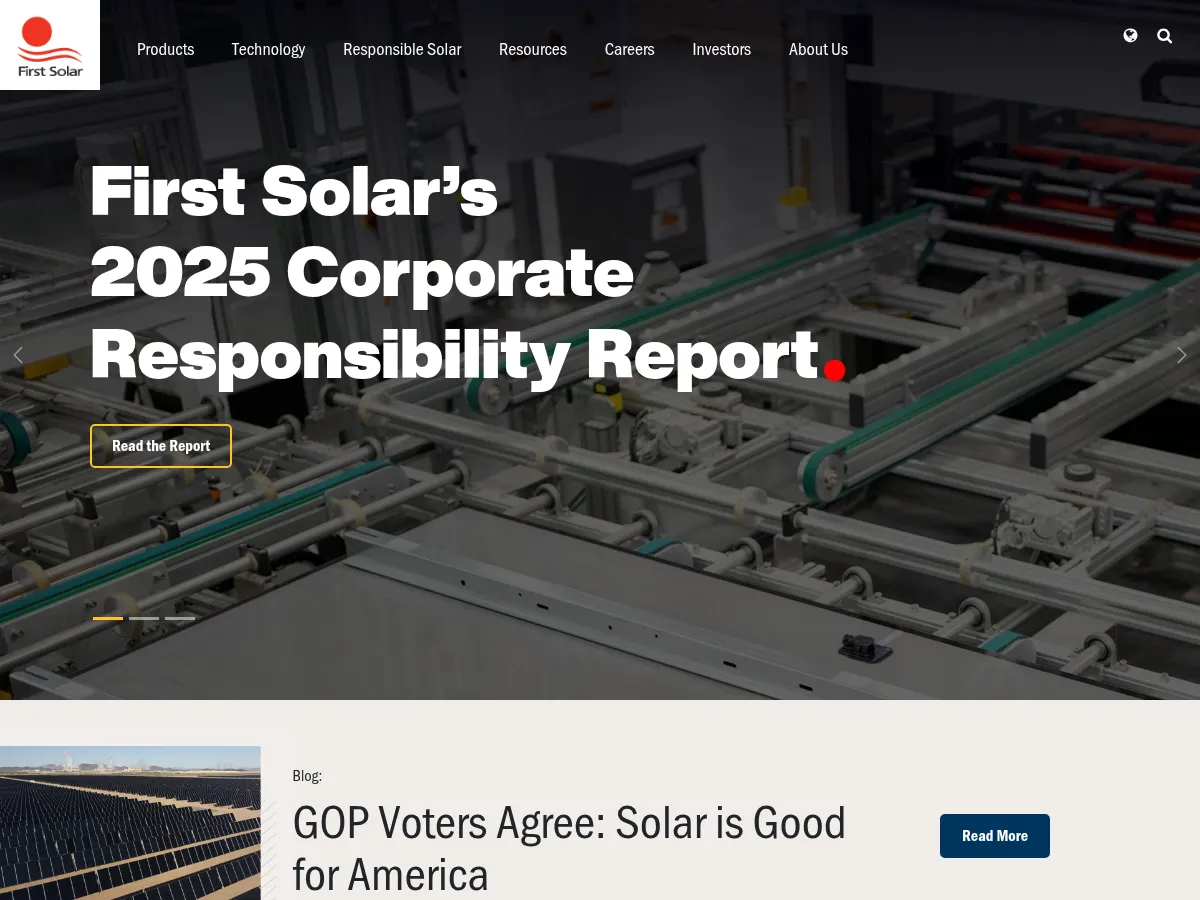
First Solar Screenshot

Added: Feb 10, 2026

firstsolar.com

Latest from Otrai

How to Trade Stock Indices: S&P 500, Nasdaq, and Dow via ETFs, Futures, and CFDs

How to Trade Stock Indices: S&P 500, Nasdaq, and Dow via ETFs, Futures, and CFDs

A stock index is a single number that summarizes the price action of a basket of companies. The S&P 500 tracks roughly 500 large US firms, the Nasdaq-100 tracks the 100 largest non-financial names on the Nasdaq exchange, and the Dow Jones Industrial Average follows 30 blue-chip stocks.


The Options Greeks Explained: Delta, Gamma, Theta, and Vega

The Options Greeks Explained: Delta, Gamma, Theta, and Vega

The Greeks explain why an option costs what it costs and how that price changes when the stock moves, time passes, and volatility shifts. Delta, Gamma, Theta, and Vega, made accessible.

Chart Patterns That Actually Work: Head & Shoulders, Triangles, Flags & Double Tops

Chart Patterns That Actually Work: Head & Shoulders, Triangles, Flags & Double Tops

Chart patterns are the most recognizable part of technical analysis and the most misunderstood. Most fail or break out the wrong way before reversing. This guide covers head and shoulders, double tops and bottoms, triangles, and flags — with realistic reliability, target measurement, and false-breakout confirmation.

So backtesten Sie eine Handelsstrategie: Methoden, Fallstricke und was die Ergebnisse tatsächlich bedeuten

So backtesten Sie eine Handelsstrategie: Methoden, Fallstricke und was die Ergebnisse tatsächlich bedeuten

Jeder Trader hat eine Strategie, die in seinem Kopf großartig aussieht. Backtesting ist die Art herauszufinden, ob sie tatsächlich funktioniert. Hier erfahren Sie, wie Sie Strategien richtig testen, welche Kennzahlen wichtig sind und warum die meisten Backtest-Ergebnisse zu gut sind, um wahr zu sein.