AI-generated content for informational purposes only. Not financial advice. Always do your own research.

About

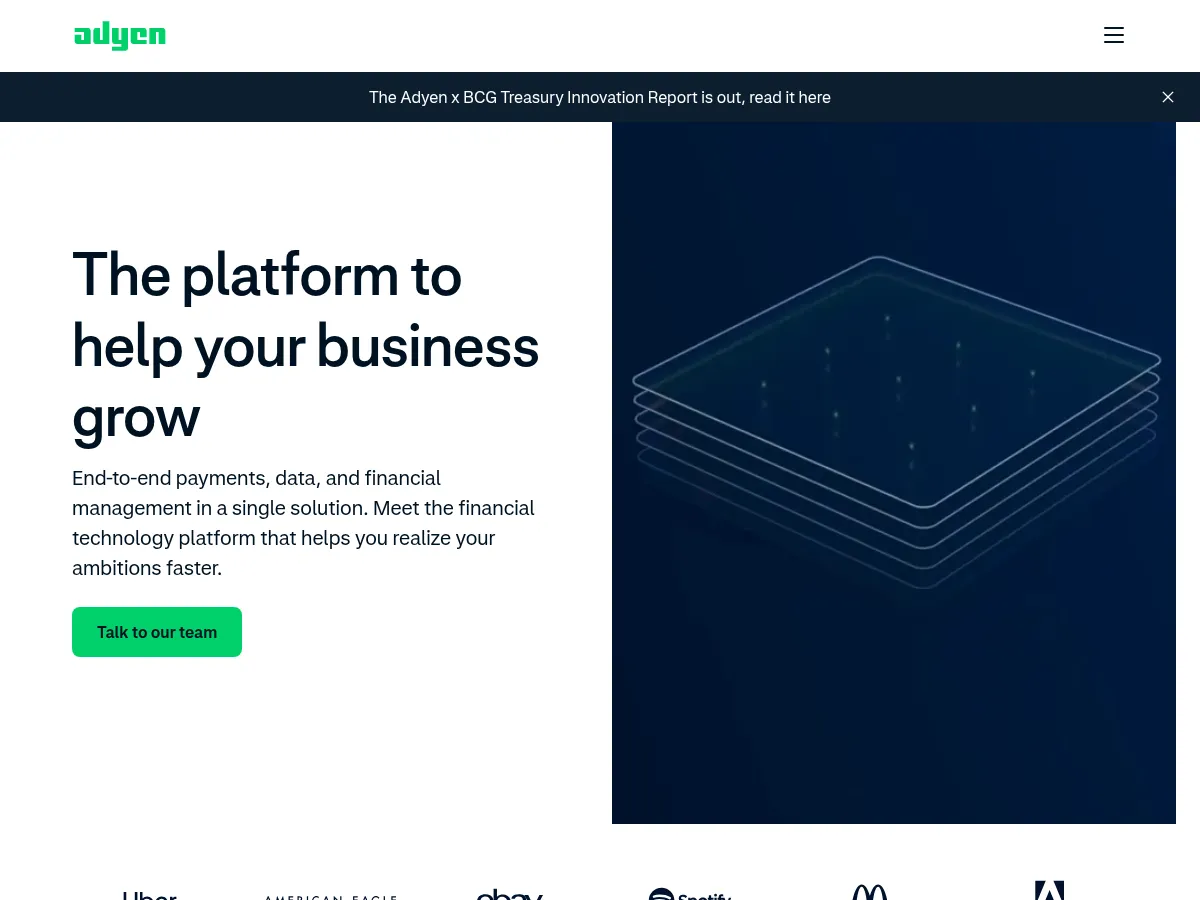
Dutch fintech company providing a single payments platform for global businesses. Processes payments for Netflix, Uber, Spotify, and other major enterprises.

European Blue Chips

Adyen is a leading European fintech blue chip providing a unified global payments platform used by major enterprises including Netflix, Uber, and Spotify.

Payment Stocks

Adyen's single-platform approach to global payment processing for enterprise clients like Netflix and Spotify makes it one of the most innovative pure-play payment stocks available.

Key Financials ADYEY

Price $10.72
Change (1D) -2.19%
Change (30D) -32.87%
Change (60D) -31.81%
Change (90D) -37.93%
Change (180D) -41.20%
Change (1Y) -34.55%
Change (5Y) -54.48%
52-Week Range $10.57 — $19.94
50-Day MA $15.50
Volume 3.22M

Data updated Feb 15 · Source: Twelve Data

3.7
1 reviews
Brand Reputation
4.2
Innovation Capability
4
Market Leadership
4
Governance & Ethics
3.7
Financial Stability
3.5
Claude Opus 4.6
AI Review
3.7/5

Adyen is a leading global payment technology platform serving enterprise clients like Microsoft, Uber, and eBay, offering end-to-end payment processing across online, in-store, and unified commerce channels. The company's single-platform architecture is a genuine competitive moat, reducing complexity versus legacy payment processors.

The stock has experienced a brutal selloff, down over 54% over five years and currently trading near its 52-week low of $10.57, well below its 50-day moving average of $15.50. This decline reflects concerns about slowing revenue growth, margin compression from heavy hiring, and increased competition from peers like Stripe and legacy acquirers.

Bull case: Adyen remains highly profitable with strong EBITDA margins, minimal debt, and expanding take rates in North America. The enterprise-focused model provides sticky, high-quality revenue. At current levels, the valuation has compressed significantly from peak euphoria.

Bear case: The 30-day decline of nearly 33% signals potential structural concerns beyond mere sentiment. Competition is intensifying, and the premium European tech multiple may continue contracting. Growth deceleration could persist as enterprise client wins become harder.

Adyen is a quality franchise at a much more reasonable price, but investors should watch for stabilization before building positions.

Brand Reputation
4.2
Market Leadership
4
Innovation Capability
4
Governance & Ethics
3.7
Financial Stability
3.5
Feb 15, 2026
Adyen Screenshot

Added: Feb 15, 2026

adyen.com

Latest from Otrai

How to Backtest a Trading Strategy: Methods, Pitfalls, and What the Results Actually Mean

How to Backtest a Trading Strategy: Methods, Pitfalls, and What the Results Actually Mean

Every trader has a strategy that looks great in their head. Backtesting is how you find out whether it actually works. Here is how to test strategies properly, what metrics matter, and why most backtest results are too good to be true.
Risk-Reward Ratios: How to Set Targets That Make Your Strategy Profitable

Risk-Reward Ratios: How to Set Targets That Make Your Strategy Profitable

A risk-reward ratio compares how much you stand to lose on a trade to how much you stand to gain. It is arguably the most important number in your trading plan, because it determines whether your strategy can survive a normal losing streak.

Trading the News: How Economic Events Move Forex and What to Do About It

Trading the News: How Economic Events Move Forex and What to Do About It

Every month, a handful of economic data releases move the forex market more in five minutes than most sessions move in five days. Non-Farm Payrolls, CPI prints, and central bank rate decisions create violent spikes, whipsaws, and trend shifts that can make or break a trading account.

What Is a CFD? How Contracts for Difference Work and When to Use Them

What Is a CFD? How Contracts for Difference Work and When to Use Them

A CFD is a contract between you and your broker to exchange the difference in an asset's price from when you open the trade to when you close it. You never own the underlying asset. That single distinction shapes everything about how CFDs work, what they cost, and why regulators treat them differently from traditional investing.