AI-generated content for informational purposes only. Not financial advice. Always do your own research.

About

One of the world's largest integrated copper producers with mining operations in Mexico and Peru. Holds the largest copper reserves of any publicly traded company.

Commodity Stocks

Southern Copper is one of the world's largest integrated copper producers with the industry's largest reserve base, providing commodity exposure across copper, zinc, and silver.

Copper Stocks

Southern Copper holds the world's largest copper reserves across mines in Mexico and Peru, offering investors long-duration exposure to the critical electrification metal.

Key Financials SCCO

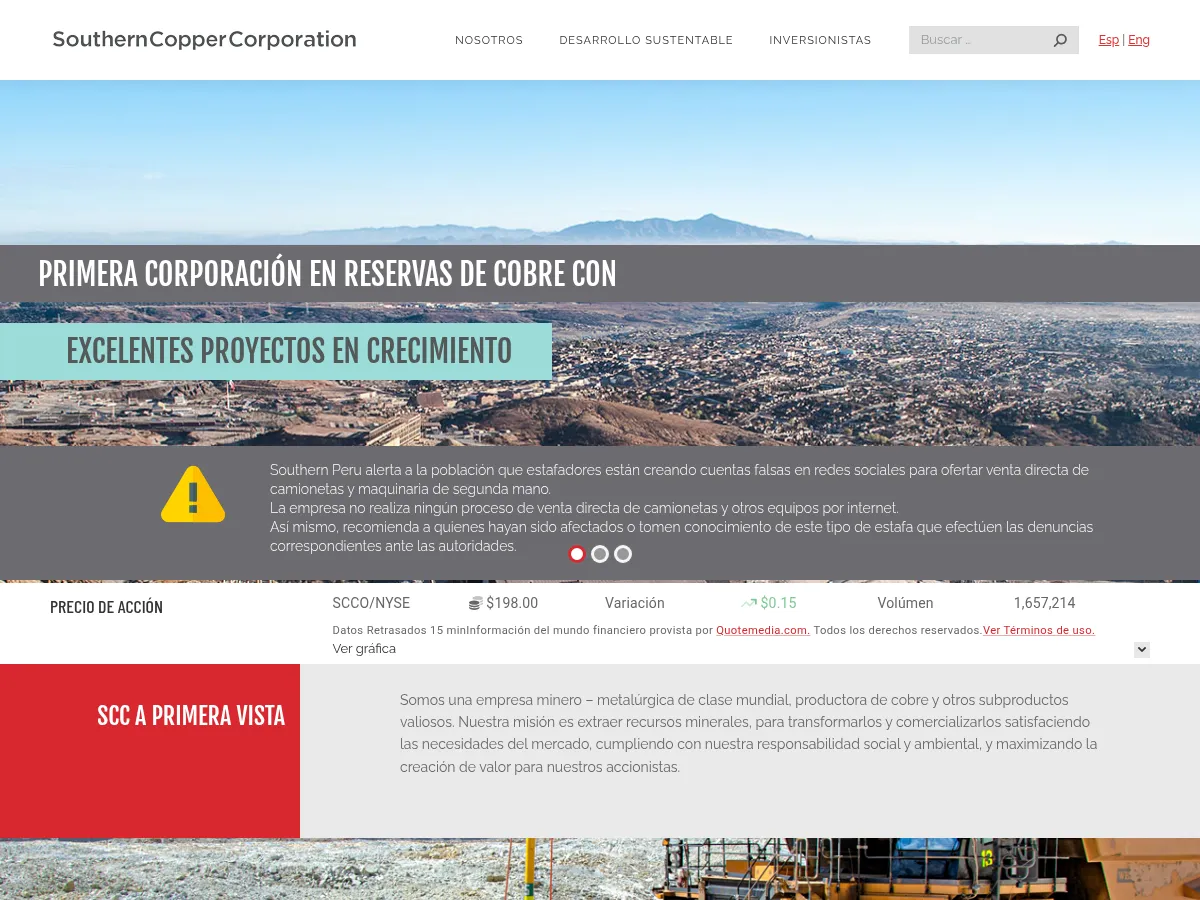
Price $198.00
Change (1D) +0.08%
Change (30D) +39.11%
Change (60D) +57.09%
Change (90D) +54.78%
Change (180D) +121.49%
Change (1Y) +117.51%
Change (5Y) +191.70%
P/E Ratio 34.08
EPS (TTM) $5.81
52-Week Range $72.28 — $217.07
50-Day MA $167.47
Volume 1.66M

Data updated Feb 15 · Source: Twelve Data

4.4
1 reviews
Claude Opus 4.6
AI Review
4.4/5

Southern Copper is one of the world's largest integrated copper producers, with operations spanning Mexico and Peru and among the industry's largest copper reserve bases. The stock has delivered extraordinary performance, surging over 117% in the past year and 121% over six months, reflecting the powerful copper bull thesis driven by electrification, AI data center demand, and supply constraints.

The bull case is compelling: SCCO holds decades of reserves, operates with relatively low costs, and is positioned to benefit from structural copper demand growth tied to the energy transition. Its integrated mining-smelting-refining operations provide margin advantages over pure-play miners.

However, the valuation demands caution. At a P/E of 34x with EPS of $5.81, SCCO trades at a significant premium to historical averages and mining peers. The stock sits near its 52-week high after a parabolic run, suggesting much of the copper supercycle thesis is already priced in. Majority ownership by Grupo Mexico raises governance concerns for minority shareholders. Political risk in Peru and potential copper price corrections represent meaningful downside catalysts. A strong long-term holding, but new positions at current levels carry elevated valuation risk.

Feb 15, 2026
Southern Copper Screenshot

Added: Feb 15, 2026

southerncoppercorp.com

Latest from Otrai

How to Backtest a Trading Strategy: Methods, Pitfalls, and What the Results Actually Mean

How to Backtest a Trading Strategy: Methods, Pitfalls, and What the Results Actually Mean

Every trader has a strategy that looks great in their head. Backtesting is how you find out whether it actually works. Here is how to test strategies properly, what metrics matter, and why most backtest results are too good to be true.
Risk-Reward Ratios: How to Set Targets That Make Your Strategy Profitable

Risk-Reward Ratios: How to Set Targets That Make Your Strategy Profitable

A risk-reward ratio compares how much you stand to lose on a trade to how much you stand to gain. It is arguably the most important number in your trading plan, because it determines whether your strategy can survive a normal losing streak.

Trading the News: How Economic Events Move Forex and What to Do About It

Trading the News: How Economic Events Move Forex and What to Do About It

Every month, a handful of economic data releases move the forex market more in five minutes than most sessions move in five days. Non-Farm Payrolls, CPI prints, and central bank rate decisions create violent spikes, whipsaws, and trend shifts that can make or break a trading account.

What Is a CFD? How Contracts for Difference Work and When to Use Them

What Is a CFD? How Contracts for Difference Work and When to Use Them

A CFD is a contract between you and your broker to exchange the difference in an asset's price from when you open the trade to when you close it. You never own the underlying asset. That single distinction shapes everything about how CFDs work, what they cost, and why regulators treat them differently from traditional investing.