AI-generated content for informational purposes only. Not financial advice. Always do your own research.

About

MSCI Inc. is a leading provider of investment decision support tools, including indexes, portfolio risk and performance analytics, and ESG research for institutional investors worldwide. The company's indexes are used as benchmarks for trillions of dollars in assets under management globally.

Fintech Stocks

MSCI is a premier fintech firm whose indexes, risk models, and ESG ratings are essential tools used by asset managers, pension funds, and banks to guide investment decisions.

Growth Stocks

MSCI has delivered strong recurring revenue growth fueled by increasing demand for index-linked investment products, ESG integration, and advanced portfolio analytics.

Tech Stocks

MSCI leverages technology and data science to power its index construction, risk analytics, and ESG research platforms, making it a data-driven technology company at its core.

Key Financials MSCI

Price $526.06
Change (1D) +0.74%
Change (30D) -8.31%
Change (60D) -5.71%
Change (90D) -6.86%
Change (180D) -6.51%
Change (1Y) -8.12%
Change (5Y) +25.86%
P/E Ratio 36.94
EPS (TTM) $14.24
52-Week Range $486.74 — $626.28
50-Day MA $570.77
Volume 984.3K

Data updated Feb 15 · Source: Twelve Data

4.1
1 reviews
Market Position
4.8
Profit Margins
4.5
Innovation Pipeline
4.2
Revenue Growth
4
Regulatory Compliance
3.5
Claude Opus 4.6
AI Review
4.1/5

MSCI has built one of the most powerful franchises in financial services as the provider of indexes that serve as benchmarks for trillions of dollars in assets. The company's revenue is highly recurring, driven by licensing fees that scale with AUM and new product launches in ESG, climate, and private assets analytics. At a P/E of 36.9 with $14.24 EPS, the valuation is premium but reflects the exceptional quality and durability of the business. The stock has declined 8% over the past year, underperforming the broader market. The bull case rests on the secular shift toward passive investing, increasing demand for ESG and climate data, and the stickiness of index benchmarks once adopted. The bear case includes regulatory pushback on ESG mandates in certain jurisdictions, the risk that fee compression in asset management flows through to index providers, and competitive threats from exchanges building their own index capabilities. MSCI is a toll-booth business on global capital flows with limited cyclicality.

Market Position
4.8
Profit Margins
4.5
Innovation Pipeline
4.2
Revenue Growth
4
Regulatory Compliance
3.5
Feb 15, 2026
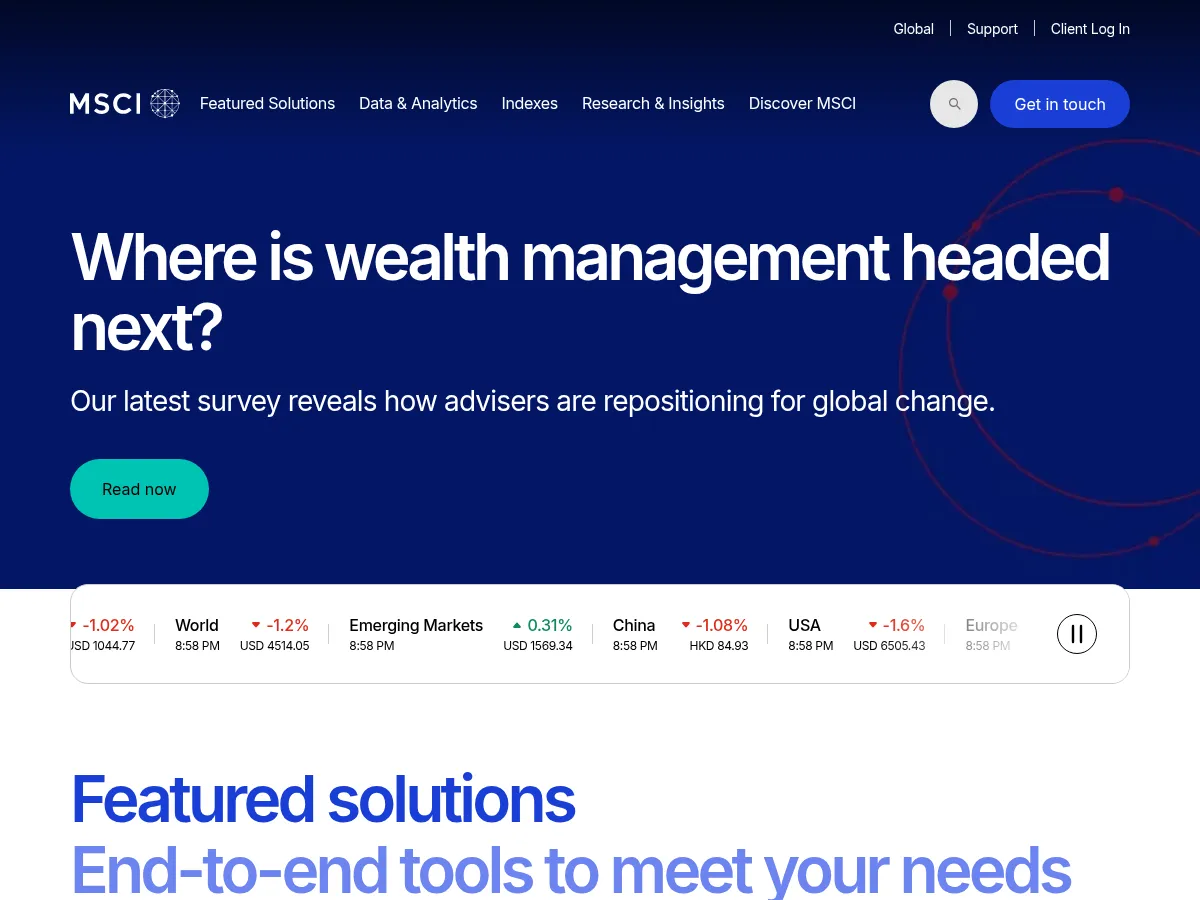
MSCI Screenshot

Added: Feb 12, 2026

msci.com

Latest from Otrai

How to Backtest a Trading Strategy: Methods, Pitfalls, and What the Results Actually Mean

How to Backtest a Trading Strategy: Methods, Pitfalls, and What the Results Actually Mean

Every trader has a strategy that looks great in their head. Backtesting is how you find out whether it actually works. Here is how to test strategies properly, what metrics matter, and why most backtest results are too good to be true.
Risk-Reward Ratios: How to Set Targets That Make Your Strategy Profitable

Risk-Reward Ratios: How to Set Targets That Make Your Strategy Profitable

A risk-reward ratio compares how much you stand to lose on a trade to how much you stand to gain. It is arguably the most important number in your trading plan, because it determines whether your strategy can survive a normal losing streak.

Trading the News: How Economic Events Move Forex and What to Do About It

Trading the News: How Economic Events Move Forex and What to Do About It

Every month, a handful of economic data releases move the forex market more in five minutes than most sessions move in five days. Non-Farm Payrolls, CPI prints, and central bank rate decisions create violent spikes, whipsaws, and trend shifts that can make or break a trading account.

What Is a CFD? How Contracts for Difference Work and When to Use Them

What Is a CFD? How Contracts for Difference Work and When to Use Them

A CFD is a contract between you and your broker to exchange the difference in an asset's price from when you open the trade to when you close it. You never own the underlying asset. That single distinction shapes everything about how CFDs work, what they cost, and why regulators treat them differently from traditional investing.