AI-generated content for informational purposes only. Not financial advice. Always do your own research.

About

iShares MSCI Germany ETF providing exposure to German equities. Closely tracks the performance of Germany's largest companies represented in the DAX 40 index.

Market Indices - Global

EWG provides exposure to Germany's largest companies represented in the DAX 40 index, spanning industrial, automotive, and financial sectors of Europe's biggest economy.

Market Data EWG

Price $43.97
Change (1D) +0.02%
Change (30D) +3.46%
Change (60D) +9.90%
Change (90D) +3.65%
Change (180D) +5.27%
Change (1Y) +22.99%
Change (5Y) +34.30%
52-Week Range $32.82 — $44.62
50-Day MA $42.89
Volume 960.6K

Data updated Feb 15 · Source: Twelve Data

4.2
1 reviews
Performance
4.4
Fundamentals
4.2
Management Quality
4.2
Valuation
3.8
Risk Profile
3.6
Claude Opus 4.6
AI Review
4.2/5

EWG (iShares MSCI Germany ETF) provides exposure to Germany's equity market, closely tracking large- and mid-cap companies heavily weighted toward industrials, financials, and technology " with SAP, Siemens, and Allianz among top holdings. The fund has delivered an impressive 23% one-year return, trading near its 52-week high of $44.62, reflecting renewed optimism around European equities. Germany's fiscal pivot " including a landmark infrastructure and defense spending package " has been a powerful catalyst, shifting the narrative from stagnation to reflation. The ECB's easing cycle further supports valuations. However, risks remain meaningful: Germany's manufacturing sector faces structural headwinds from energy costs and Chinese competition, while trade tensions and potential U.S. tariffs could weigh on this export-dependent economy. Valuations have expanded but remain reasonable relative to U.S. peers. The 50-day MA at $42.89 suggests solid near-term momentum. EWG serves as a useful diversifier for U.S.-centric portfolios seeking developed-market European exposure, though currency risk (EUR/USD) adds volatility. Moderate volume indicates adequate liquidity for most investors.

Performance
4.4
Fundamentals
4.2
Management Quality
4.2
Valuation
3.8
Risk Profile
3.6
Feb 15, 2026
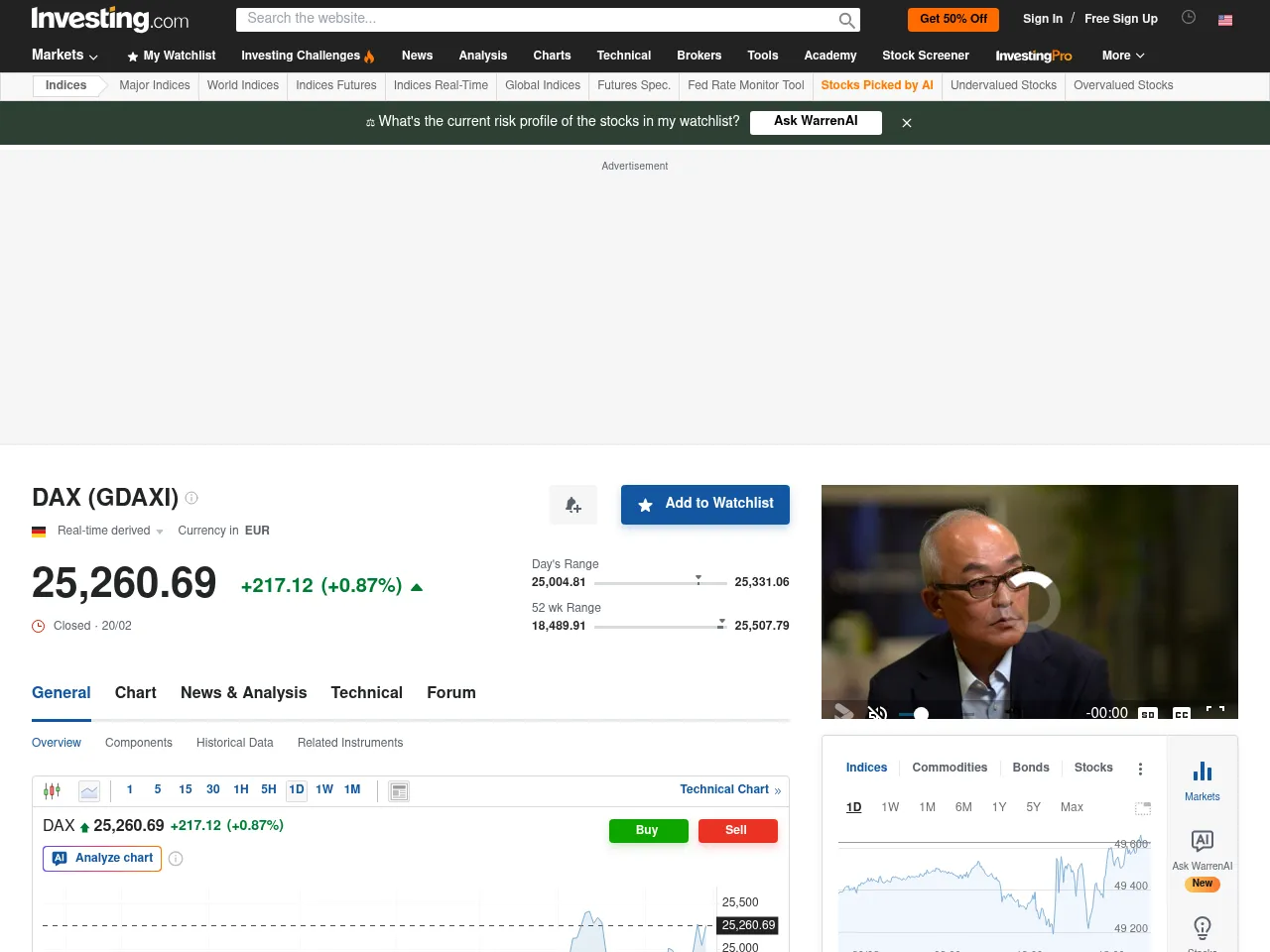
DAX 40 (EWG) Screenshot

Added: Feb 15, 2026

investing.com/indices/germany-30

Latest from Otrai

How to Backtest a Trading Strategy: Methods, Pitfalls, and What the Results Actually Mean

How to Backtest a Trading Strategy: Methods, Pitfalls, and What the Results Actually Mean

Every trader has a strategy that looks great in their head. Backtesting is how you find out whether it actually works. Here is how to test strategies properly, what metrics matter, and why most backtest results are too good to be true.
Risk-Reward Ratios: How to Set Targets That Make Your Strategy Profitable

Risk-Reward Ratios: How to Set Targets That Make Your Strategy Profitable

A risk-reward ratio compares how much you stand to lose on a trade to how much you stand to gain. It is arguably the most important number in your trading plan, because it determines whether your strategy can survive a normal losing streak.

Trading the News: How Economic Events Move Forex and What to Do About It

Trading the News: How Economic Events Move Forex and What to Do About It

Every month, a handful of economic data releases move the forex market more in five minutes than most sessions move in five days. Non-Farm Payrolls, CPI prints, and central bank rate decisions create violent spikes, whipsaws, and trend shifts that can make or break a trading account.

What Is a CFD? How Contracts for Difference Work and When to Use Them

What Is a CFD? How Contracts for Difference Work and When to Use Them

A CFD is a contract between you and your broker to exchange the difference in an asset's price from when you open the trade to when you close it. You never own the underlying asset. That single distinction shapes everything about how CFDs work, what they cost, and why regulators treat them differently from traditional investing.