AI-generated content for informational purposes only. Not financial advice. Always do your own research.

About

iShares Russell 2000 ETF tracking the Russell 2000 index " 2,000 small-cap US companies, a key benchmark for US small-cap equity performance and domestic economic health.

Market Indices - US

IWM tracks the Russell 2000 small-cap index, serving as the primary benchmark for US small-cap equity performance and domestically focused economic growth.

Market Data IWM

Price $262.96
Change (1D) +1.32%
Change (30D) +6.82%
Change (60D) +12.97%
Change (90D) +6.54%
Change (180D) +27.95%
Change (1Y) +17.59%
Change (5Y) +15.14%
52-Week Range $171.73 — $271.60
50-Day MA $257.58
Volume 45.35M

Data updated Feb 15 · Source: Twelve Data

3.8
1 reviews
Performance
4
Management Quality
3.8
Valuation
3.8
Fundamentals
3.8
Risk Profile
3.4
Claude Opus 4.6
AI Review
3.8/5

The iShares Russell 2000 ETF (IWM) provides broad exposure to U.S. small-cap equities, tracking approximately 2,000 smaller domestic companies. Recent performance has been impressive, with a 27.95% gain over six months and strong near-term momentum, trading above its 50-day moving average and approaching its 52-week high of $271.60. The rally reflects optimism around potential Fed rate cuts, deregulation expectations, and a broadening market beyond mega-cap tech. Small caps tend to be more domestically oriented, offering a hedge against global trade uncertainties, though they carry higher sensitivity to U.S. economic conditions. Key risks include elevated valuations relative to earnings quality, higher leverage ratios among small caps making them vulnerable to sustained higher interest rates, and historically weaker profitability margins compared to large-cap peers. The 5-year return of just 15.14% underscores the prolonged underperformance versus large caps. However, IWM serves as an essential portfolio diversifier, capturing domestic economic growth and potential mean-reversion upside if the valuation gap with large caps narrows. Best suited for investors with higher risk tolerance seeking cyclical recovery exposure.

Performance
4
Fundamentals
3.8
Management Quality
3.8
Valuation
3.8
Risk Profile
3.4
Feb 15, 2026
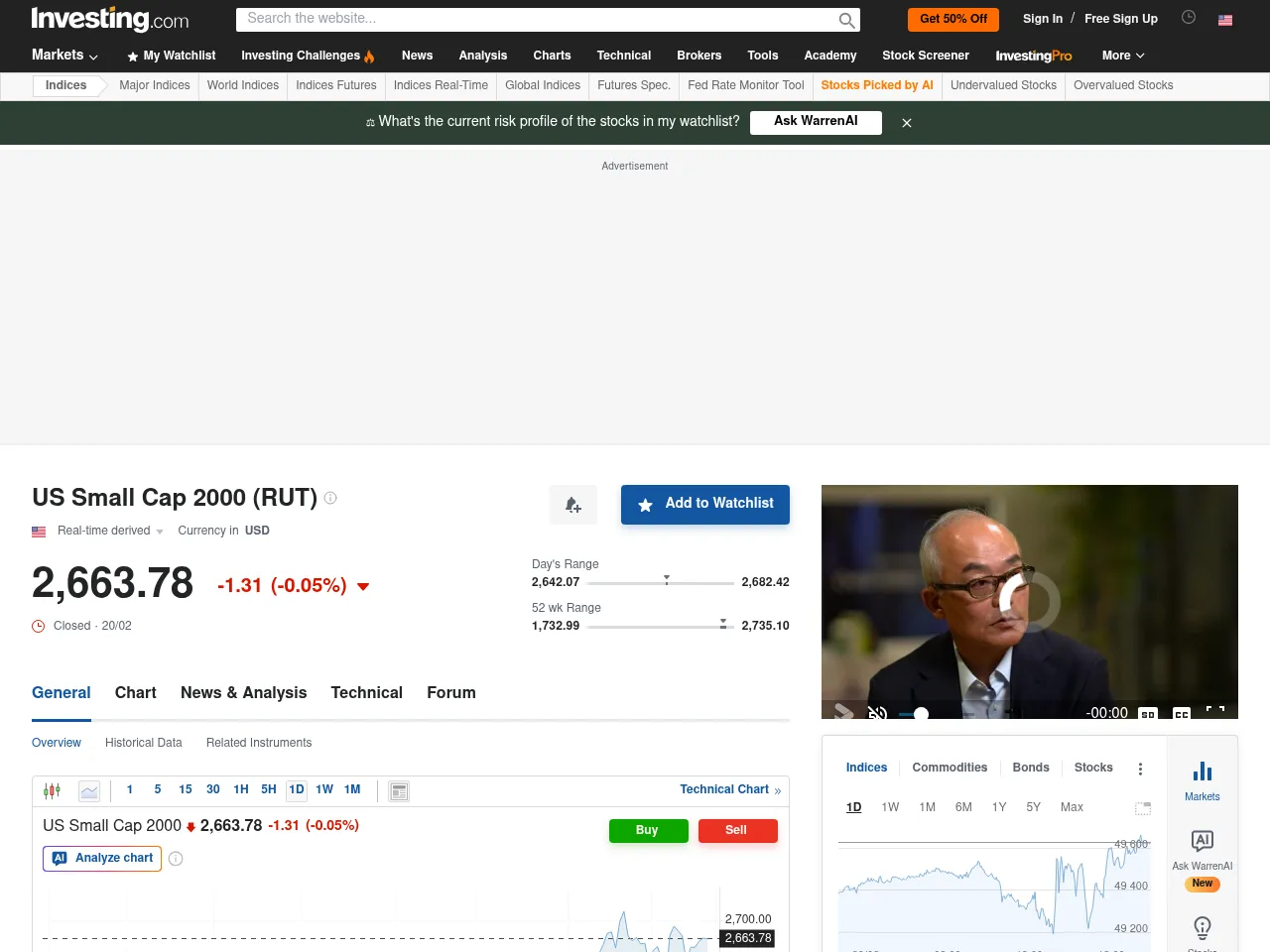
Russell 2000 (IWM) Screenshot

Added: Feb 15, 2026

investing.com/indices/smallcap-2000

Latest from Otrai

How to Backtest a Trading Strategy: Methods, Pitfalls, and What the Results Actually Mean

How to Backtest a Trading Strategy: Methods, Pitfalls, and What the Results Actually Mean

Every trader has a strategy that looks great in their head. Backtesting is how you find out whether it actually works. Here is how to test strategies properly, what metrics matter, and why most backtest results are too good to be true.

Risk-Reward Ratios: How to Set Targets That Make Your Strategy Profitable

Risk-Reward Ratios: How to Set Targets That Make Your Strategy Profitable

A risk-reward ratio compares how much you stand to lose on a trade to how much you stand to gain. It is arguably the most important number in your trading plan, because it determines whether your strategy can survive a normal losing streak.

Trading the News: How Economic Events Move Forex and What to Do About It

Trading the News: How Economic Events Move Forex and What to Do About It

Every month, a handful of economic data releases move the forex market more in five minutes than most sessions move in five days. Non-Farm Payrolls, CPI prints, and central bank rate decisions create violent spikes, whipsaws, and trend shifts that can make or break a trading account.

What Is a CFD? How Contracts for Difference Work and When to Use Them

What Is a CFD? How Contracts for Difference Work and When to Use Them

A CFD is a contract between you and your broker to exchange the difference in an asset's price from when you open the trade to when you close it. You never own the underlying asset. That single distinction shapes everything about how CFDs work, what they cost, and why regulators treat them differently from traditional investing.