AI-generated content for informational purposes only. Not financial advice. Always do your own research.

About

Palladium spot price in US dollars per troy ounce. Critical for gasoline vehicle catalytic converters and electronics manufacturing.

Commodities - Precious Metals

Palladium is a precious metal critical for gasoline vehicle catalytic converters and electronics manufacturing, with price driven by automotive demand and constrained mining supply.

Market Data XPD/USD

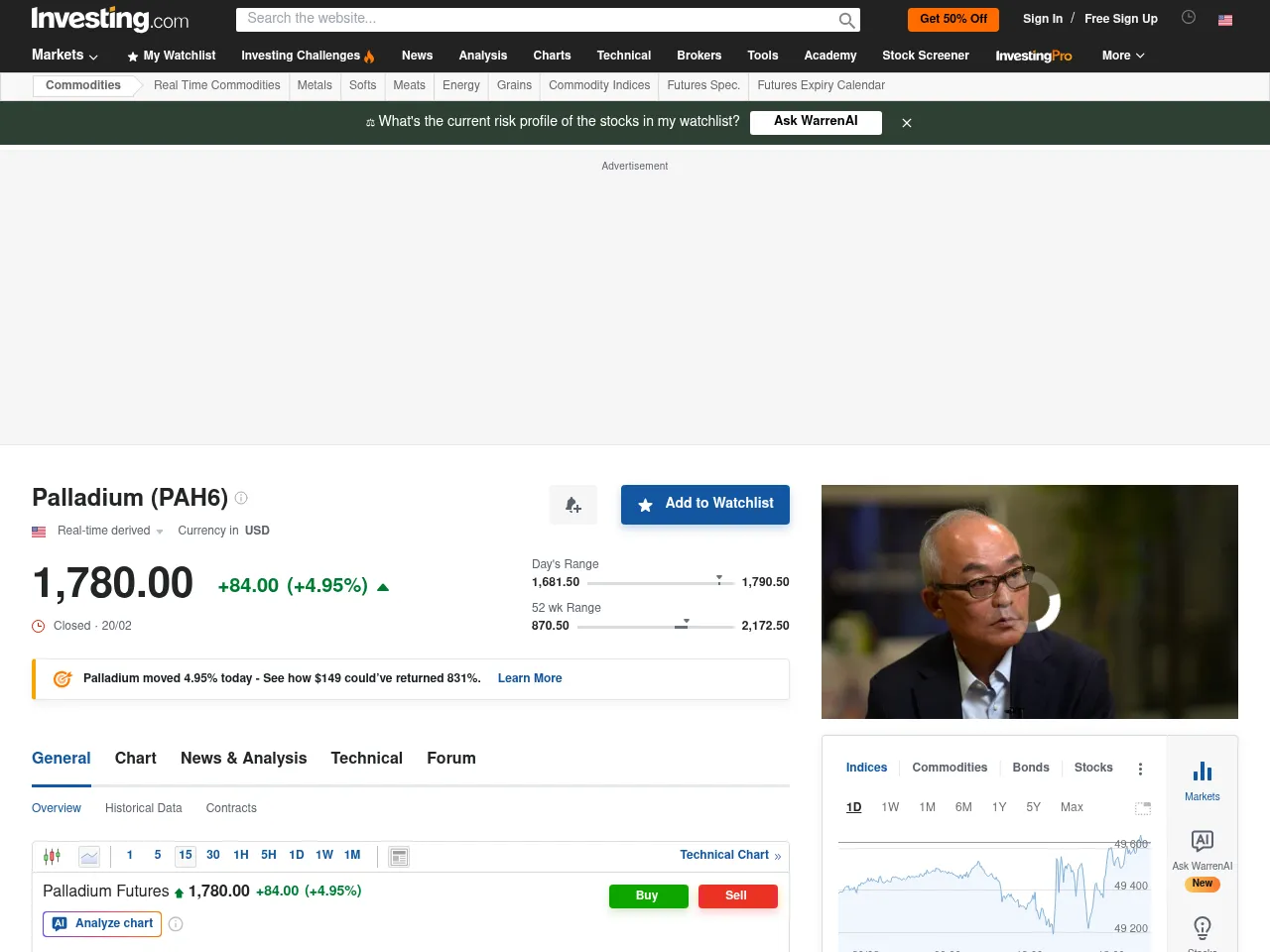
Price $1,709.01
Change (1D) +0.00%
Change (30D) -4.92%
Change (60D) +3.75%
Change (90D) +21.55%
Change (180D) +41.65%
Change (1Y) +75.01%
Change (5Y) -35.17%
52-Week Range $890.66 — $2,190.20
50-Day MA $1,785.17

Data updated Feb 15 · Source: Twelve Data

3.6
1 reviews
Volatility
3.8
Market Fundamentals
3.8
Liquidity
3.5
Historical Performance
3.4
Accessibility
3.2
Claude Opus 4.6
AI Review
3.6/5

Palladium (XPD/USD) has staged a remarkable recovery from its 52-week low of $890.66, surging over 75% year-over-year, though it remains well below its 2022 highs and is down 35% over five years. The metal's primary demand driver remains automotive catalytic converters for gasoline vehicles, where it plays an irreplaceable role in emissions reduction. Supply remains structurally constrained, with roughly 80% sourced from Russia and South Africa"both regions facing persistent geopolitical and operational risks. However, the 30-day decline of nearly 5% and trading below the 50-day moving average ($1,785) suggest near-term momentum is fading. Bearish headwinds include the accelerating EV transition reducing long-term catalytic converter demand, potential substitution with cheaper platinum, and sensitivity to global manufacturing slowdowns. On the bullish side, tight mine supply, ongoing sanctions uncertainty regarding Russian exports, and resilient internal combustion engine sales in emerging markets support prices. Palladium remains one of the most volatile precious metals, better suited for experienced commodity traders than conservative investors seeking safe-haven exposure.

Volatility
3.8
Market Fundamentals
3.8
Liquidity
3.5
Historical Performance
3.4
Accessibility
3.2
Feb 15, 2026
Palladium (XPD/USD) Screenshot

Added: Feb 15, 2026

investing.com/commodities/palladium

Latest from Otrai

How to Backtest a Trading Strategy: Methods, Pitfalls, and What the Results Actually Mean

How to Backtest a Trading Strategy: Methods, Pitfalls, and What the Results Actually Mean

Every trader has a strategy that looks great in their head. Backtesting is how you find out whether it actually works. Here is how to test strategies properly, what metrics matter, and why most backtest results are too good to be true.
Risk-Reward Ratios: How to Set Targets That Make Your Strategy Profitable

Risk-Reward Ratios: How to Set Targets That Make Your Strategy Profitable

A risk-reward ratio compares how much you stand to lose on a trade to how much you stand to gain. It is arguably the most important number in your trading plan, because it determines whether your strategy can survive a normal losing streak.

Trading the News: How Economic Events Move Forex and What to Do About It

Trading the News: How Economic Events Move Forex and What to Do About It

Every month, a handful of economic data releases move the forex market more in five minutes than most sessions move in five days. Non-Farm Payrolls, CPI prints, and central bank rate decisions create violent spikes, whipsaws, and trend shifts that can make or break a trading account.

What Is a CFD? How Contracts for Difference Work and When to Use Them

What Is a CFD? How Contracts for Difference Work and When to Use Them

A CFD is a contract between you and your broker to exchange the difference in an asset's price from when you open the trade to when you close it. You never own the underlying asset. That single distinction shapes everything about how CFDs work, what they cost, and why regulators treat them differently from traditional investing.