AI-generated content for informational purposes only. Not financial advice. Always do your own research.

About

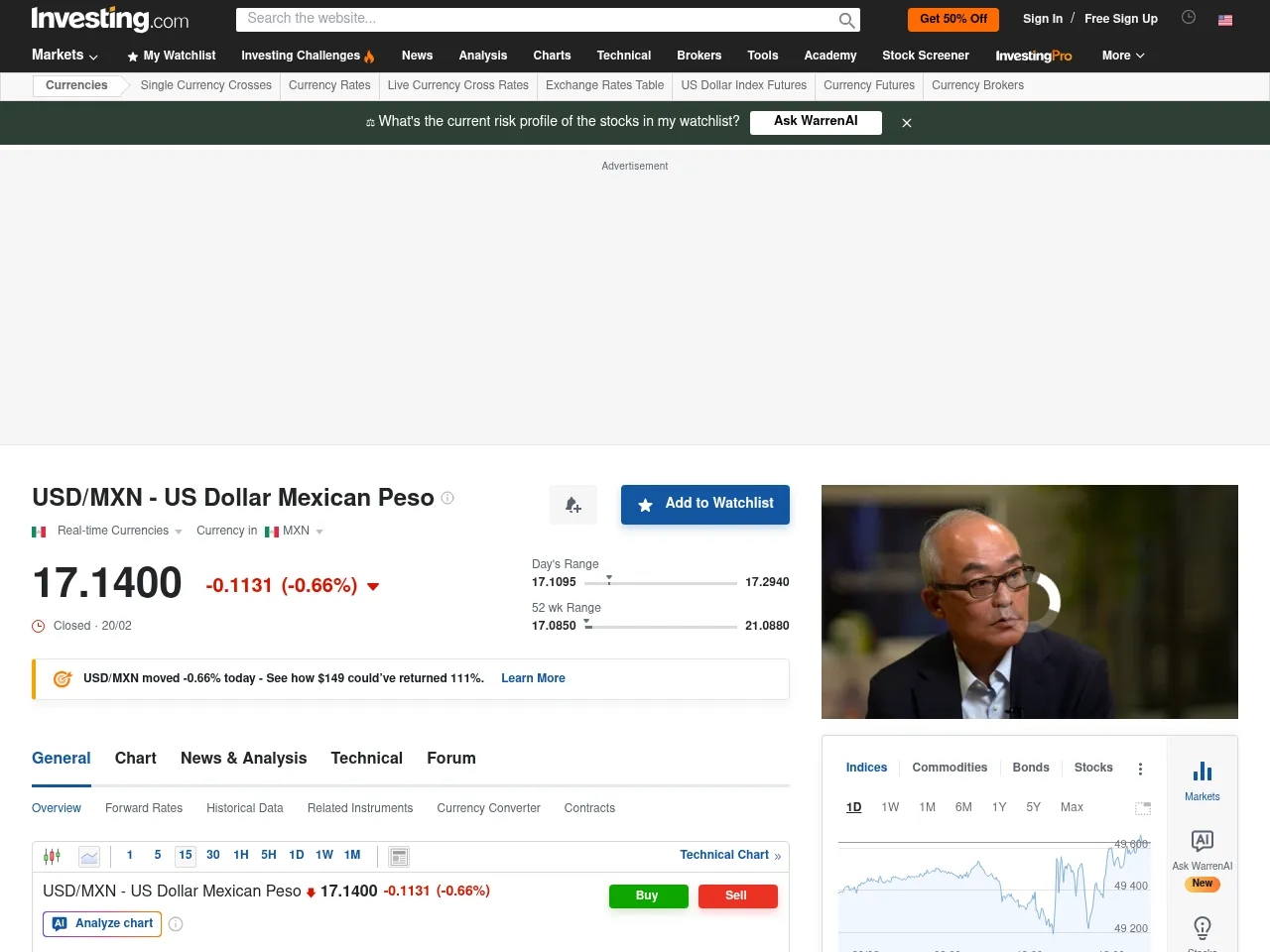
US Dollar vs Mexican Peso. Affected by US-Mexico trade relations, oil prices, and nearshoring trends.

Forex - Exotic Pairs

USD/MXN reflects US-Mexico trade relations, oil prices, and nearshoring trends, making it a popular exotic pair for trading North American economic integration dynamics.

Market Data USD/MXN

Price 17.1700
Change (1D) -0.01%
52-Week Range 17.1100 — 21.0800

Data updated Feb 15 · Source: Twelve Data

4.5
1 reviews
Historical Performance
4.7
Liquidity
4.6
Market Fundamentals
4.5
Accessibility
4.4
Volatility
4.3
Claude Opus 4.6
AI Review
4.5/5

USD/MXN remains one of the most actively traded exotic pairs, currently hovering near its 52-week low of 17.11, suggesting sustained peso strength. The Mexican peso has benefited from Banxico's hawkish monetary stance, maintaining elevated interest rates that create a favorable carry trade differential against the USD. Mexico's nearshoring boom, driven by companies diversifying supply chains away from China, continues to attract foreign direct investment and support peso demand. Remittance flows from the U.S. remain robust, providing additional structural support. However, risks persist: potential U.S. economic slowdown could dampen trade flows, while political uncertainty ahead of Mexico's elections may introduce volatility. A break below 17.10 could open further downside toward 16.80, while resistance sits near 17.50-17.80. The wide 52-week range (17.11-21.08) highlights significant volatility potential, making this pair attractive for both carry traders and swing traders. The high liquidity relative to other exotic pairs and substantial interest rate differential make USD/MXN a standout in the exotic category.

Historical Performance
4.7
Liquidity
4.6
Market Fundamentals
4.5
Accessibility
4.4
Volatility
4.3
Feb 15, 2026
USD/MXN Screenshot

Added: Feb 15, 2026

investing.com/currencies/usd-mxn

Latest from Otrai

How to Backtest a Trading Strategy: Methods, Pitfalls, and What the Results Actually Mean

How to Backtest a Trading Strategy: Methods, Pitfalls, and What the Results Actually Mean

Every trader has a strategy that looks great in their head. Backtesting is how you find out whether it actually works. Here is how to test strategies properly, what metrics matter, and why most backtest results are too good to be true.
Risk-Reward Ratios: How to Set Targets That Make Your Strategy Profitable

Risk-Reward Ratios: How to Set Targets That Make Your Strategy Profitable

A risk-reward ratio compares how much you stand to lose on a trade to how much you stand to gain. It is arguably the most important number in your trading plan, because it determines whether your strategy can survive a normal losing streak.

Trading the News: How Economic Events Move Forex and What to Do About It

Trading the News: How Economic Events Move Forex and What to Do About It

Every month, a handful of economic data releases move the forex market more in five minutes than most sessions move in five days. Non-Farm Payrolls, CPI prints, and central bank rate decisions create violent spikes, whipsaws, and trend shifts that can make or break a trading account.

What Is a CFD? How Contracts for Difference Work and When to Use Them

What Is a CFD? How Contracts for Difference Work and When to Use Them

A CFD is a contract between you and your broker to exchange the difference in an asset's price from when you open the trade to when you close it. You never own the underlying asset. That single distinction shapes everything about how CFDs work, what they cost, and why regulators treat them differently from traditional investing.