AI-generated content for informational purposes only. Not financial advice. Always do your own research.

About

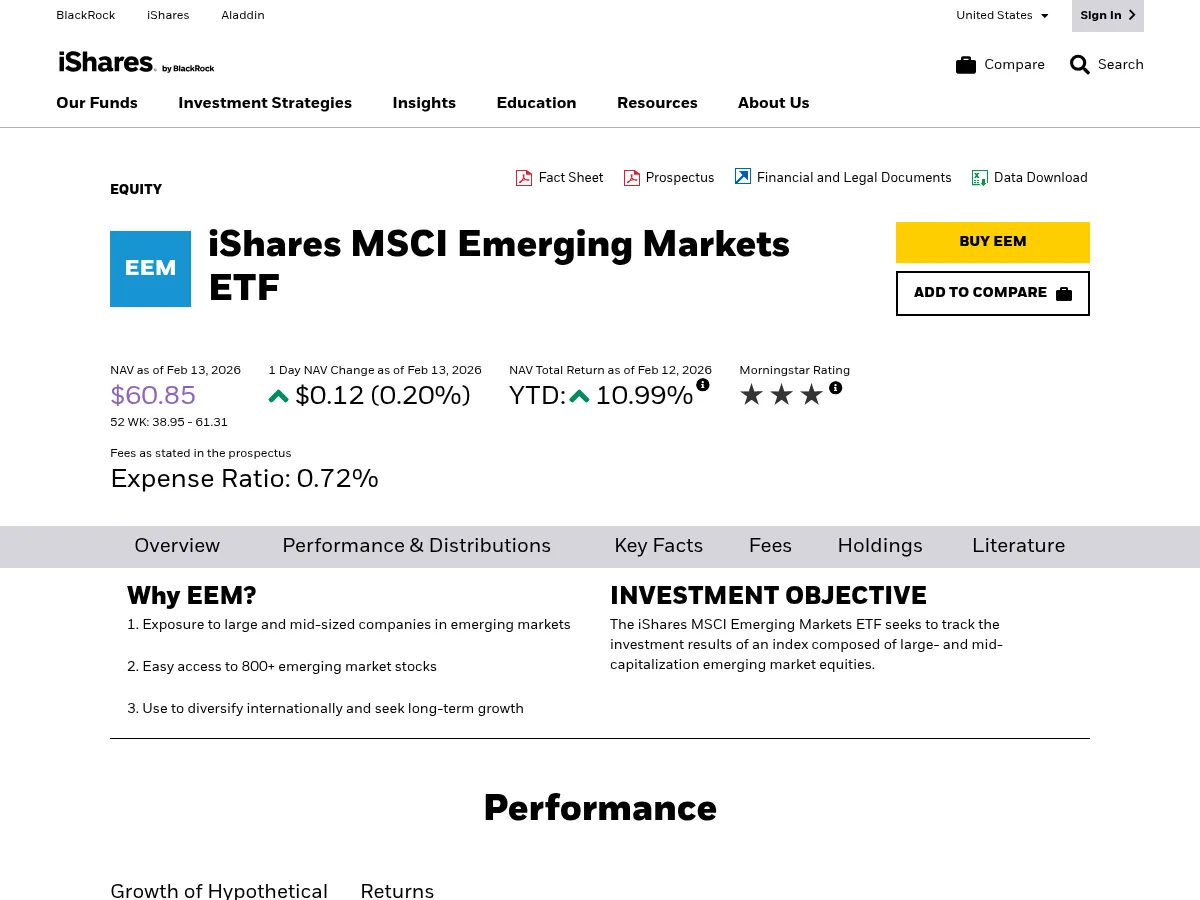
Provides broad exposure to emerging market equities including China, India, Brazil, Taiwan, and South Korea. Core holding for international diversification.

ETF Picks

VGT provides broad exposure to the US information technology sector including semiconductor, software, and hardware companies through Vanguard's low-cost index tracking approach.

Key Financials EEM

Price $61.12
Change (1D) +0.43%
Change (30D) +11.72%
Change (60D) +12.54%
Change (90D) +12.19%
Change (180D) +33.13%
Change (1Y) +39.58%
Change (5Y) +11.05%
P/E Ratio 1,528.00
EPS (TTM) $0.04
52-Week Range $38.19 — $61.91
50-Day MA $56.99
Volume 40.07M

Data updated Feb 15 · Source: Twelve Data

3.4
1 reviews
Quality
3.6
Features
3.5
Customer Support
3.2
Value for Money
3
Claude Opus 4.6
AI Review
3.4/5

The iShares MSCI Emerging Markets ETF (EEM) is one of the most widely traded emerging markets funds, offering broad exposure to large and mid-cap equities across developing economies including China, India, Taiwan, South Korea, and Brazil. With massive daily volume (~40M shares), liquidity is exceptional, making it ideal for tactical allocation.

The bull case is compelling near-term: EEM has surged ~39.6% over the past year and is trading near its 52-week high, reflecting renewed investor appetite for EM equities driven by China stimulus hopes and dollar weakness. The 33% gain over six months signals strong momentum.

However, several concerns temper enthusiasm. The extraordinarily high P/E ratio of 1,528x and negligible EPS ($0.04) suggest underlying earnings weakness across the portfolio. Five-year returns of just 11% highlight EM's chronic underperformance versus developed markets. Investors also face geopolitical risks, currency volatility, and heavy China concentration. Additionally, EEM's expense ratio (0.70%) is notably higher than competitors like VWO (0.08%) and its newer sibling IEMG. For cost-conscious long-term investors, cheaper alternatives exist. EEM remains best suited for active traders seeking liquid EM exposure rather than buy-and-hold portfolios.

Quality
3.6
Features
3.5
Customer Support
3.2
Value for Money
3
Feb 15, 2026

Latest from Otrai

How to Backtest a Trading Strategy: Methods, Pitfalls, and What the Results Actually Mean

How to Backtest a Trading Strategy: Methods, Pitfalls, and What the Results Actually Mean

Every trader has a strategy that looks great in their head. Backtesting is how you find out whether it actually works. Here is how to test strategies properly, what metrics matter, and why most backtest results are too good to be true.

Risk-Reward Ratios: How to Set Targets That Make Your Strategy Profitable

Risk-Reward Ratios: How to Set Targets That Make Your Strategy Profitable

A risk-reward ratio compares how much you stand to lose on a trade to how much you stand to gain. It is arguably the most important number in your trading plan, because it determines whether your strategy can survive a normal losing streak.

Trading the News: How Economic Events Move Forex and What to Do About It

Trading the News: How Economic Events Move Forex and What to Do About It

Every month, a handful of economic data releases move the forex market more in five minutes than most sessions move in five days. Non-Farm Payrolls, CPI prints, and central bank rate decisions create violent spikes, whipsaws, and trend shifts that can make or break a trading account.

What Is a CFD? How Contracts for Difference Work and When to Use Them

What Is a CFD? How Contracts for Difference Work and When to Use Them

A CFD is a contract between you and your broker to exchange the difference in an asset's price from when you open the trade to when you close it. You never own the underlying asset. That single distinction shapes everything about how CFDs work, what they cost, and why regulators treat them differently from traditional investing.