AI-generated content for informational purposes only. Not financial advice. Always do your own research.

About

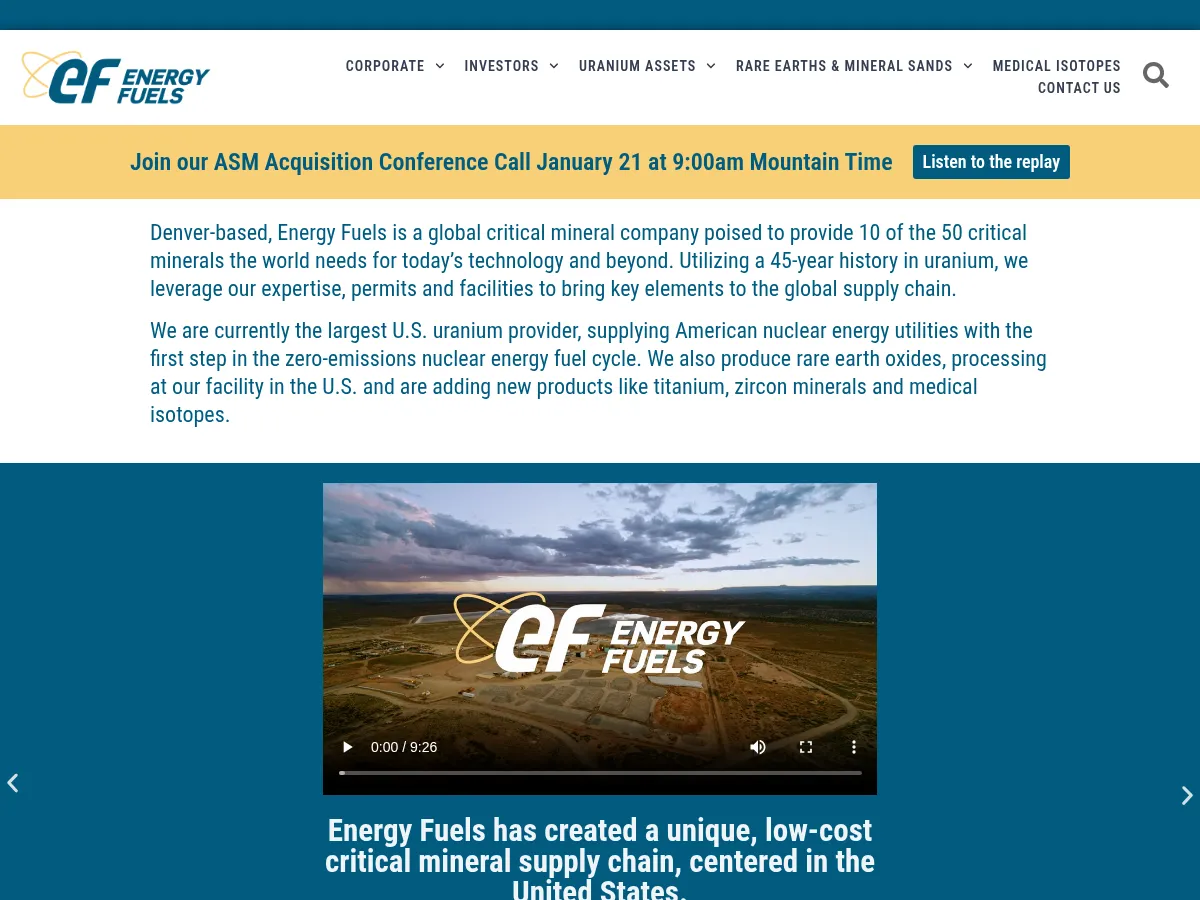
Leading US-based uranium and rare earth element producer. Processing monazite sands to produce rare earth carbonates as part of building a domestic rare earth supply chain.

Nuclear Stocks

Energy Fuels is a leading US-based uranium producer also building a domestic rare earth supply chain, offering dual exposure to nuclear fuel and critical mineral production.

Rare Earth Stocks

Energy Fuels is one of the few US companies producing both uranium and rare earth elements, strategically positioned to supply critical materials for clean energy and national defense.

Key Financials UUUU

Price $20.72
Change (1D) -2.72%
Change (30D) +42.50%
Change (60D) +38.50%
Change (90D) +22.53%
Change (180D) +289.47%
Change (1Y) +311.93%
Change (5Y) +288.01%
P/E Ratio -60.94
EPS (TTM) $-0.34
52-Week Range $3.20 — $27.90
50-Day MA $18.90
Volume 8.92M

Data updated Feb 15 · Source: Twelve Data

4.1
1 reviews
Performance
4.6
Fundamentals
4.2
Management Quality
4
Valuation
3.6
Risk Profile
3.4
Claude Opus 4.6
AI Review
4.1/5

Energy Fuels is the largest U.S. uranium producer and an emerging rare earth element processor, positioning it at the intersection of two critical clean energy supply chains. The stock has delivered extraordinary returns, surging over 300% in the past year, driven by the uranium bull market and growing recognition of nuclear power's role in energy security and AI-driven electricity demand.

The bull case is compelling: Energy Fuels owns licensed uranium mills, a growing rare earth separation circuit at its White Mesa Mill, and significant vanadium optionality. U.S. government support for domestic nuclear fuel supply adds a strong policy tailwind. The company's rare earth diversification provides a unique dual-commodity thesis few peers can match.

However, caution is warranted. The negative P/E ratio (-60.94) reflects ongoing losses, and profitability depends on sustained high uranium prices and successful rare earth commercialization at scale. The stock trades well above its 50-day MA, suggesting potential near-term pullback risk after its parabolic run. Competition in rare earth processing from established players remains a challenge. A speculative but strategically positioned play for investors with higher risk tolerance.

Performance
4.6
Fundamentals
4.2
Management Quality
4
Valuation
3.6
Risk Profile
3.4
Feb 15, 2026
Energy Fuels Screenshot

Added: Feb 15, 2026

energyfuels.com

Latest from Otrai

How to Backtest a Trading Strategy: Methods, Pitfalls, and What the Results Actually Mean

How to Backtest a Trading Strategy: Methods, Pitfalls, and What the Results Actually Mean

Every trader has a strategy that looks great in their head. Backtesting is how you find out whether it actually works. Here is how to test strategies properly, what metrics matter, and why most backtest results are too good to be true.

Risk-Reward Ratios: How to Set Targets That Make Your Strategy Profitable

Risk-Reward Ratios: How to Set Targets That Make Your Strategy Profitable

A risk-reward ratio compares how much you stand to lose on a trade to how much you stand to gain. It is arguably the most important number in your trading plan, because it determines whether your strategy can survive a normal losing streak.

Trading the News: How Economic Events Move Forex and What to Do About It

Trading the News: How Economic Events Move Forex and What to Do About It

Every month, a handful of economic data releases move the forex market more in five minutes than most sessions move in five days. Non-Farm Payrolls, CPI prints, and central bank rate decisions create violent spikes, whipsaws, and trend shifts that can make or break a trading account.

What Is a CFD? How Contracts for Difference Work and When to Use Them

What Is a CFD? How Contracts for Difference Work and When to Use Them

A CFD is a contract between you and your broker to exchange the difference in an asset's price from when you open the trade to when you close it. You never own the underlying asset. That single distinction shapes everything about how CFDs work, what they cost, and why regulators treat them differently from traditional investing.